Showing posts with label classic horror. Show all posts

Saturday, October 27, 2012

The Black Cat (1934)

The Black Cat (1934)
Directed by Edgar G. Ulmer
Screenplay by Peter Ruric
Runtime: 1 hr, 5 min
 
I now find myself at the end of Classic Horror Month, and only now am I struck my how little horror I’ve actually seen in my life.  Perhaps the best demonstration of this fact is that I had never seen a movie starring Bela Lugosi or Boris Karloff.  What better way to fix that than to watch a film that they both were in?  Lugosi and Karloff filmed eight pictures together, so that presents many options.  As I always say, however, start at the beginning, which is why today’s movie is the 1934 version of The Black Cat.
The opening credits claim the film was “suggested” by the Edgar Allan Poe story, but in reality the two have nothing in common besides a black cat being somehow involved.  In this story, Lugosi plays Dr. Vitus Werdegast, a former prisoner of war off to visit an old acquaintance, Hjalmer Poelzig (Karloff).  On the train, he meets an American couple, Peter and Joan Alison (David Manners and Julie Bishop), who are on honeymoon.  Later on, however, their bus crashes, injuring Joan.  The three take refuge at the Poelzig estate, where it soon becomes evident that everything is not quite right.
I myself would begin to be suspicious just on looking at Poelzig.  The first time the audience sees him, he’s getting out of bed in a mechanical, monster-come-to-life fashion, all in silhouette.  Then there’s Karloff’s performance, which somehow manages to be dead-cold and maniacal at once.  All of his dialogue carries a combination of smugness and calculation that it leaves no doubt that he’s the villain.  Ordinarily I would find this sort of character dull, but Karloff has the chops to pull it off.
But what brings Karloff’s character to life is his relationship to Werdegast, whom Lugosi plays expertly.  Werdegast is determined to get revenge on Poelzig, whom he accuses of betraying him during the war and stealing his wife, Karen.  He’s also a bit unstable, despite being a psychiatrist, and is deathly afraid of a black cat in the mansion.  Yet Lugosi brings a great deal of nobility to his character, such as when he tells the Alisons of his past: “Have you ever heard of Kurgaal?  It is a prison below Amsk.  Many men have gone there.  Few have returned.  I have returned.  After fifteen years…I have returned.”
Karloff and Lugosi are brilliant together, and their disdain for each other’s existence could easily drive the story on its own.  Somewhat unfortunately, however, the Alisons are effectively The Black Cat’s motor.  It’s Joan’s injury that brings the trio to the mansion, and it’s Poelzig’s plan for her that keeps them there.  It’s not that Manners and Bishop are bad, per se, but they are not given very interesting characters, though their scenes together do have a certain affectionate charm.  Overall, though, the Alisons are just sort of a nuisance that keep Poelzig and Werdegast from settling their personal affairs.
But when the leads are let loose on each other, oh boy, this film kicks into high gear.  The confrontation has just about everything in it: Satanic cults, encased women, human sacrifice, torture, tons of dynamite, misunderstandings, and a game of chess.  And it’s all crammed into about thirty minutes of glorious footage.  Part of me wants to say that the film is trying too hard and throwing everything it can think of on screen, but the execution is so tight that the result is sheer destructive beauty.  This is what ridiculous action should be like.
Not only is The Black Cat suspenseful, but also it is pretty scary and disturbing.  Werdegast’s final confrontation with Poelzig sees the doctor go so far for revenge that it’s hard to remember that he’s the not-villain.  And while the cult meeting is bit silly, the staging carries a dark aura with it.  I can totally see why this film was a little controversial in its day, what with the Satanic and sadistic textures throughout.  This was released in May 1934; had it been delayed a few weeks I’m sure a lot would not have passed the Hays Code’s muster.
Finally, The Black Cat functions as a horror film not only with scares but also with atmosphere.  The architecture of the Poelzig mansion will abruptly transition from hard and angular Art Deco to a cartoonish Gothic appearance, which gives the proceedings an uneasy feel; major credit to Charles D. Hall’s art direction.  Further, the film’s use of heavy blacks and dark grays, punctuated by bright lightening flashes, is not just beautiful—it’s definitely and quintessentially creepy.  With its actions, scares and tone, The Black Cat fully succeeds.
It might be a shame that the film is not actually an adaptation of the Poe story—seriously, that needs to happen—but all the same, The Black Cat is a gem, by far my favorite film I reviewed for Classic Horror Month.  It’s the sort of film that has nearly everything working for it; a little plot trimming, and it would be damn near perfect.  If were to have children one day and wanted to show them a scary movie that succeeds at being “scary” and “a movie”, then I would need look no further than The Black Cat.

Saturday, October 20, 2012

Mad Love (1935)

Mad Love (1935)
Directed by Karl Freund
Screenplay by P. J. Wolfson and John L. Balderston, based on the novel Les mains d’Orlac by Maurice Renard
Runtime: 1 hr, 8 minutes
 
In film, and most likely any medium, there is a fine line between scary and funny.  Given poor execution in any department, a scene or character that is meant to instill terror in the audience instead brings them to floor in stitches.  Perhaps the actor or the writing is too hammy, or the setup is too unrealistic for the viewer to accept.  Rarely, however, does the very concept of the work inspire that undesired reaction.  Such is the case with the only Karl Freund-directed film and Peter Lorre’s American debut, Mad Love.
Lorre plays Dr. Gogol, a brilliant Paris-based surgeon.  Gogol is obsessed with one Yvonne Orlac (Frances Drake), an actress at Le Théâtre des Horreurs.  Meeting her after a performance, however, he discovers that Yvonne plans to retire from the stage and head to England with her concert pianist husband, Stephen (Colin Clive).  This sends what is clearly an unstable man over the edge, and he’ll do anything to get Yvonne to be his.  Gogol is more than ready to strike at a chance to ruin Stephen’s life.
This is where Mad Love jumps over the believability cliff and into the ravine.  Following a train accident which smashes Stephen’s hands, Yvonne takes her husband to Gogol for surgery.  Gogol has to amputate, but then attaches the hands of the recently executed knife thrower Rollo (Edward Brophy).  This not only prevents Stephen from playing piano as well as he did before, but also makes him a knife thrower.  Gogol then just uses the power of suggestion to convince Stephen that he murdered his father.
Yeah, there’s no way that I’m taking that plot seriously.  “Yeah, right” is my consistent, sole reaction for most of the film.  Yet the film plays it perfectly straight throughout, as if the whole hands plot is inherently terrifying, rather than simply being ridiculous.  The mood of the film is always eerie with nary a moment of genuine levity that this sort of premise requires.  This does give the story some humor value, but even then it only stretches so far before it becomes a mere head scratcher.
That’s not to say that the film itself is poor quality, even though most of it is.  Stephen, despite going through all this trauma—the crash, the surgery, the realization he now sucks at piano—never shows all that much emotion, and when he does it’s too upbeat to be believable.  Yvonne is a bit better, but no matter who she’s acting with she never really stands out.  And then there’s the comic relief character, a journalist played by Ted Healy.  To put it bluntly, I laughed more at a car horn which lasted for a second than at the totality of Healy’s performance.
In the cast, the only saving grace is Lorre.  When he first appears on screen, it seems possible that Mad Love might be legitimately scary.  From the complete baldness to the lack of blinking to his Hungarian accent, Lorre exudes creepy as Gogol.  I would completely buy this man swiping the wax figurine of Yvonne and having conversations with it, or just trying to make Stephen miserable to get to his beloved.  He and the film still lose me the knife throwing hands plan, though.  Can’t win them all, I guess.
I will say, though, that though Mad Love is a pretty bad movie, it’s not that painful a watch.  I’m not even sure if it’s because it’s so bad, it’s good.  It may just be the absurdity of the proceedings.  It’s not just the premise—like I said, that only goes so far.  There’s the cinematography, which I hear inspired Citizen Kane but I’m not seeing it  At one point, Gogol’s silhouette is cast on the wall, and it’s so gargantuan that it makes me think that a vulture is about to attack.  Clearly going for scary, but that’s just hilarious.
And that’s not even getting into the strange behavior of Gogol’s maid (May Beatty), the unconvincing manner in which Stephen’s new found knife throwing talents are shown, or how blasé Stephen sounds when he gets arrested for murder.  Hell, if Freund had taken this premise and played it for laughs, it could have been an effective spoof of mad scientist/doctor movies.  That’s obviously not what he did, however, and the result is movie which is rarely frightening and only intermittently funny.  Not a winning formula, that.
So can I recommend even an ironic viewing of Mad Love?  Not really, considering that it only gets truly humorous, as opposed to strange, on occasion.  I can certainly see how having crazy hands attached could make for some psychological drama, but not when part of a crazy scheme to win over an actress.  I guess you could say that this was filmed in all seriousness is a bit frightening, but suffice to say that as is, Mad Love does not make for a good horror movie, or for that matter, an exceptionally “so bad, it’s good” one, either.

Saturday, October 13, 2012

Freaks (1932)

Freaks (1932)
Directed by Tod Browning
Screenplay by Willis Goldbeck and Leon Gordon, based on the story “Spurs” by Tod Robbins
Runtime: 1 hour, 4 minutes
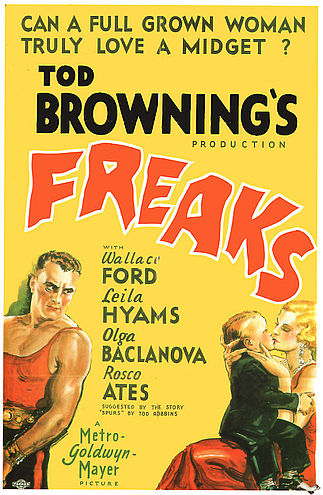
Freaks is not a film which is easy to discuss, and I was torn as to whether to write about it for Classic Horror Month.  Not only is it debatable whether Freaks qualifies as a horror film, but also to review the film would require me to possibly criticize the performances of people who were actually deformed—people who legitimately were “circus freaks”.  However, in the end I decided that it was a film too good to pass up on, and it may be a starting place for a discussion on what constitutes horror and normality in society.
The story of Freaks contains both a central plot and a series of vignettes about a group of circus performers.  The main character is a short person named Hans (Harry Earles), who is in love with a “normal” circus acrobat named Cleopatra (Olga Blacanova).  Cleopatra and most of the other “normals” laugh at Hans and his comrades, but when Cleopatra learns from Hans’ girlfriend Frieda (Daisy Earles) that Hans is heir to a large fortune, she marries Hans and plots to kill him to gain his inheritance.
Because of the way this film is structured, this conflict doesn’t come up until more than halfway through the film.  The first part of Freaks is largely devoted to showcasing the various circus acts, both “freaks” and “normals” (and I will henceforth drop the scare quotes).  It’s difficult to decipher the purpose of these early scenes.  Is it that the film wishes to engage in exploitation by putting as many freaks on screen as possible, or does it wish to portray their plight and challenge the audience to view them with sympathy?
Well, this may be a cop-out answer, but it’s likely a little of both.  There are certainly sequences which only serve the purpose of entertainment.  The one that sticks out most in my mind is where the Living Torso, Prince Randian, lights a cigarette using only his mouth.  It’s not as if the man is given a particularly developed character in the film; in fact, that bit is practically his whole shtick.  To see him struggle to do something most of us would find rudimentary may elicit some pangs of sympathy, but its purpose seems exploitative, and the same applies to many other performers as well.
However, at its heart, Freaks takes a sympathetic view of those with deformities.  The staging of the proceedings clearly condemns the harassment that Josephine Joseph (the Half-Woman Half-Man) receives, and Madame Tetrallini (Rose Dione) scolds the man who tells the freaks under her supervision to get off of his property.  In fact, the film’s portrayal of these people has such a noticeable heart to it that the bits which come across as exploitative could probably be written off as unfortunate implications.  I’m still not sure they should be, but they could.
I must commend the film for how it portrays certain characters not just as objects of sympathy, but as actual people.  Hans and Frieda, other than being short, have a thoroughly human relationship, even if their acting is a bit stiff and their accents miles thick.  They lust, they get jealous and despondent, the whole nine yards.  In fact, while one can’t ever forget that there’s a love quadrilateral involving two midgets, the whole affair could easily be written for four random people plucked off of the street.
Further, not all of the “normals” are presented as malicious bastards out to steal inheritances.  Venus (Lelia Hyams) and Phroso (Wallace Ford), who form a couple during the film—and get top billing—are continually nice to the freaks, if a little condescending.  They tangentially are involved in the freaks’ plot to get revenge on Cleopatra, and they joke around with their fellow performers and practice new skits with them.  And given how the Earleses are not exactly the Barrymores, they are the most compelling characters throughout.
As for the horror element, well, it’s not really there.  At least not in the terror sense, it isn’t.  The wedding sequence, which is the iconic bit in the film, does get more than a little unnerving to watch, but at least to my eyes, it’s more bizarre than scary.  Later on, when the freaks put their revenge plot into action and attack Cleopatra and her beau, Hercules (Henry Victor), the cinematography is too hectic to easily decipher what’s going on—confusing, yes, but not particularly horrifying.
Once more, however, that’s not a bad thing.  In fact, given the nature of the film’s subject, it’s probably for the best that Freaks doesn’t turn into a straight horror film.  Instead, it’s a weird little funhouse ride through a 1930s circus with a bit of social commentary thrown in for good measure.  It’s still more than a little uncomfortable to watch at times, but Freaks ultimately has its heart in the right place.  This might not be a Halloween film for the whole family, but it is worth a watch someday.

Saturday, October 6, 2012

Dr. Jekyll and Mr. Hyde (1931)

Dr. Jekyll and Mr. Hyde (1931)
Directed by Rouben Mamoulian
Screenplay by Samuel Hoffenstein and Percy Hath, based on the novella The Strange Case of Dr. Jekyll and Mr. Hyde by Robert Louis Stevenson
Runtime: 1 hr, 36 min
 
Ah, Jekyll and Hyde: the classic twist ending that people forget was in fact a twist ending.  The strange case of Henry Jekyll and Edward Hyde is so ingrained in our culture, almost synonymous with “multiple personality” disorders, that it’s easy to forget that the Robert Louis Stevenson work was not so much a horror story, but a mystery.  Granted, the original story is not very cinematic in that regard, so most adaptations just make the “Jekyll-is-Hyde” conclusion the starting point of the story, as is the case with the first film of Classic Horror Month.
Directed by Rouben Mamoulian, the 1931 version of the tale stars Fredric March and a heap of makeup as both Dr. Jekyll and Mr. Hyde.  Jekyll appears to have it all; he’s a respected scientist and lecturer and he’s engaged to the lovely Muriel Carew (Rose Hobart).  Yet there’s a scientific enterprise which is consuming his efforts.  Jekyll makes a concoction which can separate the bad in a man from the good.  Long story short, he drinks the potion and becomes his concentrated evil, Hyde.  No surprise there.
What may be a bit surprising is how much this adaptation changes from the Stevenson text.  For example, Muriel and the temptress Ivy (Miriam Hopkins) are not in the text—in fact, the number of female leads in the book is zero.  Meanwhile, the book’s narrator and detective, Mr. Utterson, is only mentioned in passing and I don’t think he has one line of dialogue.  And then there are the confusing changes to Danvers Carew (Halliwell Hobbes), turned from an elderly Parliament member who exists to get murdered to a stubborn general keeping Jekyll and his daughter from marrying earlier.
Aside from the alterations to Carew, these changes are mostly justified for the page-to-screen adaptation.  After all, following Mr. Utterson’s quest to compare handwriting would likely not make for thrilling cinema.  At any rate, most of the action would have to take place off-screen, and if the filmmakers were really being faithful to the text, then the whole ending would be revealed via a series of letters.  The film medium just wouldn’t support that very well.  The change in perspective and the addition of romances make the story more visually oriented, which is fine in my book.
Of course, the key is whether these changes actually work.  Fortunately, they do.  Muriel as a character may be a bit on the bland side, but she is relatable in her worries regarding what’s gotten into Henry as of late.  Similarly, while Hobbes’ performance as her father tends toward one note (anger), he does provide some additional conflict to the story.  Meanwhile, while Ivy, a beleaguered bar singer, is probably expendable plot-wise, she is able to bring out both the nobility--and the baseness—in Dr. Jekyll.  Yeah, two minutes with Ivy is enough to demonstrate that this movie was pre-Code.
However, the scene stealer is, appropriately, March’s Jekyll and Hyde routine.  As the former, he is a gentleman and compassionate, but always with an undercurrent of impatience for those around him.  March makes it clear that Jekyll could in fact possess an interior Hyde.  And when that dwarfish monster is set loose, so is March’s more hammy side.  A lot of the character may be brought out in the makeup and transformation sequences, but March himself is so lustful and lively that it’s hard not to get involved in the performance.
Dr. Jekyll and Mr. Hyde is certainly a fun movie to watch, and on that merit alone it is worth watching.  However, it must be said that the film is not particularly frightening or suspenseful.  Given that we already know the twist and can’t be scared by the implications it has for humanity, any fear factor must be found in the atmosphere or the plotting—what is Hyde going to do next?  There certainly is build-up, with Hyde lusting after Ivy and making her life hell, but there’s little payoff involved, and other incidents are similarly wanting.  Let’s just say this film is not scream-inducing.
Then again, it could easily be that modern audiences just have different standards for what constitutes horror.  Hell, given how good the makeup work on March looks for 1931, that alone might have been a frightening sequence.  Further, the way the film is shot does give it a certain off-kilter feel.  Mamoulian and cinematographer Karl Struss love close-ups of people eyes, which is nicely eerie touch.  And really, the source material is not especially scary, so it’s not as if they failed in that regard.  Given what Mamoulian and crew had to work with, the finished product is fine enough scary flick.
I will say that at 96 minutes, the film does come off as a bit padded.  There are only so many times that we can see Jekyll show up late/not at all for a Carew affair before it feels repetitive.  Yet Dr. Jekyll and Mr. Hyde is never a bore to watch, either.  It moves at its own pace, tells its own story and delivers its own scares.  It’s not a masterwork of horror or psychological drama, but it is a damn fine film nonetheless.  If you’d like some classic-lit based classic horror this Halloween, then this would be a good bet.