Wednesday, November 28, 2012

A Tribute to "Singin' in the Rain"

I first saw Singin' in the Rain on April 1, 2010.  It was the first movie I viewed for the express purpose of gaining knowledge of classic cinema.  It has since become on of my all time favorite movies, and I find something new to love every time that I watch it.  2012 marks the fiftieth anniversary of the film's initial release, and I think it is only appropriate that pay tribute to this musical masterpiece.  Oh, but where to be begin?

Brace yourselves, folks, this is going to be a long one.

But like dancing in a downpour, it's worth every second.
What's the Story?

Well, I suppose summing up the film would be a good place to start.  Normally I'm not one for detailed plot recaps, but considering this isn't a review so much as a tribute, I'll make an exception.  If you haven't seen the movie, I'm about to spoil the entire thing.  Also, if you haven't seen the movie, what are you waiting for?  Go watch it right now.  Go ahead, I can wait for an hour and forty-three minutes.  You won't regret it.

Ready?  Let's go!

Singin' in the Rain (Gene Kelly and Stanley Donen, 1952) is set during the late 1920s, just as movies with synchronized sound are being unveiled.  At first, not many people in the industry take the new technology seriously; to them "talkies" are little more than a novelty, on par with Smell-O-Vision.  However, once The Jazz Singer becomes a smash success and the public starts clamoring for more talking pictures, Hollywood studios must struggle to adapt.

The film centers around one studio in particular, the fictional Monumental Pictures.  The studio is home to famed silent duo of Don Lockwood and Lina Lamont (Gene Kelly and Jean Hagen).  The great big publicity machine drums up a romance between the two stars, but while Lina believes it the love is real, Don frankly can't stand his partner.  Not only is Lina airheaded and unbelievably vain, she also has a voice that sets the dogs howling.

We first see Don and Lina at the premiere of their most recent film, The Royal Rascal.  Asked to recount how he got to this point in his career, Don starts spinning a yarn.  Stating that his motto is "Dignity, always dignity," Don claims to have been brought up on high culture, seeing Molière on stage and going to prestigious music conservatories.  His narration is malarky, however, as the flashback shown tells a decidely less classy tale.

Don and his best friend Cosmo (Donald O'Conner) spent their youth dancing in saloons and sneaking into movie theaters before taking up the vaudeville stage; the film's first number, "Fit as a Fiddle", shows them performing for crowds and getting a less than positive reception.  The pair eventually travel to Hollywood--and get jobs playing mood music for Monumental Pictures, with Don on violin and Cosmo on the piano.

Don's break comes when a stuntman gets knocked out while filming a fight scene for a western.  Don volunteers to fill his spot, and soon is performing all sorts of death-defying stunts for Monumental Pictures.  Lina, however, refuses to give Don the time of day--until studio head R.F. Simpson (Millard Mitchell) hears about Don's stuntwork and pairs him up with Lina for her next picture.  Now she's clearly into him, but Don turns her down and walks off, at which point the flashback ends and The Royal Rascal starts.

Once the film is over, Don and Lina take a bow on the stage.  Don does all the talking, much to Lina's chagrin.  She complains about not being allowed to talk to the audience and refers to Don as her fiancé.  Don tries to tell her in no uncertain terms that the cooked up romance is fictional, but Lina's in her own little world.  The cast and crew take separate cars to the after-party at R.F.'s house, in order to escape the fans and keep Lina away from Don.

On the way, however, Cosmo's car gets a flat tire, and Don is swarmed by fans who literally start tearing his clothes apart.  He manages to climb atop a trolley car and jump into a passing vehicle.  The woman driving (Debbie Reynolds) panics, thinking that he's a criminal.  A police officer reveals that the man is Don Lockwood, and all is set straight.  The woman offers to drive Don towards his destination, and introduces herself as Kathy Selden.

Things get messy, however, when Cathy starts to disparage movies in general.  "If you've seen one, you've seen 'em all," she tells Don.  To Kathy, it appears that screen acting is "dumb show", a series of exaggerated facial expressions.  Don does not take this well, and when he presses her, Kathy says that she's an aspiring stage actress soon to make her way to New York.  The two argue all the way to the end, and Don leaves the car feeling quite stung.

At the party, R.F. shows the guests a demonstration of a talking picture.  The crowd is divided on how to take the technology; some say it's wonderful, while one actress calls it "vulgar".  It's at this point that R.F. reveals that Warner Bros. is making a whole movie with synchronized sound, The Jazz Singer.  The party festivities restart, however, and a giant cake is wheeled in to celebrate the success of The Royal Rascal.

Of course, this is one of those cakes out of which a chorus girl pops, and who should be in the cake but Kathy Selden.  "Well, if it isn't Ethel Barrymore?" says an amused Don.  Kathy's embarrassed, but there's no time for that; the girls must sing the prophetic second number, "All I Do Is Dream of You".  Don seems impressed and tries to talk to Kathy, but she's pissed.  Lina's also miffed that Don's paying attention to Kathy.  Long story short, Lina gets a pie in the face and Kathy runs out before Don can talk to her again.

We cut to a busy day at Monumental Pictures, where it seems a year's worth of films are being made on one lot.  Don still has Kathy on his mind; not only does her talk about his acting still burn, but he feels bad that Kathy lost her job as a chorus girl.  Cosmo tries cheering him with a comedic song-and-dance number, "Make 'Em Laugh", in which he becomes a one man slapstick show, encouraging comedic acting and literally dancing up the walls of a set before collapsing from exhaustion.

Filming starts for the next Lockwood and Lamont picture, The Dueling Cavalier.  While filming a romantic meeting between their characters, Lina mentions how she had Kathy fired from her job.  Don is furious, but filming must continue, and so Don confronts Lina while his character is gently carassing hers (oh, the benefits of silent filmmaking).  The director, Roscoe Dexter (Douglas Fowley), declares the scene perfect, but R.F. has some big news and orders filming stopped.

It turns out that The Jazz Singer has become a massive hit, and the movie-going public is demanding more talking pictures.  R.F. has Monumental Studios converted for sound filming, despite the reservations of the cast and crew.  With that, talkies come to dominate the movie landscape, and if the montage that follows is anything to go by, flashy musicals are the style of choice to take advantage of the new technology of synchronized sound.

The montage culminates with the song "Beautiful Girl", sung by an uncredited Jimmy Thompson.  It turns out that Kathy is a dancer in the sequence, and R.F. decides to hire her for another picture.  Don and Cosmo walk up to them, at which point Kathy is ready to reject the offer.  Don, however, reveals that he's been looking all over for her, and that he does not care if Lina hates Kathy with a fiery, ditzy passion.  R.F. hires her, though he says Lina can't find out she's working for Monumental.

Don and Kathy walk the lot together, and Don discovers that Kathy is in reality a fan of Lockwood-Lamont films, having seen at least eight or nine of them.  The two starting hitting it off, and Don's got something he wants to say.  However, he can't spit it out without the proper setting, so he takes Kathy inside a soundstage and literally sets the stage for his grand romantic gesture.  What follows is the song "You Were Meant for Me", establishing the pair as a romantic couple.

Meanwhile, Monumental Pictures is preparing for their move to talkies.  Among other things, their silent actors needed to take lessons from diction coaches.  These lessons involve reciting tongue twisters, leading to the next tune, "Moses Supposes".  But speaking properly seems to be the least of the studio's worries; getting everyone wired for sound is a nightmare.  In particular, Roscoe is pulling his hair out that Lina cannot grasp the concept of talking into a microphone.

The production is a mess, and so is the final product.  Suffice to say, the preview for The Dueling Cavalier is an unmitigated disaster.  The sound mixing is atrocious, the dialogue is clunky and, worst of all, sight and sound become unsynchronized; characters appear to speaking the dialogue of others.  The audience begins to walk out, with some swearing off watching another Lockwood and Lamont film again.  How bad is it?  Lina enjoyed it.

Don, Cosmo and Kathy have a post-mortem at Don's house, which he claims will be up for auction in the morning.  Kathy and Cosmo try cheering him up, reminding him off all the (terrible) things he could when his career ends.  Cosmo evens jokes about them going back in vaudeville, which leads Kathy to suggest that turn The Dueling Cavalier into a musical.  This finally breaks Don out of his funk, and upon realizing that it's already 1:30 in the morning, the trio break out into "Good Morning".

However, Don remembers one major hurdle to that plan: Lina.  The musical idea now seems dead in the water, but when Debby brings up the synchronization problems in the preview, Cosmo gets a bright idea: have Kathy dub over Lina's voice.  Don's a bit reluctant, as Kathy would surely not get credit for that, but Kathy insists, seeing it would only be for one picture.  Once more, the gang are back in the hunt, and the movie might be saved yet.

After Don takes Kathy to he pad, he waves off the cab and starts walking (and dancing) in a downpour, which leads into, you guessed it, "Singin' in the Rain", a perfect representation of being over the moon.  The next day, Don and Cosmo pitch the musical idea and the dubbing idea to R.F., who's on board--though, again, Lina must be kept in the dark.  They plan to incorporate modern musical numbers into the script, and settle on The Dancing Cavalier as a title.

Don and Kathy get straight to work on recording vocals to dub over Lina, including the big romantic song of the The Dancing Cavalier, "Would You?"  Then Don and Cosmo unveil a sequence for the modern section of the picture: a dancer tries to make it big on Broadway while becoming infatuated with a mobster's lady, played by Cyd Charisse.  The sequence is set to a combination of "The Broadway Melody" and "Broadway Rhythm", and the scene concludes with R.F. claiming that he can't quite visualize it.

Production is finally over, and Don is eager to have Kathy's name placed in the credits.  Lina, however, catches wind of this from a fellow actress, Zelda (Rita Moreno), and uses the terms of her contract to not only keep Kathy from getting recognition, but also to make Kathy continuing dubbing for her in perpetuity.  R.F. doesn't want to give into Lina's demands, but the threat of breach of contract suit is too much, and he gives in.

Opening night for The Dancing Cavalier comes, and it's a home run.  The audience is particular impressed with Lina's wonderous pipes.  When Don and Lina go out to take a bow, Don, Cosmo and Kathy hear about Lina's plot, and everyone who's not Lina begs R.F. to renege on his word.  When Lina goes onstage to talk to her adoring fans, the boys come up with a plan to reveal whose voice the audience actually heard that night.

Given her terrible voice, it's no surprise that Lina's speech gets the audience laughing, and she runs backstage to get "help" with her singing.  The boys convince Kathy to dub for Lina again, though she's clearly unhappy and tells Don she never wants to see him again.  Kathy whispers to Lina that she'll be performing "Singin' in the Rain" in A flat, and off "Lina" goes.  It appears that Ms. Lamont is going to have her way after all.

Just kidding--Don, Cosmo and R.F. raise the theater curtain to reveal Kathy singing at a microphone--and for the hell of it, Cosmo runs on and starts singing as well.  Kathy tries running down the aisle and out of the theater, but Don has the audience stop her and tells them that's the girl whose voice they loved.  The film ends with Don and Kathy singing "You Are My Lucky Star" to each other, fading into a billboard advertising the next Lockwood and Selden picture...Singin' in the Rain.

What's the Draw?

The first time I saw Singin' in the Rain, one thing above all else struck me: it's very, very funny.  Settng aside the film's broader context, watching Kelly and company on screen is a laugh-a-minute experience.  Whether it's the use of slapstick comedy (e.g., Kathy throwing the pie into Lina's face) or the constant quips from Cosmo, Singin' in the Rain is a movie which is constantly delivering jokes, rarely giving the audience time to recuperate from the previous gags.

Yet if humor were the only thing drawing me Singin' in the Rain, I can't imagine it having the rewatch value that it has for me.  After all, any form of humor, no matter who delivers it, will eventually get stale.  And while I still do laugh while watching the film, it's been more chuckling than out loud guffawing as time goes on.  But this doesn't mean my enjoyment has diminished over time--in fact, I'd say that my appreciation of the film has increased instead.

In a way, Singin' in the Rain was a perfect to start the process of absorbing classic cinema: it's about cinema.  Let's not forget that the narrative of the film centers around a pivotal moment in the history of Hollywood, and the process of making a movie drives the plot and characters forward.  It's a film which looks back on earlier films and the people behind them, so as I've seen more and more cinematic pieces, the more relevant Singin' in the Rain becomes.

The movie reflects on a bygone era of filmmaking, which is something that the film industry has always been fond of doing--look at The Artist for a recent example.  But Singin' in the Rain is a bit different in that it's not an entirely celebratory work.  It pokes fun at the conventions of the Hollywood machinery during the late-silent, early-sound era.  It's a movie that loves movies, but there's a recurring notion of whether the film industry of the time has any artistic credibility.

When Kathy tells Don that seeing one movie means seeing them all, the movie treats it as a serious possibility, and much of the film spends time addressing that notion.  At the start of his article "Dance, Flexibility and the Renewal of Genre in Singin' in the Rain", Peter N. Chumo II highlights the sequence directly before "Make 'Em Laugh", in which the audience sees the Hollywood machinery in full swing:
The silent films from Monumental Pictures recycle the same plot lines and generic conventions so that each new production is already old.  The assembly line-like sets which Don and Cosmo walk on their first day of work (generic jungle film, football movie, western) attest to the formulaic nature of such filmmaking.  One question this film poses, then, is indeed, "Why bother to shoot this picture?"  Can an original film be produced, and if so, how? (39).
This sort of problem is one that fascinates me personally, and I find it uplifting that the answer seems to be, "Yes."  But, ah, there are complications, for not only is Singin' in the Rain a movie about movies, but also it is in part a movie made of movies.  Both the narrative within the film and the context in which the film was made involve the recycling and appropriation of other filmic elements, which results in a well-made but somewhat confusing "movie-loaf".

It is fair to conclude, then, that what constantly brings me back to Singin' in the Rain is the desire to fully untangle its web of references, critiques and borrowed elements, both internal and external.  Trying to reconcile the characters' desire for originality with the recycled nature of the movies parts is a challenge indeed.  It's a sort of puzzle, one in which picture become progressively less clear the more I dig into it.  But that doesn't mean I can't try to clear things up.

What Exactly is Going On?

It is perhaps easiest to start with the context and production of Singin' in the Rain, then applying what is gathered to the film itself.  And I can think of no more obvious entry point that the songs of the film, this being a musical and all.

Famously, Singin' in the Rain was a movie built around its soundtrack.  Taking a bunch of Arthur Freed songs in the MGM vault, the filmmakers were instructed to write a movie around those tunes.  And these weren't previously unreleased songs, either, but songs that had been in previous musical films.  "The Broadway Melody" was from the Best Picture-winning film of the same name, "Would You?" appeared in the movie San Francisco, etc.  One could call it a jukebox musical, and I wouldn't say he'd be off the mark.

In fact, only two songs in the book were written specifically for the film.  One was  "Moses Supposes", a largely frivolous number which largely consists of iterations of a single tongue-twister.  The other is "Make 'Em Laugh", but its original in the loosest sense of the word; it's virtually identical in topic and structure to the Cole Porter number, "Be a Clown".  Thus, even in its stabs at originality, Singin' in the Rain recycles previous material.

How, then, does one reconcile the manner in which Singin' in the Rain was made with its story about originality and the creative process?  It may be a matter of working with one's predetermined boundaries.  After all, the production team did not consciously choose to use recycled songs for the film; the songs were presented as a framework.  The job of the filmmakers, then, was to create an original production given those arbitrary constraints.

In many ways, this mirrors the conception of The Dancing Cavalier within the movie.  Since the movie is set to be released in six weeks, Monumental Pictures has to incorporate the available elements from The Dueling Cavalier.  When Don, Cosmo and Kathy first hatch the musical plan, Kathy suggests that they can keep much of the story from the first picture, just with some needed edits.  Similarly, when Don and Cosmo present R. F. with the idea, they mention how they'd be able to reuse the costumes.

It is not hard to imagine that the story to Singin' in the Rain, "work with what you have", could be an unconscious metaphor for the process of filmmaking at a Hollywood studio, with details mandated by the executives at the top.  That said, Singin' in the Rain borrows a lot more than its musical numbers.  The filmmakers toss in elements of various other films as well, even when these elements are tangential or completely unrelated to the central narrative.

The movie which Singin' in the Rain references most often is, unsurprisingly, The Jazz Singer.  Given the subject of Singin' in the Rain, some allusions wold be expected, but the frequency would suggest that the film is preoccupied with it.  An explanation which Carol J. Clover presents for this phenomenon is that Singin' in the Rain is concerned with the degree to which black dancers have influenced the dance numbers, and that these references are manifestations of this anxiety (728-9).

Clover raises some good points, and if The Jazz Singer were the movie's sole infatuation, she would likely be correct.  But Singin' in the Rain is stuck on other films and genres as well, which suggests that a one-to-one relationship is not at work.  For instance, gangster films feature prominently in the story as well: Kathy first assumes when Don jumps into her car that he's a man on a wanted poster, while a "Scarface" clone is an important figure in the "Broadway Melody" sequence.

As with the references to The Jazz Singer, allusions to gangsters could be spliced from the footage and have no impact on the story.  What, then, is the film trying to accomplish by incorporating elements of other pictures?  What is the endgame of tying in the dawn of synchronized sound films and a mainstay of Hollywood genre movies into what is really a jukebox musical that can stand independent of either's presence?

The best explanation that I can give is that Singin' in the Rain is ultimately a defense of the Hollywood system.  Even though it pokes fun at the rabid fanbases that the star system built, the frequent disconnect between an actor's public persona and her actual personality, and especially the formulaic nature of studio production, Singin' in the Rain argues that a quality, original film can still be made with the confines of that system.

In tying in blockbusters, genre references and songs previously used in glitzy Hollywood productions, Singin' in the Rain tries to show that the formula can still create golden pictures.  After all, it's not as if Monumental Pictures never thought of musicals, or that the French aristocratic setting is a new idea, or that really anything in the film hadn't been tried before.  But through all that, an engaging and moving piece of cinema can still be made.

In fact, that's what is most striking about Singin' in the Rain.  For a movie that is frequently piercing in its critiques of 1920s Hollywood, the story it tells is rather life-affirming: no matter what constraints one is given (the numbers to use, the time available, the actresses to incorporate), art can and is made all the time.  As someone who admires the artistic process and who desires to enter into a creative field, its a message that, however overly optimistic, bears repeating.

Works cited:
Chumo II, Peter N. "Dance, Flexibility, and the Renewal of Genre in Singin' in the
     Rain." Cinema Journal 36.1 (1996): 39-54. JSTOR. Web. 24 June 2012.

Clover, Carol J. "Dancin' in the Rain." Critical Inquiry 21.4 (1995): 722-747. JSTOR.
     Web. 24 June 2012.

Singin' in the Rain. Dir. Gene Kelly and Stanley Donen. Perf. Gene Kelly, Donald
     O'Conner, and Debbie Reynolds. Metro-Goldwyn-Mayer, 1952. DVD.

Saturday, November 17, 2012

Blackboard Jungle (1955)

Blackboard Jungle (1955)
Directed by Richard Brooks
Screenplay by Richard Brooks, based on the novel by Evan Hunter
Runtime: 1 hr, 41 min
The post-WWII era saw a growing concern for the parents of American youth: juvenile delinquency.  To many it appeared that the teenagers of the 1950s, especially in the country’s inner cities, were completely out of control, and this had a profound impact on the nation’s popular culture.  From Dr. Frederic Wertham’s Seduction of the Innocent to the evils of that new fangled rock ‘n’ roll, those damn kids were front and center.  The plight of juvenile delinquency is at the heart of today’s film, Blackboard Jungle.
Richard Dadier, or as some students call him, Daddy-o (Glenn Ford), is a brand new English teacher at a high school filled with unruly teenagers.  They talk back, get into fights, and try to inflict sexual harm on female teachers—all the horrible things associated with problem children.  Despite all the trouble, Dadier is determined to get the kids to learn something, or at least behave.  Whether it’s the bright but resigned Greg Miller (Sidney Poitier) or gang leading and completely incorrigible Artie West (Vic Morrow), the mission is the same.
If Blackboard Jungle sounds like one of those movies with the inspirational teacher who has to somehow get his troubled students to excel in school, well, that’s because it is.  Of course, this one’s almost sixty years old, so this was before popular culture got filled to the brim with this sort of story.  Even better, Blackboard Jungle does not follow many of the conventions of its own genre.  Somehow the movie manages simultaneously to establish and subvert the foundations of the formula, and that makes for a more interesting movie experience.
Dadier is far from the savior figure.  For one thing, the problem at the school runs so deep that Ford’s character, by film’s end, still has a long, long ways to go to get things right at the school.  For another, Dadier has many moments where one must question his resolve and morality.  One of Ford’s best sequences involves getting drunk after school (a gradual process), getting mugged by West’s gang, and then refusing to tell an investigator which boys jumped him, claiming it was too dark.  At times he appears resigned; he loses his temper and wants to quit when West makes his life hell.
But, really, the appeal of the film lies not in the inspirational teacher figure, as intriguing as Dadier is.  No, the stars of Blackboard Jungle are the troublemakers.  The central figure, the leader of the rascals, is Miller.  Poitier gives the character a lot of street smarts and dignity, even if he is clearly too old for the part of a high-school student (he was 28 at the time).  West is must more anti-authoritarian, the last holdout as the class begins to turn.  And Morales (Rafael Campos) is easily the liveliest student, and the unfortunate butt end of the pranksters.
Indeed, the film is seen as a landmark for 1950s youth culture, despite (or perhaps because of) its depiction of the students as cruel and unduly disrespectful of authority.  In fact, sometimes the film seems to celebrate the rebelliousness of the youth, contrary to its stated intentions.  This manifests in the colorful cast of characters, but also appears in some of the directorial decisions.  When West’s gang jumps Dadier and a fellow teacher (Richard Kiley), there’s no ominous string section but a lively swing tune to underscore it.
As a matter of fact, Blackboard Jungle’s most lasting legacy is related to music.  The film is largely responsible for the success of Bill Haley and the Comets’ hit “Rock Around the Clock”, which plays during the film’s opening credits.  This may be further evidence that the filmmakers sympathize on some level with the youth of the 1950s.  Rather than ignoring the teenagers’ cultural institutions, Brooks places them into the film without explicitly condemning them (even though the student’s smash the math teachers old, irreplaceable swing records).
I’ve praised a lot in this film, but there’s one nagging problem.  This movie loves to obviously foreshadow things.  By this I mean that details are brought up, such as the math teacher’s record collection or Dadier’s wife’s (Anne Francis) previous miscarriage, which caused my dad and I to think, “Well, that’s clearly a plot point.”  I’ve my own problems with foreshadowing in general, but I especially find it grating when things are brought up specifically to foreshadow something else.  At that point, why bother?  The result is a narrative that tends towards the blindingly obvious.
It’s still a fine narrative, though, with a more open ending and complex conflicts than one might expect from such a film.  Not everyone has learned a lesson at the end, and even those who have still are far from completely converted.  Blackboard Jungle may therefore lack the inspiration potion of the “inspirational teacher” genre, but that may just be for the better.  After all, if the goal is to make a movie showcasing the problem of delinquency in America, it better damn well show the problem as complicated and not easily solved.  Blackboard Jungle excels on precisely that front.

Wednesday, November 14, 2012

Forcing My Way through "The Sound and the Fury"

I am a reader, and as I must assume that many other readers do, I get immense satisfaction in finishing a book.  Yet I am not the sort of person who feels the need to finish reading every book that I start.  If I'm not feeling it, then I'll put it down and never give it a second thought.  That's not to say that that is the norm for me; most books that I start will get finished.  But there's very little self-pressure to do so.  With so many great books out there, why get bogged down in one you don't like?

I bring this up because for a couple of years now--I can't even remember how long, but I'm going to say three or four--I have been intermittently forcing my way through The Sound and the Fury by William Faulkner.  At no point has it ever been assigned reading for me, and as far as I can tell no one has put a curse on the book to force completion.  I had checked it out of the library at least four times, and returned unfinished each time, never getting more than halfway through.  What compels me to keep trying then?

Now, it's not as if I've abandoned books temporarily only to return to them later.  One such case was Charlotte Brontë's Jane Eyre.  During the summer before my junior year of high school, I purchased an old copy of Jane Eyre at a used book sale for $0.25.  I have referred to it as the worst quarter I ever spent, not because what I read was bad, but because the pages of the book started coming out until the whole thing fell to pieces.  And this all happened while running around Newark Liberty International Airport.

I didn't hate the book then, but I was content with keeping it as a footnote in my reading career.  Unfortunately for that plan, that year in high school, one of the required readings was Jane Eyre.  Now there was no escaping it, and that time around I loathed every sentence of it.  Had it been on my own terms, I'd have chucked it out the window.  But in that case, I was essentially compelled to read through it.  Such is not the case for The Sound and the Fury.

Perhaps a better analogue for the current situation is my experience with Aleksandr Solzhenitsyn's One Day in the Life of Ivan Denisovich.  It's a bit harder for me to determine how long it took me to finish that book.  I know that received it around the time that I turned 13, which would mean late 2005.  However, I have no idea when I first tried to read it.  I figure that I must have tried on three separate occasions, but the details are more fuzzy.

As with The Sound and the Fury, I was not assigned to read One Day in the Life of Ivan Denisovich at any point, so I was not externally compelled.  But I may have felt internally compelled.  See, for my thirteenth birthday, my dad gave me a bunch of books he had to read in high school, and Solzhenitsyn's was one of them.  He obviously put some thought into that, and I probably felt the need to finish it.  So, sometime during my senior year of high school, I did.

So, really, neither of those experiences give me a satisfactory explanation for why I have constantly tried and failed to finish The Sound and the Fury.  It was never assigned, it was never gifted, and it was never purchased.  And since I don't feel the need to finish every book I read, I'm plum out of external causes.  But there is something there that repeatedly draws me back.  So, the obvious solution is to take a brief look at the text itself.

First, a little introductory material is in order.  The Sound and the Fury is about the Compson family, a group of former Southern aristocrats who have fallen from on high.  The book primarily focuses on the Compson children; from oldest to youngest, they are Quentin, Caddy, Jason and Benjy, though their parents, Caddy's daughter, and their longtime household servant Dilsey also play important roles.  Put simply, The Sound in the Fury captures the Compson clan in ruins.

I'll tell you, the first time I tried to read The Sound and the Fury, I quit before I got to page 10.  It was a case where I honestly did not know what I was getting into.  I had simply heard that William Faulkner was one of the great American authors, and that The Sound and the Fury was his best work.  That was all I knew about the book before diving in.  What followed in that short first time with the text was pure, unadulterated confusion.

Here's the thing to keep in mind about The Sound and the Fury: the book is divided into four parts, each set on a different day and each with a different narrator.  the first part, told from Benjy's perspective, takes place on April 7, 1928.  The next is from Quentin's point of view on June 2, 1910.  Jason gets the third part (April 6, 1928), while an omniscient third person narrator, who tends to focus on Dilsey, recounts the events of April 8, 1928.

This doesn't seem all that confusing; indeed, one might expect that the multiple points of view given in the next would make comprehending the events of the book easier.  Alas, Faulkner was an early pioneer of stream-of-consciousness writing, and the first two parts of the book are notoriously difficult to comprehend.  Neither flows linearly and both Benjy and Quentin tend towards extended, out-of-nowhere digressions.

In Benjy's case, this is because the character has a severe mental disability.  He has no understanding of time; everything that has ever happened to Benjy exists in the present tense.  As a result, Benjy may be narrating about something happening on April 7, 1928, and then seamlessly will start talking about another event from ten, twenty, even thirty years ago.  An early example of this--there are too many to count--occurs at a fence on the Compson property as Benjy and Luster walk about:
     "Wait a minute." Luster said.  "You snagged on that nail again.  Cant you never crawl through here without snagging on that nail."
     Caddy uncaught me and we crawled through.  Uncle Maury said to not let anybody see us, Caddy said.  Stoop over, Benjy.  Like this, see.  We stooped over crossed the garden, where the flowers rasped and rattled against us.  The ground was hard.  We climbed the fence, where the pigs were grunting and snuffing.  I expect they're sorry because one of them got killed today, Caddy said.  The ground was hard, churned and knotted. (4)
Ignoring the lack of proper punctuation, another feature of the text, note how the two paragraphs, which describe two different events at two different points in time, seem to flow directly into each other.  Benjy gets caught on the fence in 1928, which causes him to think of another time in the past where a similar thing happened.  And this keeps happening, frequently within other memories.  The italicized text is the only indicator that the scene changed, and Faulkner doesn't always use that device.

On my second attempt, I did a little research before diving in, found out what was going on, and managed to get through Benjy's section.  After that, I put the book down.  Reading through Benjy's narration was easier after I figured out what Faulkner was doing, but it was still a tiring experience.  Still, I figured that when I made my third attempted read through, I could get through Benjy's section again and breeze through the rest of the book.

Well, that was dead wrong.  Quentin's section follows Benjy's, as Quentin narrates the events of the day he commits suicide in 1910.  Unlike Benjy, thank God, Quentin mentally fit and can tell past from present.  On the other hand, Quentin is clearly in a damaged mental state, as he flashes back repeatedly--and without any italics whatsoever.  On top of that, Quentin keeps repeating things which aren't true, such as an incestuous relationship with Caddy.

But what makes Quentin's section even more frustrating than Benjy's is that Quentin is clearly a Harvard man.  If you go back and read the Benjy excerpt, you'll note that Benjy's language is very simple and choppy.  Quentin's narration, on the other hand is sophisticated and eloquent; at least, it would be if he weren't out of his mind.  Further, as his mind deteriorates more and more, Faulkner stops uses punctuation and capital letters, until the text starts to resemble a free association nightmare.

On read-through #3, I got through Quentin's section, but was similarly drained and had to put it down.  As for the fourth attempt...the same exact thing happened.  "June 2, 1910" represented a wall that just could not be surpassed, even though my further research indicated that the last two sections were actually in the Queen's English.  I just could not press on, no matter how much I grew to love the first half of the book.

In fact, now that I think of it, it could be that, because I knew that the last two sections of the book were "normal", it felt as if I were entering an anticlimax.  As disorienting and confusing as Benjy and Quentin's sections were, they were among the most fascinating things that I had ever read.  You could say that I was content to pretend that The Sound and the Fury ended after 180 pages, that the rest of the book was sequel I was comfortable skipping.

Except, well, that wasn't true.  This one, I had to finish.  I had tried four time previously, and even the sunk cost fallacy probably applies here, I had put too much into it, spent too much time reading, to let it go at that.  So, after a stop at the local library (and week of putting it off by reading American Gods), I set off on attempt number 5.  Six days later, at exactly 11:00 p.m. EDT on June 29, 2012, I finally won.  I finally got to the end of the book.  Yay.

And if only for Jason Compson being the most evil, horrible, spiteful and pathetic character I've ever encountered in literature, it was worth the struggle.

Works cited:
Faulkner, William. The Sound and the Fury. 1929. New York: Vintage-Random
     House, 1990. Print.

Saturday, November 10, 2012

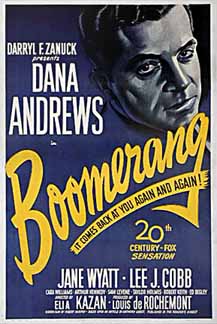
Boomerang! (1947)

Boomerang! (1947)
Directed by Elia Kazan
Screenplay by Richard Murphy, based on the article “The Perfect Case” by Fulton Oursler
Runtime: 1 hr, 28 min
One night, a beloved Episcopalian minister is shot on a Connecticut street.  There are many witnesses, but the killer cannot be found.  Tensions run high and the political pressures are on.  This is not a far out scenario; in fact, it actually occurred.  Elia Kazan’s Boomerang! is based on the real-life murder of Bridgeport resident Father Hubert Dahme and the ensuing search for the guilty party.  What Kazan and screenwriter Richard Murphy craft from it is a fascinating study of personal politics and society’s instinct to immediately condemn.
After endless days of tracing down suspects—with only “wearing a dark coat and light hat” to work with—the police force, led by Chief Harold Robinson (Lee J. Cobb) settle on a down-on-his-luck WWII veteran who just recently left town, John Waldron (Arthur Kennedy).  The prosecution is up to state’s attorney Henry Harvey (Dana Andrews).  All of the evidence, from the eyewitness testimony to the forensic analysis to the suspect’s confession, seems to point in one direction, but Harvey has his doubts regarding Waldron’s guilt.
Setting aside that Boomerang! is grounded in actual events, the film is filled with true-to-life drama.  The citizens of the town are outraged, forming their own committees and sending tips on anyone vaguely matching the vague sketch.  At one point a group of the reverend’s friends are damn set on lynching Waldron as he’s brought out of the court building.  The drama is not restricted to the everyday citizen either.  The sitting politicians are feeling the heat, and with an election coming up, the party desperately wants a conviction.
With all this building tension, it’s no surprise that the film’s greatest strength is how it portrays the individual reactions to the events.  It may be useful to compare the arcs of the prosecutor and the police chief.  Andrews’ character certainly has some political ambitions, and like anyone else in town he wants to see justice served and the murderer apprehended.  Meanwhile, Chief Robinson, described as one stubborn goat, remains skeptical of Waldron’s guilt, even as the evidence starts pouring into the station.
Yet it many ways, the changing realities of the situation causes them to switch positions.  Once the bullet has been analyzed and found to match Waldron’s gun, Robinson’s mind is set.  Harvey, though, upon his own investigations into the crime, turns his own skeptical eye on the evidence.  Both Cobb and Andrews are exquisite in their roles, makes both of their characters’ transitions believable in the context of the narrative.  This especially shines through in their multiple conversations; behind the chatter is an air of frustration with each other.
It would be obvious, though, that emotions would be running high.  What Boomerang! remembers—places at the forefront, even—is how the politics, big picture and otherwise, are in play as well.  I’d imagine a temptation to follow the murder mystery aspect of the case all the way down.  It would work, given the strength of the performances, but it would also give the false impression that one man’s guilt is the sole intrigue in the case.  What about the question, “What’s at stake if we can’t convict someone?”
Ultimately, it is this question that Kazan and Murphy focus on.  Murphy writes in ample scenes of local politicians discussing the stakes—elections are in the air, money is on the table, ambitions and reputations could be shattered.  Meanwhile, Kazan stages these encounters beautifully, especially a late night talk between Harvey and a local backer of a recreation center played by Ed Begley, a scene which proves pivotal to Harvey’s character development.  It’s not just a whodunit; there’s a whole other world emerging here.
This is not to imply that the film doesn’t have some problems.  Boomerang! is in the style of a docudrama, with narrations supplying context and off screen goings-on.  It may be too much to ask the filmmakers to abandon an aesthetic, but the result tends to tell rather than show; we can see they’re rounding up everyone wearing the wrong outfit without a full explication.  Also, there’s a clear alternate suspect who Kazan spends far too much time showcasing as an alternate suspect; one scene near the beginning of the film is enough to establish that fact.
I nitpick, however, as the finished work is exceedingly good.  The case which inspired the film was never solved, and while the in-story resolution is a bit more clear-cut, the interpersonal ambiguities certainly remain.  Whose motives are suspect and whose are sincere?  Does anyone have the integrity to set ambition aside and see justice served?  These questions are answered, sure, but to answer them is not a short process.  It requires soul-searching and determination, but the truth is out there somewhere, which is what makes Boomerang! a movie well worth a watch.
Oh, and fun fact: one of the people standing in a line-up is played by…Arthur Miller.

Saturday, November 3, 2012

Mr. Smith Goes to Washington (1939)

Mr. Smith Goes to Washington (1939)
Directed by Frank Capra
Screenplay by Sidney Buchman, story by Lewis Foster
Runtime: 2 hr, 10 min
It is of course an election year in the United States, so it is only fitting to discuss a film centered on the American political machinery.  There are many films that could fit the bill, but the one I have in mind for today is perhaps the most beloved.  Mr. Smith Goes to Washington, one of the standouts from that golden year of 1939, is a film that strikes at the heart of the American system.  At once it highlights the corrupt, easily manipulated world of Congressional politics and public opinion while still allowing a faint ray of hope to shine through.
After the death of a senator, the governor of some western state (Guy Kibbee) appoints the local head of a Boy Scouts stand-in, Jefferson Smith (James Stewart).  Smith has a likeable image but is completely new to politics, which would seem to make him very malleable.  Smith is glad, however, to be serving alongside Joseph Paine (Claude Rains), a respected politician and friend of his father.  However, when Smith determines to set up a boys’ camp in his state, he discovers that a dam is to be built on the property, with a political boss named James Taylor (Edward Arnold) behind it.
Because the film follows someone brand new to politics, the ensuing tale of corruption is not one of backroom deals, though those are present.  Instead, the audience follows Smith—a man who firmly believes in whatever the phrase “American ideals” means—as he attempts to get to the bottom of the dam scheme.  The details of the plan are vague: it’s in a deficiency bill, there’s graft involved, and Jim Taylor is the primary beneficiary.  What is clear, however, is that corruption runs deep in the Senate, and the players are more than willing to maintain the status quo.
Not that they’d suspect Jefferson Smith to give them much trouble; while his love of the country and what it stands for is great, he’s not the least bit savvy politically.  Smith’s secretary, Clarissa Saunders (Jean Arthur), labors to explain the laborious process of getting a bill into law.  It’s in scenes such as this that Stewart’s acting chops truly shine.  His dialogue is extremely hesitant.  He can talk sense but has little articulation.  Yet Stewart never makes Smith out to be an imbecile, but rather an everyday man who is simply in over his head.
Arthur is no slouch, either.  If nothing else, she is a very good drunk.  While at dinner with her would-be lover/Washington journalist Diz Moore (Thomas Mitchell), her character has definitely had a few.  She is not boisterous, but she is letting everything out.  Arthur places her in a vulnerable state, one in which Moore is briefly able to convince her that they were in fact getting married.  Add in her gradually increasing affections for Smith are completely natural, and it’s clear that to call Arthur’s performance excellent is no hyperbole.
What may sound a bit hyperbolic, however—and I do mean it—is that Mr. Smith Goes to Washington contains some of the most beautifully shot sequences in cinema.  Some scenes give Citizen Kane a run for its money.  There’s so much raw power in seeing Smith, a mere speck of dust, stand inside the massive Lincoln Memorial, as if he were standing before Zeus.  Later, when Smith and Saunders have a late night chat there, Jean Arthur is cast in striking silhouette, with just a glimmer of light on Stewart.  Give credit both to Frank Capra’s staging and Joseph Walker’s cinematography; their work is commendable.
But what the film does best of all—that’s saying something—is just how hopeless the events of the film feel.  Whatever Jefferson Smith believes aside, the idea of one man making a difference is torn to shreds.  Taylor, who I must say is a bit too transparently evil, controls nearly the whole press in his state; he can and does mold public opinion to suit whatever ends he has in mind, convincing voters and senators that Smith’s boys’ camp is all a money-making scheme.  As the film progresses, it becomes painfully clear how much the media forms the views of the masses, and how little can ultimately be done to change it.
Further, Capra’s film shows what the world of politics will do to the upstanding man.  Senator Paine is a fascinating, frustrating man.  A former champion of the lost cause and eloquent beyond compare in the Senate, he decided that serving his people meant compromise, and that meant falling in line with the Taylor machine.  It may seem that someone as dedicated to the American ideal as Jefferson Smith could withstand the temptations of power and reputation, but the question becomes at what cost one ultimately meaningless man does so.
Both a personal saga and a sharp critique of the American political establishment (let’s just that the government wasn’t too thrilled when the film was screened in D.C.), Mr. Smith Goes to Washington is a must-see film.  It’s the sort of movie where my rooting interests are conflicted: in my heart of hearts I want to see Smith triumph over the corrupt political machinery, but every rational brain cell I have wants to tell him, “Give up; it’s hopeless.”  I’m not sure where the truth of the matter lies, but it sure as hell isn’t on the idealistic end.

Wednesday, October 31, 2012

"Tessy Dubois": A Ghost Story

Happy Halloween, everybody!  Rather than the essay I'd normally post every other Wednesday, I thought I'd try to entertain all three of my readers with a brief little ghost story.  A campfire tale, if you will.  I'll try to keep this around 1,000 words, because I know that all of you have candy to collect and apples for which to bob.  Or whatever it is the kids are doing for Halloween these days.  Boo!

*     *     *
 
"Tessy Dubois"

As the late autumn wind blew through the forests of Adams, two men crossed a decaying bridge across the Sessaqueek River and stepped onto leaf-covered banks.  They now stood on the old Dubois estate.  A century ago it was the center of the small-town aristocracy, but decades of neglect had removed most of the luster from the property.  Except, naturally, for the manor house.

"There it is, Tommy," Jack said, trailing.  "Are you sure you're up for this?"

Jack's doubt surprised Tommy; they'd been making these short films for years.  Nobody ever minded them using these old houses as sets--they were, after all, abandoned.  "What are you talking about?"

It was Jack's turn to look surprised.  "Are you telling me that you've never heard the stories about this place?"

"If you're going to tell me it's haunted--" Tommy began, not intending to finish the thought.

"I'm just saying, everybody knows about Tessy Dubois and the fourth floor window."

"Let me guess," said Tommy, turning towards the manor house.  "Her parents had arranged for her to marry some fellow she couldn't stomach, so the night before the wedding she jumped through the window to her death.  And now her ghost haunts the building and all the poor fools who enter it.  Is that right?"

Jack had no answer, because that was the legend to the letter.  Sometime in 1912--April and December were the most popular times--Tessy Dubois took her life and her family's hopes to the ground.  The momentous decision came not long Mrs. Dubois found her daughter moping in her darkened room.  The mother held a candle over Tessy's head, telling her to stop the nonsense and embrace the marriage for her family's sake.  An hour later, Tessy was gone.

The family moved out of Adams soon after, and while others wealthy clans bought the property, nobody stayed there longer than two years; the last owners left town in 1957.

Tommy started walking to the mansion, but Jack grabbed his arm.  "Dude, you're pushing your luck."

"What luck?  Look at the place," he said, motioning to the attic down to the ground floor.  "Haunted?  Please; Major Amberson himself could have lived here." 

Jack was about to say that Miss Havisham also lived in a mansion like this one, but before he could say so Tommy was halfway to the front door with the equipment bag.  "Hey, what gives?" he shouted.

Tommy stopped and turned around.  "I'm going to set up the set in the foyer.  Tell you what, I'll just get the lights all ready and I'll come after you.  Show you it's safe."  With that, he raced to the front door, ignoring the rest of Jack protestations.

After blowing the cobwebs out of the doorway, Tommy found that the house was even more magnificent than he had imagined.  All the furnishings, from the grand staircase to the candelabra beside the entrance, radiated the grandeur yet despair of the late Victorian, early Edwardian era.  That the place had clearly not been dusted since the Eisenhower administration made the perfect spot for a horror film; hell, he would consider setting a Dracula adaptation in this foyer.

Tommy stepped further into the room, in awe of his surroundings.  How could anyone refuse to live here, he thought.  With the striking paintings of the Dubois family framed in gold on every wall, the art collection alone must be a king's ransom.  He saw at least a dozen doors leading to Lord knows how many rooms, which in the past were staffed by Lord knows how many servants.  It was a testament to good old American materialism.  What citizen or filmmaker could resist?

What he found no sign of, though, was Tessy Dubois.  He could just imagine what he would tell Jack when he got back out.  "You would think that after living so long undisturbed she would just come charging after me.  Guess she's a deep sleeper, am I right?"  Okay, so he'd have to think of something wittier in the meantime, but the point still stood.

Now Tommy started feeling a bit risky.  Why not, he thought: "Hey, Tessy!  Yeah, you heard me!  Come down here, will you?  What, are you scared, too?"  He got no response besides his own voice echoing off the walls.  Such a beautiful echo, too, particularly high-pitched.  He'd have to take advantage of that somehow for the movie.  Note to self: buy good recording gear

Having had his fun, he unzipped the equipment bag, took out a tungsten lamp and tested it.  Bright as ever, he saw.  Very bright, indeed, given the contrast with the room.

Then, from nowhere, he heard a wail.  "Turn that off!  Turn that off!"

It was the same exact frequency as the echo he heard before.  Only, Tommy knew he didn't say that.  And there was no one else in the house.  Or was there?

He flipped about and looked up the grand staircase.  Quickly descending was a petite shade of a woman, dressed in a white gown and a piercing scowl.  "Turn that off!  Turn that off!"

Desperately, Tommy tried to push himself up from the floor, but his hands were too shaky to be helpful.  With every second Tessy Dubois came closer and closer, sounding more and more violent.  "Turn that off!"

Finally, Tommy was somehow back on his feet.  Leaving the shining lamp and the equipment bag behind, he barged through the front door and raced down the hill, Tessy's wail still echoing behind him.

Tommy's legs didn't stop once out of the mansion; he just kept on running, right past Jack sitting by the Sessaqueek passing the time.  "Run!" Tommy barked as the bridge creaked beneath him.  "Run, run!"

Jack just sat there grinning.  "I told you so!"

Saturday, October 27, 2012

The Black Cat (1934)

The Black Cat (1934)
Directed by Edgar G. Ulmer
Screenplay by Peter Ruric
Runtime: 1 hr, 5 min
 
I now find myself at the end of Classic Horror Month, and only now am I struck my how little horror I’ve actually seen in my life.  Perhaps the best demonstration of this fact is that I had never seen a movie starring Bela Lugosi or Boris Karloff.  What better way to fix that than to watch a film that they both were in?  Lugosi and Karloff filmed eight pictures together, so that presents many options.  As I always say, however, start at the beginning, which is why today’s movie is the 1934 version of The Black Cat.
The opening credits claim the film was “suggested” by the Edgar Allan Poe story, but in reality the two have nothing in common besides a black cat being somehow involved.  In this story, Lugosi plays Dr. Vitus Werdegast, a former prisoner of war off to visit an old acquaintance, Hjalmer Poelzig (Karloff).  On the train, he meets an American couple, Peter and Joan Alison (David Manners and Julie Bishop), who are on honeymoon.  Later on, however, their bus crashes, injuring Joan.  The three take refuge at the Poelzig estate, where it soon becomes evident that everything is not quite right.
I myself would begin to be suspicious just on looking at Poelzig.  The first time the audience sees him, he’s getting out of bed in a mechanical, monster-come-to-life fashion, all in silhouette.  Then there’s Karloff’s performance, which somehow manages to be dead-cold and maniacal at once.  All of his dialogue carries a combination of smugness and calculation that it leaves no doubt that he’s the villain.  Ordinarily I would find this sort of character dull, but Karloff has the chops to pull it off.
But what brings Karloff’s character to life is his relationship to Werdegast, whom Lugosi plays expertly.  Werdegast is determined to get revenge on Poelzig, whom he accuses of betraying him during the war and stealing his wife, Karen.  He’s also a bit unstable, despite being a psychiatrist, and is deathly afraid of a black cat in the mansion.  Yet Lugosi brings a great deal of nobility to his character, such as when he tells the Alisons of his past: “Have you ever heard of Kurgaal?  It is a prison below Amsk.  Many men have gone there.  Few have returned.  I have returned.  After fifteen years…I have returned.”
Karloff and Lugosi are brilliant together, and their disdain for each other’s existence could easily drive the story on its own.  Somewhat unfortunately, however, the Alisons are effectively The Black Cat’s motor.  It’s Joan’s injury that brings the trio to the mansion, and it’s Poelzig’s plan for her that keeps them there.  It’s not that Manners and Bishop are bad, per se, but they are not given very interesting characters, though their scenes together do have a certain affectionate charm.  Overall, though, the Alisons are just sort of a nuisance that keep Poelzig and Werdegast from settling their personal affairs.
But when the leads are let loose on each other, oh boy, this film kicks into high gear.  The confrontation has just about everything in it: Satanic cults, encased women, human sacrifice, torture, tons of dynamite, misunderstandings, and a game of chess.  And it’s all crammed into about thirty minutes of glorious footage.  Part of me wants to say that the film is trying too hard and throwing everything it can think of on screen, but the execution is so tight that the result is sheer destructive beauty.  This is what ridiculous action should be like.
Not only is The Black Cat suspenseful, but also it is pretty scary and disturbing.  Werdegast’s final confrontation with Poelzig sees the doctor go so far for revenge that it’s hard to remember that he’s the not-villain.  And while the cult meeting is bit silly, the staging carries a dark aura with it.  I can totally see why this film was a little controversial in its day, what with the Satanic and sadistic textures throughout.  This was released in May 1934; had it been delayed a few weeks I’m sure a lot would not have passed the Hays Code’s muster.
Finally, The Black Cat functions as a horror film not only with scares but also with atmosphere.  The architecture of the Poelzig mansion will abruptly transition from hard and angular Art Deco to a cartoonish Gothic appearance, which gives the proceedings an uneasy feel; major credit to Charles D. Hall’s art direction.  Further, the film’s use of heavy blacks and dark grays, punctuated by bright lightening flashes, is not just beautiful—it’s definitely and quintessentially creepy.  With its actions, scares and tone, The Black Cat fully succeeds.
It might be a shame that the film is not actually an adaptation of the Poe story—seriously, that needs to happen—but all the same, The Black Cat is a gem, by far my favorite film I reviewed for Classic Horror Month.  It’s the sort of film that has nearly everything working for it; a little plot trimming, and it would be damn near perfect.  If were to have children one day and wanted to show them a scary movie that succeeds at being “scary” and “a movie”, then I would need look no further than The Black Cat.