Wednesday, November 14, 2012

Forcing My Way through "The Sound and the Fury"

I am a reader, and as I must assume that many other readers do, I get immense satisfaction in finishing a book.  Yet I am not the sort of person who feels the need to finish reading every book that I start.  If I'm not feeling it, then I'll put it down and never give it a second thought.  That's not to say that that is the norm for me; most books that I start will get finished.  But there's very little self-pressure to do so.  With so many great books out there, why get bogged down in one you don't like?

I bring this up because for a couple of years now--I can't even remember how long, but I'm going to say three or four--I have been intermittently forcing my way through The Sound and the Fury by William Faulkner.  At no point has it ever been assigned reading for me, and as far as I can tell no one has put a curse on the book to force completion.  I had checked it out of the library at least four times, and returned unfinished each time, never getting more than halfway through.  What compels me to keep trying then?

Now, it's not as if I've abandoned books temporarily only to return to them later.  One such case was Charlotte Brontë's Jane Eyre.  During the summer before my junior year of high school, I purchased an old copy of Jane Eyre at a used book sale for $0.25.  I have referred to it as the worst quarter I ever spent, not because what I read was bad, but because the pages of the book started coming out until the whole thing fell to pieces.  And this all happened while running around Newark Liberty International Airport.

I didn't hate the book then, but I was content with keeping it as a footnote in my reading career.  Unfortunately for that plan, that year in high school, one of the required readings was Jane Eyre.  Now there was no escaping it, and that time around I loathed every sentence of it.  Had it been on my own terms, I'd have chucked it out the window.  But in that case, I was essentially compelled to read through it.  Such is not the case for The Sound and the Fury.

Perhaps a better analogue for the current situation is my experience with Aleksandr Solzhenitsyn's One Day in the Life of Ivan Denisovich.  It's a bit harder for me to determine how long it took me to finish that book.  I know that received it around the time that I turned 13, which would mean late 2005.  However, I have no idea when I first tried to read it.  I figure that I must have tried on three separate occasions, but the details are more fuzzy.

As with The Sound and the Fury, I was not assigned to read One Day in the Life of Ivan Denisovich at any point, so I was not externally compelled.  But I may have felt internally compelled.  See, for my thirteenth birthday, my dad gave me a bunch of books he had to read in high school, and Solzhenitsyn's was one of them.  He obviously put some thought into that, and I probably felt the need to finish it.  So, sometime during my senior year of high school, I did.

So, really, neither of those experiences give me a satisfactory explanation for why I have constantly tried and failed to finish The Sound and the Fury.  It was never assigned, it was never gifted, and it was never purchased.  And since I don't feel the need to finish every book I read, I'm plum out of external causes.  But there is something there that repeatedly draws me back.  So, the obvious solution is to take a brief look at the text itself.

First, a little introductory material is in order.  The Sound and the Fury is about the Compson family, a group of former Southern aristocrats who have fallen from on high.  The book primarily focuses on the Compson children; from oldest to youngest, they are Quentin, Caddy, Jason and Benjy, though their parents, Caddy's daughter, and their longtime household servant Dilsey also play important roles.  Put simply, The Sound in the Fury captures the Compson clan in ruins.

I'll tell you, the first time I tried to read The Sound and the Fury, I quit before I got to page 10.  It was a case where I honestly did not know what I was getting into.  I had simply heard that William Faulkner was one of the great American authors, and that The Sound and the Fury was his best work.  That was all I knew about the book before diving in.  What followed in that short first time with the text was pure, unadulterated confusion.

Here's the thing to keep in mind about The Sound and the Fury: the book is divided into four parts, each set on a different day and each with a different narrator.  the first part, told from Benjy's perspective, takes place on April 7, 1928.  The next is from Quentin's point of view on June 2, 1910.  Jason gets the third part (April 6, 1928), while an omniscient third person narrator, who tends to focus on Dilsey, recounts the events of April 8, 1928.

This doesn't seem all that confusing; indeed, one might expect that the multiple points of view given in the next would make comprehending the events of the book easier.  Alas, Faulkner was an early pioneer of stream-of-consciousness writing, and the first two parts of the book are notoriously difficult to comprehend.  Neither flows linearly and both Benjy and Quentin tend towards extended, out-of-nowhere digressions.

In Benjy's case, this is because the character has a severe mental disability.  He has no understanding of time; everything that has ever happened to Benjy exists in the present tense.  As a result, Benjy may be narrating about something happening on April 7, 1928, and then seamlessly will start talking about another event from ten, twenty, even thirty years ago.  An early example of this--there are too many to count--occurs at a fence on the Compson property as Benjy and Luster walk about:
     "Wait a minute." Luster said.  "You snagged on that nail again.  Cant you never crawl through here without snagging on that nail."
     Caddy uncaught me and we crawled through.  Uncle Maury said to not let anybody see us, Caddy said.  Stoop over, Benjy.  Like this, see.  We stooped over crossed the garden, where the flowers rasped and rattled against us.  The ground was hard.  We climbed the fence, where the pigs were grunting and snuffing.  I expect they're sorry because one of them got killed today, Caddy said.  The ground was hard, churned and knotted. (4)
Ignoring the lack of proper punctuation, another feature of the text, note how the two paragraphs, which describe two different events at two different points in time, seem to flow directly into each other.  Benjy gets caught on the fence in 1928, which causes him to think of another time in the past where a similar thing happened.  And this keeps happening, frequently within other memories.  The italicized text is the only indicator that the scene changed, and Faulkner doesn't always use that device.

On my second attempt, I did a little research before diving in, found out what was going on, and managed to get through Benjy's section.  After that, I put the book down.  Reading through Benjy's narration was easier after I figured out what Faulkner was doing, but it was still a tiring experience.  Still, I figured that when I made my third attempted read through, I could get through Benjy's section again and breeze through the rest of the book.

Well, that was dead wrong.  Quentin's section follows Benjy's, as Quentin narrates the events of the day he commits suicide in 1910.  Unlike Benjy, thank God, Quentin mentally fit and can tell past from present.  On the other hand, Quentin is clearly in a damaged mental state, as he flashes back repeatedly--and without any italics whatsoever.  On top of that, Quentin keeps repeating things which aren't true, such as an incestuous relationship with Caddy.

But what makes Quentin's section even more frustrating than Benjy's is that Quentin is clearly a Harvard man.  If you go back and read the Benjy excerpt, you'll note that Benjy's language is very simple and choppy.  Quentin's narration, on the other hand is sophisticated and eloquent; at least, it would be if he weren't out of his mind.  Further, as his mind deteriorates more and more, Faulkner stops uses punctuation and capital letters, until the text starts to resemble a free association nightmare.

On read-through #3, I got through Quentin's section, but was similarly drained and had to put it down.  As for the fourth attempt...the same exact thing happened.  "June 2, 1910" represented a wall that just could not be surpassed, even though my further research indicated that the last two sections were actually in the Queen's English.  I just could not press on, no matter how much I grew to love the first half of the book.

In fact, now that I think of it, it could be that, because I knew that the last two sections of the book were "normal", it felt as if I were entering an anticlimax.  As disorienting and confusing as Benjy and Quentin's sections were, they were among the most fascinating things that I had ever read.  You could say that I was content to pretend that The Sound and the Fury ended after 180 pages, that the rest of the book was sequel I was comfortable skipping.

Except, well, that wasn't true.  This one, I had to finish.  I had tried four time previously, and even the sunk cost fallacy probably applies here, I had put too much into it, spent too much time reading, to let it go at that.  So, after a stop at the local library (and week of putting it off by reading American Gods), I set off on attempt number 5.  Six days later, at exactly 11:00 p.m. EDT on June 29, 2012, I finally won.  I finally got to the end of the book.  Yay.

And if only for Jason Compson being the most evil, horrible, spiteful and pathetic character I've ever encountered in literature, it was worth the struggle.

Works cited:
Faulkner, William. The Sound and the Fury. 1929. New York: Vintage-Random
     House, 1990. Print.

Saturday, November 10, 2012

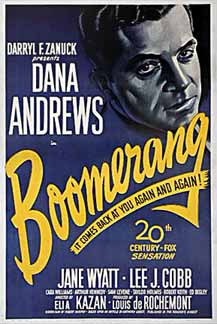
Boomerang! (1947)

Boomerang! (1947)
Directed by Elia Kazan
Screenplay by Richard Murphy, based on the article “The Perfect Case” by Fulton Oursler
Runtime: 1 hr, 28 min
One night, a beloved Episcopalian minister is shot on a Connecticut street.  There are many witnesses, but the killer cannot be found.  Tensions run high and the political pressures are on.  This is not a far out scenario; in fact, it actually occurred.  Elia Kazan’s Boomerang! is based on the real-life murder of Bridgeport resident Father Hubert Dahme and the ensuing search for the guilty party.  What Kazan and screenwriter Richard Murphy craft from it is a fascinating study of personal politics and society’s instinct to immediately condemn.
After endless days of tracing down suspects—with only “wearing a dark coat and light hat” to work with—the police force, led by Chief Harold Robinson (Lee J. Cobb) settle on a down-on-his-luck WWII veteran who just recently left town, John Waldron (Arthur Kennedy).  The prosecution is up to state’s attorney Henry Harvey (Dana Andrews).  All of the evidence, from the eyewitness testimony to the forensic analysis to the suspect’s confession, seems to point in one direction, but Harvey has his doubts regarding Waldron’s guilt.
Setting aside that Boomerang! is grounded in actual events, the film is filled with true-to-life drama.  The citizens of the town are outraged, forming their own committees and sending tips on anyone vaguely matching the vague sketch.  At one point a group of the reverend’s friends are damn set on lynching Waldron as he’s brought out of the court building.  The drama is not restricted to the everyday citizen either.  The sitting politicians are feeling the heat, and with an election coming up, the party desperately wants a conviction.
With all this building tension, it’s no surprise that the film’s greatest strength is how it portrays the individual reactions to the events.  It may be useful to compare the arcs of the prosecutor and the police chief.  Andrews’ character certainly has some political ambitions, and like anyone else in town he wants to see justice served and the murderer apprehended.  Meanwhile, Chief Robinson, described as one stubborn goat, remains skeptical of Waldron’s guilt, even as the evidence starts pouring into the station.
Yet it many ways, the changing realities of the situation causes them to switch positions.  Once the bullet has been analyzed and found to match Waldron’s gun, Robinson’s mind is set.  Harvey, though, upon his own investigations into the crime, turns his own skeptical eye on the evidence.  Both Cobb and Andrews are exquisite in their roles, makes both of their characters’ transitions believable in the context of the narrative.  This especially shines through in their multiple conversations; behind the chatter is an air of frustration with each other.
It would be obvious, though, that emotions would be running high.  What Boomerang! remembers—places at the forefront, even—is how the politics, big picture and otherwise, are in play as well.  I’d imagine a temptation to follow the murder mystery aspect of the case all the way down.  It would work, given the strength of the performances, but it would also give the false impression that one man’s guilt is the sole intrigue in the case.  What about the question, “What’s at stake if we can’t convict someone?”
Ultimately, it is this question that Kazan and Murphy focus on.  Murphy writes in ample scenes of local politicians discussing the stakes—elections are in the air, money is on the table, ambitions and reputations could be shattered.  Meanwhile, Kazan stages these encounters beautifully, especially a late night talk between Harvey and a local backer of a recreation center played by Ed Begley, a scene which proves pivotal to Harvey’s character development.  It’s not just a whodunit; there’s a whole other world emerging here.
This is not to imply that the film doesn’t have some problems.  Boomerang! is in the style of a docudrama, with narrations supplying context and off screen goings-on.  It may be too much to ask the filmmakers to abandon an aesthetic, but the result tends to tell rather than show; we can see they’re rounding up everyone wearing the wrong outfit without a full explication.  Also, there’s a clear alternate suspect who Kazan spends far too much time showcasing as an alternate suspect; one scene near the beginning of the film is enough to establish that fact.
I nitpick, however, as the finished work is exceedingly good.  The case which inspired the film was never solved, and while the in-story resolution is a bit more clear-cut, the interpersonal ambiguities certainly remain.  Whose motives are suspect and whose are sincere?  Does anyone have the integrity to set ambition aside and see justice served?  These questions are answered, sure, but to answer them is not a short process.  It requires soul-searching and determination, but the truth is out there somewhere, which is what makes Boomerang! a movie well worth a watch.
Oh, and fun fact: one of the people standing in a line-up is played by…Arthur Miller.

Saturday, November 3, 2012

Mr. Smith Goes to Washington (1939)

Mr. Smith Goes to Washington (1939)
Directed by Frank Capra
Screenplay by Sidney Buchman, story by Lewis Foster
Runtime: 2 hr, 10 min
It is of course an election year in the United States, so it is only fitting to discuss a film centered on the American political machinery.  There are many films that could fit the bill, but the one I have in mind for today is perhaps the most beloved.  Mr. Smith Goes to Washington, one of the standouts from that golden year of 1939, is a film that strikes at the heart of the American system.  At once it highlights the corrupt, easily manipulated world of Congressional politics and public opinion while still allowing a faint ray of hope to shine through.
After the death of a senator, the governor of some western state (Guy Kibbee) appoints the local head of a Boy Scouts stand-in, Jefferson Smith (James Stewart).  Smith has a likeable image but is completely new to politics, which would seem to make him very malleable.  Smith is glad, however, to be serving alongside Joseph Paine (Claude Rains), a respected politician and friend of his father.  However, when Smith determines to set up a boys’ camp in his state, he discovers that a dam is to be built on the property, with a political boss named James Taylor (Edward Arnold) behind it.
Because the film follows someone brand new to politics, the ensuing tale of corruption is not one of backroom deals, though those are present.  Instead, the audience follows Smith—a man who firmly believes in whatever the phrase “American ideals” means—as he attempts to get to the bottom of the dam scheme.  The details of the plan are vague: it’s in a deficiency bill, there’s graft involved, and Jim Taylor is the primary beneficiary.  What is clear, however, is that corruption runs deep in the Senate, and the players are more than willing to maintain the status quo.
Not that they’d suspect Jefferson Smith to give them much trouble; while his love of the country and what it stands for is great, he’s not the least bit savvy politically.  Smith’s secretary, Clarissa Saunders (Jean Arthur), labors to explain the laborious process of getting a bill into law.  It’s in scenes such as this that Stewart’s acting chops truly shine.  His dialogue is extremely hesitant.  He can talk sense but has little articulation.  Yet Stewart never makes Smith out to be an imbecile, but rather an everyday man who is simply in over his head.
Arthur is no slouch, either.  If nothing else, she is a very good drunk.  While at dinner with her would-be lover/Washington journalist Diz Moore (Thomas Mitchell), her character has definitely had a few.  She is not boisterous, but she is letting everything out.  Arthur places her in a vulnerable state, one in which Moore is briefly able to convince her that they were in fact getting married.  Add in her gradually increasing affections for Smith are completely natural, and it’s clear that to call Arthur’s performance excellent is no hyperbole.
What may sound a bit hyperbolic, however—and I do mean it—is that Mr. Smith Goes to Washington contains some of the most beautifully shot sequences in cinema.  Some scenes give Citizen Kane a run for its money.  There’s so much raw power in seeing Smith, a mere speck of dust, stand inside the massive Lincoln Memorial, as if he were standing before Zeus.  Later, when Smith and Saunders have a late night chat there, Jean Arthur is cast in striking silhouette, with just a glimmer of light on Stewart.  Give credit both to Frank Capra’s staging and Joseph Walker’s cinematography; their work is commendable.
But what the film does best of all—that’s saying something—is just how hopeless the events of the film feel.  Whatever Jefferson Smith believes aside, the idea of one man making a difference is torn to shreds.  Taylor, who I must say is a bit too transparently evil, controls nearly the whole press in his state; he can and does mold public opinion to suit whatever ends he has in mind, convincing voters and senators that Smith’s boys’ camp is all a money-making scheme.  As the film progresses, it becomes painfully clear how much the media forms the views of the masses, and how little can ultimately be done to change it.
Further, Capra’s film shows what the world of politics will do to the upstanding man.  Senator Paine is a fascinating, frustrating man.  A former champion of the lost cause and eloquent beyond compare in the Senate, he decided that serving his people meant compromise, and that meant falling in line with the Taylor machine.  It may seem that someone as dedicated to the American ideal as Jefferson Smith could withstand the temptations of power and reputation, but the question becomes at what cost one ultimately meaningless man does so.
Both a personal saga and a sharp critique of the American political establishment (let’s just that the government wasn’t too thrilled when the film was screened in D.C.), Mr. Smith Goes to Washington is a must-see film.  It’s the sort of movie where my rooting interests are conflicted: in my heart of hearts I want to see Smith triumph over the corrupt political machinery, but every rational brain cell I have wants to tell him, “Give up; it’s hopeless.”  I’m not sure where the truth of the matter lies, but it sure as hell isn’t on the idealistic end.

Wednesday, October 31, 2012

"Tessy Dubois": A Ghost Story

Happy Halloween, everybody!  Rather than the essay I'd normally post every other Wednesday, I thought I'd try to entertain all three of my readers with a brief little ghost story.  A campfire tale, if you will.  I'll try to keep this around 1,000 words, because I know that all of you have candy to collect and apples for which to bob.  Or whatever it is the kids are doing for Halloween these days.  Boo!

*     *     *
 
"Tessy Dubois"

As the late autumn wind blew through the forests of Adams, two men crossed a decaying bridge across the Sessaqueek River and stepped onto leaf-covered banks.  They now stood on the old Dubois estate.  A century ago it was the center of the small-town aristocracy, but decades of neglect had removed most of the luster from the property.  Except, naturally, for the manor house.

"There it is, Tommy," Jack said, trailing.  "Are you sure you're up for this?"

Jack's doubt surprised Tommy; they'd been making these short films for years.  Nobody ever minded them using these old houses as sets--they were, after all, abandoned.  "What are you talking about?"

It was Jack's turn to look surprised.  "Are you telling me that you've never heard the stories about this place?"

"If you're going to tell me it's haunted--" Tommy began, not intending to finish the thought.

"I'm just saying, everybody knows about Tessy Dubois and the fourth floor window."

"Let me guess," said Tommy, turning towards the manor house.  "Her parents had arranged for her to marry some fellow she couldn't stomach, so the night before the wedding she jumped through the window to her death.  And now her ghost haunts the building and all the poor fools who enter it.  Is that right?"

Jack had no answer, because that was the legend to the letter.  Sometime in 1912--April and December were the most popular times--Tessy Dubois took her life and her family's hopes to the ground.  The momentous decision came not long Mrs. Dubois found her daughter moping in her darkened room.  The mother held a candle over Tessy's head, telling her to stop the nonsense and embrace the marriage for her family's sake.  An hour later, Tessy was gone.

The family moved out of Adams soon after, and while others wealthy clans bought the property, nobody stayed there longer than two years; the last owners left town in 1957.

Tommy started walking to the mansion, but Jack grabbed his arm.  "Dude, you're pushing your luck."

"What luck?  Look at the place," he said, motioning to the attic down to the ground floor.  "Haunted?  Please; Major Amberson himself could have lived here." 

Jack was about to say that Miss Havisham also lived in a mansion like this one, but before he could say so Tommy was halfway to the front door with the equipment bag.  "Hey, what gives?" he shouted.

Tommy stopped and turned around.  "I'm going to set up the set in the foyer.  Tell you what, I'll just get the lights all ready and I'll come after you.  Show you it's safe."  With that, he raced to the front door, ignoring the rest of Jack protestations.

After blowing the cobwebs out of the doorway, Tommy found that the house was even more magnificent than he had imagined.  All the furnishings, from the grand staircase to the candelabra beside the entrance, radiated the grandeur yet despair of the late Victorian, early Edwardian era.  That the place had clearly not been dusted since the Eisenhower administration made the perfect spot for a horror film; hell, he would consider setting a Dracula adaptation in this foyer.

Tommy stepped further into the room, in awe of his surroundings.  How could anyone refuse to live here, he thought.  With the striking paintings of the Dubois family framed in gold on every wall, the art collection alone must be a king's ransom.  He saw at least a dozen doors leading to Lord knows how many rooms, which in the past were staffed by Lord knows how many servants.  It was a testament to good old American materialism.  What citizen or filmmaker could resist?

What he found no sign of, though, was Tessy Dubois.  He could just imagine what he would tell Jack when he got back out.  "You would think that after living so long undisturbed she would just come charging after me.  Guess she's a deep sleeper, am I right?"  Okay, so he'd have to think of something wittier in the meantime, but the point still stood.

Now Tommy started feeling a bit risky.  Why not, he thought: "Hey, Tessy!  Yeah, you heard me!  Come down here, will you?  What, are you scared, too?"  He got no response besides his own voice echoing off the walls.  Such a beautiful echo, too, particularly high-pitched.  He'd have to take advantage of that somehow for the movie.  Note to self: buy good recording gear. 

Having had his fun, he unzipped the equipment bag, took out a tungsten lamp and tested it.  Bright as ever, he saw.  Very bright, indeed, given the contrast with the room.

Then, from nowhere, he heard a wail.  "Turn that off!  Turn that off!"

It was the same exact frequency as the echo he heard before.  Only, Tommy knew he didn't say that.  And there was no one else in the house.  Or was there?

He flipped about and looked up the grand staircase.  Quickly descending was a petite shade of a woman, dressed in a white gown and a piercing scowl.  "Turn that off!  Turn that off!"

Desperately, Tommy tried to push himself up from the floor, but his hands were too shaky to be helpful.  With every second Tessy Dubois came closer and closer, sounding more and more violent.  "Turn that off!"

Finally, Tommy was somehow back on his feet.  Leaving the shining lamp and the equipment bag behind, he barged through the front door and raced down the hill, Tessy's wail still echoing behind him.

Tommy's legs didn't stop once out of the mansion; he just kept on running, right past Jack sitting by the Sessaqueek passing the time.  "Run!" Tommy barked as the bridge creaked beneath him.  "Run, run!"

Jack just sat there grinning.  "I told you so!"

Saturday, October 27, 2012

The Black Cat (1934)

The Black Cat (1934)
Directed by Edgar G. Ulmer
Screenplay by Peter Ruric
Runtime: 1 hr, 5 min
 
I now find myself at the end of Classic Horror Month, and only now am I struck my how little horror I’ve actually seen in my life.  Perhaps the best demonstration of this fact is that I had never seen a movie starring Bela Lugosi or Boris Karloff.  What better way to fix that than to watch a film that they both were in?  Lugosi and Karloff filmed eight pictures together, so that presents many options.  As I always say, however, start at the beginning, which is why today’s movie is the 1934 version of The Black Cat.
The opening credits claim the film was “suggested” by the Edgar Allan Poe story, but in reality the two have nothing in common besides a black cat being somehow involved.  In this story, Lugosi plays Dr. Vitus Werdegast, a former prisoner of war off to visit an old acquaintance, Hjalmer Poelzig (Karloff).  On the train, he meets an American couple, Peter and Joan Alison (David Manners and Julie Bishop), who are on honeymoon.  Later on, however, their bus crashes, injuring Joan.  The three take refuge at the Poelzig estate, where it soon becomes evident that everything is not quite right.
I myself would begin to be suspicious just on looking at Poelzig.  The first time the audience sees him, he’s getting out of bed in a mechanical, monster-come-to-life fashion, all in silhouette.  Then there’s Karloff’s performance, which somehow manages to be dead-cold and maniacal at once.  All of his dialogue carries a combination of smugness and calculation that it leaves no doubt that he’s the villain.  Ordinarily I would find this sort of character dull, but Karloff has the chops to pull it off.
But what brings Karloff’s character to life is his relationship to Werdegast, whom Lugosi plays expertly.  Werdegast is determined to get revenge on Poelzig, whom he accuses of betraying him during the war and stealing his wife, Karen.  He’s also a bit unstable, despite being a psychiatrist, and is deathly afraid of a black cat in the mansion.  Yet Lugosi brings a great deal of nobility to his character, such as when he tells the Alisons of his past: “Have you ever heard of Kurgaal?  It is a prison below Amsk.  Many men have gone there.  Few have returned.  I have returned.  After fifteen years…I have returned.”
Karloff and Lugosi are brilliant together, and their disdain for each other’s existence could easily drive the story on its own.  Somewhat unfortunately, however, the Alisons are effectively The Black Cat’s motor.  It’s Joan’s injury that brings the trio to the mansion, and it’s Poelzig’s plan for her that keeps them there.  It’s not that Manners and Bishop are bad, per se, but they are not given very interesting characters, though their scenes together do have a certain affectionate charm.  Overall, though, the Alisons are just sort of a nuisance that keep Poelzig and Werdegast from settling their personal affairs.
But when the leads are let loose on each other, oh boy, this film kicks into high gear.  The confrontation has just about everything in it: Satanic cults, encased women, human sacrifice, torture, tons of dynamite, misunderstandings, and a game of chess.  And it’s all crammed into about thirty minutes of glorious footage.  Part of me wants to say that the film is trying too hard and throwing everything it can think of on screen, but the execution is so tight that the result is sheer destructive beauty.  This is what ridiculous action should be like.
Not only is The Black Cat suspenseful, but also it is pretty scary and disturbing.  Werdegast’s final confrontation with Poelzig sees the doctor go so far for revenge that it’s hard to remember that he’s the not-villain.  And while the cult meeting is bit silly, the staging carries a dark aura with it.  I can totally see why this film was a little controversial in its day, what with the Satanic and sadistic textures throughout.  This was released in May 1934; had it been delayed a few weeks I’m sure a lot would not have passed the Hays Code’s muster.
Finally, The Black Cat functions as a horror film not only with scares but also with atmosphere.  The architecture of the Poelzig mansion will abruptly transition from hard and angular Art Deco to a cartoonish Gothic appearance, which gives the proceedings an uneasy feel; major credit to Charles D. Hall’s art direction.  Further, the film’s use of heavy blacks and dark grays, punctuated by bright lightening flashes, is not just beautiful—it’s definitely and quintessentially creepy.  With its actions, scares and tone, The Black Cat fully succeeds.
It might be a shame that the film is not actually an adaptation of the Poe story—seriously, that needs to happen—but all the same, The Black Cat is a gem, by far my favorite film I reviewed for Classic Horror Month.  It’s the sort of film that has nearly everything working for it; a little plot trimming, and it would be damn near perfect.  If were to have children one day and wanted to show them a scary movie that succeeds at being “scary” and “a movie”, then I would need look no further than The Black Cat.

Saturday, October 20, 2012

Mad Love (1935)

Mad Love (1935)
Directed by Karl Freund
Screenplay by P. J. Wolfson and John L. Balderston, based on the novel Les mains d’Orlac by Maurice Renard
Runtime: 1 hr, 8 minutes
 
In film, and most likely any medium, there is a fine line between scary and funny.  Given poor execution in any department, a scene or character that is meant to instill terror in the audience instead brings them to floor in stitches.  Perhaps the actor or the writing is too hammy, or the setup is too unrealistic for the viewer to accept.  Rarely, however, does the very concept of the work inspire that undesired reaction.  Such is the case with the only Karl Freund-directed film and Peter Lorre’s American debut, Mad Love.
Lorre plays Dr. Gogol, a brilliant Paris-based surgeon.  Gogol is obsessed with one Yvonne Orlac (Frances Drake), an actress at Le Théâtre des Horreurs.  Meeting her after a performance, however, he discovers that Yvonne plans to retire from the stage and head to England with her concert pianist husband, Stephen (Colin Clive).  This sends what is clearly an unstable man over the edge, and he’ll do anything to get Yvonne to be his.  Gogol is more than ready to strike at a chance to ruin Stephen’s life.
This is where Mad Love jumps over the believability cliff and into the ravine.  Following a train accident which smashes Stephen’s hands, Yvonne takes her husband to Gogol for surgery.  Gogol has to amputate, but then attaches the hands of the recently executed knife thrower Rollo (Edward Brophy).  This not only prevents Stephen from playing piano as well as he did before, but also makes him a knife thrower.  Gogol then just uses the power of suggestion to convince Stephen that he murdered his father.
Yeah, there’s no way that I’m taking that plot seriously.  “Yeah, right” is my consistent, sole reaction for most of the film.  Yet the film plays it perfectly straight throughout, as if the whole hands plot is inherently terrifying, rather than simply being ridiculous.  The mood of the film is always eerie with nary a moment of genuine levity that this sort of premise requires.  This does give the story some humor value, but even then it only stretches so far before it becomes a mere head scratcher.
That’s not to say that the film itself is poor quality, even though most of it is.  Stephen, despite going through all this trauma—the crash, the surgery, the realization he now sucks at piano—never shows all that much emotion, and when he does it’s too upbeat to be believable.  Yvonne is a bit better, but no matter who she’s acting with she never really stands out.  And then there’s the comic relief character, a journalist played by Ted Healy.  To put it bluntly, I laughed more at a car horn which lasted for a second than at the totality of Healy’s performance.
In the cast, the only saving grace is Lorre.  When he first appears on screen, it seems possible that Mad Love might be legitimately scary.  From the complete baldness to the lack of blinking to his Hungarian accent, Lorre exudes creepy as Gogol.  I would completely buy this man swiping the wax figurine of Yvonne and having conversations with it, or just trying to make Stephen miserable to get to his beloved.  He and the film still lose me the knife throwing hands plan, though.  Can’t win them all, I guess.
I will say, though, that though Mad Love is a pretty bad movie, it’s not that painful a watch.  I’m not even sure if it’s because it’s so bad, it’s good.  It may just be the absurdity of the proceedings.  It’s not just the premise—like I said, that only goes so far.  There’s the cinematography, which I hear inspired Citizen Kane but I’m not seeing it  At one point, Gogol’s silhouette is cast on the wall, and it’s so gargantuan that it makes me think that a vulture is about to attack.  Clearly going for scary, but that’s just hilarious.
And that’s not even getting into the strange behavior of Gogol’s maid (May Beatty), the unconvincing manner in which Stephen’s new found knife throwing talents are shown, or how blasé Stephen sounds when he gets arrested for murder.  Hell, if Freund had taken this premise and played it for laughs, it could have been an effective spoof of mad scientist/doctor movies.  That’s obviously not what he did, however, and the result is movie which is rarely frightening and only intermittently funny.  Not a winning formula, that.
So can I recommend even an ironic viewing of Mad Love?  Not really, considering that it only gets truly humorous, as opposed to strange, on occasion.  I can certainly see how having crazy hands attached could make for some psychological drama, but not when part of a crazy scheme to win over an actress.  I guess you could say that this was filmed in all seriousness is a bit frightening, but suffice to say that as is, Mad Love does not make for a good horror movie, or for that matter, an exceptionally “so bad, it’s good” one, either.

Wednesday, October 17, 2012

Ambiguous Satire: "The Onion", Mark Twain and Poe's Law

Recently, the inability of some people to recognize satire has made headlines again.  As reported on The World, FARS, a government-backed news source in Iran, copied an article from The Onion entitled "Gallup Poll: Rural Whites Prefer Ahmadinejad to Obama" and ran it as if it were fact.  That FARS would be attracted to such a headline is not really surprising--anything to glorify the current regime, right?--but all the same, I have got to wonder: how is it that people keep believing what they read in The Onion?

Alas, this just keeps on happening.  No matter how long The Onion has been around, people keep missing the satire.  If anything, the rise of the Internet has made this more common; check out Literally Unbelievable if you need evidence and an afternoon of face-palms.  But it's not just the incredibly credulous on Facebook and foreign media groups who fall victim.  Kevin Fallon of The Daily Beast notes that the recently duped include Rep. John Fleming (R-LA), Stephen A. Smith of ESPN, and even The New York Times.  Not even the paper of record has a fully functioning satire-detector.

What to make of this trend?  After all, aren't we supposed to be living in a world whose culture is dominated by irony and "irony"?  If that's the case, it's sure strange how our abilities to recognize satire so often falters.  It could very well be that the world has gotten so absurd that absolutely nothing would surprise us.  But I'd like to make a modest proposal (sorry, I had to).  Perhaps the issue isn't that we are unable to recognize satire.  Maybe the problem is satire especially in text, itself tends to be ambiguous, to leave its objective and targets unclear.

Poe's Law

First things first: why do so many people mistake things obviously written as satire seriously?

Prose text is a wonderful and rich medium, but it's not the best medium to communicate on a non-literal level.  There's a reason I advise people never to be sarcastic on the Internet: without the intonations of speech and the gestures of body language, all the audience has is what is literally said.  There's no real way to determine the intent of the writer just from analyzing what he wrote, so what choice does the reader have but to take what is written at face value?  There's got to be a major tip-off in the text to do otherwise, which leads right into Poe's Law.

Poe's Law is named after an Internet user by the name of Nathan Poe; although the idea stipulated in the law had previously been floating around the Web, Poe's phrasing of the concept is the one that caught on, which is why he's the namesake.  Poe's original formulation was posted to a message board called Christian Forums, and ran thusly:
Without a winking smiley or blatant display of humor, it is utterly impossible to parody a Creationist in such a way that someone won't mistake for the genuine article.
Over time, Poe's Law has been expanded to included topics outside of creationism or even religion, and can probably be reformulated like so:
It is impossible to parody anything in such a way that no one will take you at face value.
Whether it's an article about Obama's "long missing son" or a massive leap of creationist logic, there is simply no way to craft a parody so extreme that the satiric intent is plainly visible without explicitly stating it.  After all, both The Onion and creationist parodists, while certainly humorous, play their roles straight.  If you were just given the text of the article or post, how on Earth could you determine whether what you were reading was legitimately stupid or designed to look legitimately stupid to make a larger point?

(Hell, go on and read some of the posts from Literally Unbelievable.  Some of the responses on Facebook are so over-the-top and clueless that I'm tempted to call Poe on them.)

Fuzzy Targets

Furthermore, even if it is clear, absolutely clear that a work is satire, there is still another hurdle to overcome in satire recognition: what is being satirized can be ambiguous.  You know how some conservatives feel that The Colbert Report is a parody of how liberals view right-wing pundits?  Well, especially in text, that could be a valid interpretation.  After all, what is a parodic creationist post poking fun at?  Creationism? creationists? atheists/scientists/the general public's view of creationism/creationism?  Who can be sure?

For the rest of this article, I would like to focus on one particular work of satire as a case study.  Given the author, the tone, and that proving a work to be a satire given Poe's Law would be nigh impossible, I shall grant the satiric intent as self-evident.  Even so, it will become clear that what the satiric target is can only be guessed at. 

Recently, I came across a especially ambiguous satire as an assignment for a class in nonfiction.  In The Innocents Abroad, Mark Twain details a excursion he paid to partake in, which took him to continental Europe and the Holy Land.  The text drips with Twain's trademark derision and humor, and no one is exempt from it.  His fellow American travelers, the great landmarks of Europe, the clergy and religion: everyone is an acceptable target.  So much so, it raises the question, "What is Twain even satirizing?"

Based on the title and Twain's later works such as The Adventures of Huckleberry Finn, one would be tempted to immedaitely respond that he is poking fun at American tourists.  In fact, one could argue that The Innocents Abroad predicts the rise of the "ugly American" archetype that would later emerge.  For instance, Twain spends a great deal of time describing fellow voyager Dan, who insists on speaking to everyone they meet in English, as in this exchange in Italy:
      Dan's voice rose on the air: "Oh, bring some soap, why don't you?"
      The reply was Italian.  Dan resumed: "Soap, you know - soap.  That is what I want - soap.  S-o-a-p, soap; s-o-p-e, soap; s-o-u-p, soap.  Hurry up!  I don't know how you Irish spell it, but I want it.  Spell it to suit yourself, but fetch it.  I'm freezing." (119)
Yet while Twain certainly takes a lot of jabs at the passengers, he also seems to skewer the foreigners as well.  In particular, he portrays many of the French, Italian, etc. commoners as scam artists, preying on tourists looking for tour guides; Twain and others even take to calling all of their guides "Ferguson" after one such guide.  Considering how wide Twain spray is and how light his tone is through most of the book, one could possibly say that he just wants to poke fun at humanity in general.

This view, however, would suggest that Twain lacks an agenda.  That's not impossible, but then how does one account for the drastic tonal shift that Twain's voice undergoes while in Florence?  Normally, Twain seems content to make jokes and cast everyone in unflattering lights.  Then, out of nowhere, his words become deathly serious.  Rather than making jokes about the wealth of the church and the poverty of the masses, Twain's prose takes the form of an impassioned plea:
Look at the grand Duomo of Florence - a vast pile that has been sapping the purses of her citizens for five hundred years, and is not nearly finished yet.  Like all other men, I fell down and worshipped it, but when the filthy beggars swarmed around me the contrast was too striking, too suggestive, and I said, "O, sons of classic Italy, is the spirit of enterprise, of self-reliance, of noble endeavour, utterly dead within ye?  Curse your indolent worthlessness, why don't you rob your church?" (164)
Compared to earlier passages about soap and tour-guides and general annoyance, this passage is downright acidic.  It's as if an episode of The Colbert Report suddenly smash cut to John Stewart at his most outraged.  It ceases to be a satire and transitions into straight polemic.  And most confusing, this change is only temporary.  Once Florence far behind the Quaker City, Twain jumps right back into a lighter, broader comedy.  So is Twain actually satirizing Europe, or the ruling classes, but doing so in the persona of a rural hick?  The Innocents Abroad is far from a straight-forward work.

In Search of a Solution

So how are we to make sense of ambiguous satiric targets?  One proposal comes from David McNeil, who, in an essay on A Confederacy of Dunces, suggests a type of satire which accomodates conflicting or shifting targets.  He refers to it as "reverse satire", which McNeil defines as "the kind of satire in which the satirist-persona or the satirist-character makes his attack and is ironically ridiculed himself" (33).  The term itself does not appear to have caught on, but McNeil contends that this particular satiric form is prevelant throughout American literature.

At first it would appear that the reverse satire may be the key to deciphering Twain's intentions in The Innocents Abroad.  I certainly got that hope reading McNeil's essay, since he draws myriad references to another Twain novel, and my personal favorite of his, A Connecticut Yankee in King Arthur's Court.  In that novel, the satire first appears to be aimed squarely at the chilavric, medieval age, but as the narrative develops and the tone darkens it becomes clear the real target is the industrial age and "Yankee ingenuity", represented by the protagonist Hank Morgan.

A Connecticut Yankee in King Arthur's Court works as a reverse satire because Hank Morgan "makes his attack" on the Arthurian world but later "is ironically ridiculed himself" thanks to the unfolding narrative; industrial progress is really just another form of magic that leaves nobody enlightened.  The joke, in other words, is on the perspective character.  In the case of The Innocents Abroad, however, I don't believe that the text fits the definition.  The issue is the "ironically ridiculed himself" part of the equation.

For this idea to really hold, there ought to be a clear indication that the ultimate target is the perpective character.  So, in The Innocents Abroad, that would mean that by the end we should get the sense that the Twain figure, the chronically unimpressed and dismissive narrator, is the real target.  By the end, however, Twain's character has not changed all that much.  He pretty much has the same tone and outlook that he had at the start; he's just seen the world now.  So the reverse satire approach seems to be a dead end.

What, then, do we call a work such as The Innocents Abroad?  Given the scattershot approach Twain takes, that hard to say.  Perhaps we should just forget the intent of the satire and read whatever meaning we want into it.  That's not a particularly satisfying approach, but given how the author is currently unavailable on account of being dead, it's probably the only approach.  What else can the modern reader do but interpret the satiric intent as the reader sees fit?

In fact, given how we interact with print media, far away from the author and unable to hear his voice, this may explain why satire often goes over our heads.  Because a direct statement of intent is unavailable to the audience, and text yields the fewest clues about intent, initial exposures to satire can be easy to mistake, especially when the satire itself is ambiguous.  This still doesn't excuse people who take Onion articles at face value, but at least now--I think--I can understand what exactly is going on when that happens.  Perhaps.

Works cited:
"Iranian News Agency Apologizes for Reprinting Onion Satire as Fact." The World.
     Host Marco Werman. NPR. WESA, Pittsburgh, 1 Oct. 2012. Radio.

McNeil, David. "A Confederacy of Dunces as Reverse Satire: The American
     Subgenre." The Mississippi Quarterly 38.1 (1984): 33-47. Literature Resource
     Center. Web. 2 Oct. 2012.

Poe, Nathan. "Big contradictions in the evolution theory." Christian Forums. Christian
     Forums, 11 Aug. 2005. Web. 2 Oct. 2012.

Twain, Mark. The Innocents Abroad. 1869. Introduction Stuart Hutchinson. Ware,
     Hertfordshire: Wordsworth, 2010. Print.