Wednesday, March 13, 2013

Evil for Evil's Sake: Don John, Satan and One-Dimensional Villainy

William Shakespeare's Much Ado About Nothing, a festive comedy written ca. 1599, is a showcase for all sorts of human treachery, including slander and the injustice of the patriarchal system.  These are issues which still plague society and capture the attention of the modern day reader.  However, it's worth noting that the play's explicit villain, Don John, barely figures into this discussion.  He may be the source of the stain on Hero's good name, but his motivations and actions fade into the mental background.

The simplest, and most likely, explanation for this tendency is the fact that Don John is a very one-dimensional villain.  There is no need to discuss his motivations because he barely has any.  In fact, J. Albert Shepherd argues that Don John is "the only example of absolutely motiveless villainy" to be found in Shakespeare's oeuvre (346).  There are no practical ends to his madness and no high-minded principles he deigns to follow; if there is ever a character in Shakespeare's work that just wants to watch the world burn, it would be Don John.

While I believe that a monstrous villain can be compelling to read about, Don John just does not fit that bill.  The reason for that is a matter worth discussing, and I feel that comparison to one of the greatest villains in all of literature is appropriate: Satan from John Milton's Paradise Lost.  In fact, I would and will argue that Milton's Satan is an improved version of Don John, creating a villain who, while lacking sympathetic motivations, is exciting to read about and tempting to root for.  Yes, I shall be comparing something unfavorably to epitome of evil.  This shall be fun.

In this article, I shall first argue that Don John and Satan belong to the same archetypal categories of villains, as laid out by Orrin E. Klapp.  In addition, I will posit that a link between Shakespeare and Milton's characters, while unnoted in scholarship, is in fact a plausible one.  From that point, we may discuss why Satan works as a compelling villain and Don John does not, despite them being so similar in personal makeup.  This discussion will ultimately come down to two points: the size of the threat posed and the eloquence of the characters' stated goals.

Klapp and Villain-Types

Before I begin, I should concede a bit of ethnocentrism in this piece.  As I have neither the time nor the space to research the villain-types identified in every modern society, I will be assuming an American point-of-view in terms of villainy; given the influence of American media worldwide, I feel there is some universality to these archetypes.  There is an argument to be made that to apply such a viewpoint to the creation of a 16th century British man writing about people in Sicily is unfair, but I feel it is impossible to view past works while ignoring the modern perspective.  That said...

I have mentioned Orrin E. Klapp before on this blog; in my piece on the music of Fitz and The Tantrums, I brought up what Klapp refers to as the "parasite" or "chisler" villain-type; in that case it took the form of the "gold-digger" stereotype.  This particular villain-type does not apply to Don John, but Klapp lists off many more roles and sources for antagonists in the American imagination, which he largely separates into two broad groups: "high-visibility" and "low-visibility", based on whether the villain acts in a manner obvious to heroes or society.

I say "largely", because the most obvious subtype into which Don John fits is actually a miscellaneous category based on what Klapp terms "ambiguous vilifying epithets".  The first epithet he lists is "bastard", which is what Don John is.  According to Klapp, to be labeled as a bastard or some other ambiguous vilifying epithet "consign[s] a person, without nice discrimination, to the entire category of villain" (339).  Since Don John cannot help being a bastard, this suggests that his role as a villain is innate; he is intrinsically evil.

If one were to discount the miscellaneous category, however, one would see that villain-types are differentiated primarily based on how obviously they put their treacherous plans into motion.  The "high-visibility" type acts in a manner which is transparent, whereas the "low-visibility" type is most apt to work subtly, perhaps behind-the-scenes to achieve the same ends.  Of course, the problem with categorizing villains in terms of visibility in a fictional setting is that to do so raises the question: whose vision are we discussing?  Is it the characters' or the audience's?

From the perspective of the audience, both Don John's and Satan's deeds are quite transparent, as we see or read about them planning them; it comes as no surprise to us when Don John's gang convinces the men of Messina that Hero has been unfaithful or when the Fall of Man occurs in the narrative.  However, from the point of view of the characters--or at least the relevant ones--these antagonists act in ways which are sneaky and go completely unannounced.  So what is the solution?  Do we simply ignore one perspective, or do we adopt a hybrid approach?

I propose the latter, because in observing these works we have no choice but to engage in both perspectives.  "High-visibility" and "low-visibility" may seem incompatible, but we may take elements from Klapp's groupings to describe Don John and Satan.  First, in terms of the high-visibility, audience-based type, I feel that the descriptor of "monster" fits best: "A bizarre villain whose acts and motivations are beyond the ordinary range of human comprehension and whose stature approaches the demonic" (338).  This is the closest categorization to "pure evil", so it fits for Don John and Satan.

In terms of the low-visibility, in-universe type, there fewer options to choose from.  However, both Don John and Satan would clearly fall under the "deceiver" label, as the pair "puts one over on people through fraud or deception" (338).  Thus, we may consider both villains to be in a category which can be term "monstrous deceivers".  There is no problem of incompatibility here, since one half of the label describes the motives of the villain (evil for evil's sake) while the other half describes the method used (deception).  Both terms describe Shakespeare's and Milton's creations quite well.

Now that we have established how Don John and Satan belong to the same class of treachery, I would like to suggest that similarity between the characters is not merely a coincidence.

Linking Much Ado About Nothing to Paradise Lost

Shakespeare's influence on John Milton has been well documented.  In a compilation of Miltonic allusions to the Bard, Alwin Thaler remarks, "That there are numerous points of contact between Shakspere [sic] and Milton is, to be sure, a matter of common knowledge" (645).  He goes on to argue that if anything, the relationship between the two has been understated in scholarship, and Thaler does his best to list every conceivable connection between the works of Shakespeare and Milton; just about every play credited to Shakespeare is cited.

In addition, one may surmise that Milton may have drawn more than mere inspiration from Shakespeare; there may be an element of reverence.  In the poem "On Shakespeare", originally published anonymously in the second folio of Shakespeare's works, Milton lays out his admiration for the dramatist:
Dear son of memory, great heir of Fame,
What needs't thou such weak witnes of thy name?
Thou in our wonder and astonishment
Hath built thy self a live-long Monument. (lines 5-8)
This poem, and its placement in the Second Folio, is a simple but emotionally powerful justification for reading the Bard into Milton's works.  Quite clearly there was admiration for the playwright on Milton's part.

In reading Much Ado About Nothing and parsing through Don John's declarations, my first thought was, "Hey, this sounds exactly like Satan."  In Act I, Scene 3, Don John has a conversation with one of his followers, Conrad, who pleads that Don John should be thankful, and visibly so, for the relative mercy which Don Pedro showed him.  The bastard, though, will have none of it:
I had rather be a canker in a hedge than a rose in his grace, and it better fits my blood to be disdained of all than to fashion a carriage to rob love from any.  In this, though I cannot be said to be a flattering honest man, it must not be denied that I am a plain-dealing villain. (1.3.24-29)
The opening phrases structure immediately brings to mind Satan's most famous line in Paradise Lost: "Better to reign in hell than to serve in Heaven" (1.263).  Even if Milton didn't use this particular line from Shakespeare as inspiration from Satan (a similar structure is found in Richard III), it would not be surprising if Milton at least had Don John in mind while crafting his epic.

The connections between Don John and Satan go beyond that one line near the beginning of the play.  Both characters are ultimately driven by revenge, and their motivations seem more and more petty as their respective narratives unfold.  They are able to gain the trust of key figures through deception, but their plans ultimately prove futile and justice is carried out.  Most importantly, Don John and Satan are unambiguously evil characters: they are representative of chaos and have no even semi-noble reasons to fight the protagonists.

The similarities between Don John and Satan have not gone completely unnoticed.  Michael Taylor argues that both characters have "a concept of freedom [which] is paradoxically self-denying" (146), using the "canker in a hedge" quip as evidence.  That said, the possible link between the two characters has received very little attention from the academic world; Thaler goes so far as to say that Much Ado About Nothing has absolutely no analogues anywhere in Milton's body of work (688).  Yet I cannot help linking these two villains together.

Nor can I help comparing them, and when I do so, Milton's creation comes out as clearly superior each and every time.  How is it that Milton is able to create a villain so one-dimensional as the devil himself, yet make him so fascinating and compelling, while Shakespeare's same creation barely has enough character to make it through the play?  Let us see.

Grandeur and Eloquence, or, the Making of a Monster

One may initially think that Don John's uninspired role as a villain is a product of the genre of his play.  Much Ado About Nothing, is, after all, a festive comedy, and the genre would seem to dictate an unambiguously happy tone throughout; crafting a compelling villain would detract from the experience.  Paradise Lost, meanwhile, is an epic retelling of the Creation and the Fall of Man.  The villain, Satan, is far more integral to the form of Milton's piece than a similar character would be in Shakespeare's play.

I do not find this explanation satisfying, however.  Many of Shakespeare's comedies featured villains with complex motivations and real menace behind their threats.  Setting aside the blatant, period anti-Semitism, Shylock from The Merchant of Venice is a truly frightening antagonist, and Angelo from Measure for Measure is an excellent character from the "sinner in the position of saint" archetype.  Even restricting the search to festive comedies, I find the bastard Duke Frederick in As You Like It a far better version of the archetype than Don John.  Genre, then, is not the problem.

Scale, however, may be one.  Part of the appeal in watching a monstrous villain of any sort is that they pose a great threat to society.  The dragon wants to burn down the kingdom, the rebel wants to assassinate the president, and so forth.  Sure, for villains to have concrete motivations for their deeds is often a nice touch, but what they have to gain from wreaking such havoc may end up being beside the point.  So long as the audience can see that the monstrous villain's plans will have dire consequences, it can be roped into the drama without much explanation.

This is where Don John and Satan differ the most.  Satan is...well, he is Satan.  From a Christian perspective, he is the embodiment of all that is wrong in the world, and there is an awful lot that is wrong in the world.  On top of that, he is in a perpetual war with God himself, and in Paradise Lost, Satan's goal is to get revenge on God by ruining his most prized creation: man.  Not only is the fate of humanity ultimately at stake, but what amounts to cosmic combat has been raised.  If the reader can't get behind Satan as an entertaining bad guy in this setting, than nothing could achieve that effect.

Whereas Satan's aims are impressively grand, Don John's goals are absurdly small.  I can see why, after just having lost to Don Pedro in battle, he'd not be in the mood to overthrow his brother or something to that effect.  But, despite the romantic comedy storyline, his goal of breaking up the marriage of Claudio and Hero as a means of revenge feels so insignificant that I'm still not sure he wasn't supposed to comic relief.  Hell, when Borachio tells him of the marriage, Don John asks, "Will it serve for any model to build mischief on?" (1.3.40).  He sounds more like a prankster than a menace.

On top of that, the two villains differ in how they present their ideas.  As a character in an epic, Satan gets many monologues and he certainly makes the most of them.  In particular, I've always admired his reaction to seeing the Garden of Eden, contemplating all he gave up when he rebelled against God but ultimately resolving to put his wretched schemes into motion.  It's little wonder that many people, from William Blake on down, believe that Satan is the real hero of Paradise Lost.  His way with words could win most anyone over.

Don John, on the other hand, is not eloquent in the slightest.  He describes himself as being "not of many words," and for once he speaks the truth (1.1.150).  I will admit that my reading is influenced by Keanu Reeves' dull performance in the Kenneth Branagh-directed 1993 film version, but even on paper Don John is not a well-spoken villain; at best, his dialogue is utilitarian: effective in-universe but uninteresting on its own merits.  In fact, the "canker in a hedge" quip is probably the most poetic thing he says in the entire play.

Here, then, I think we can arrive a conclusion.  One-dimensional villains, such as monstrous deceivers, can be compelling, but the trick lies in grandeur.  Classic foes such as Satan have large-scale plots which pose a real threat and present themselves in a captivating manner.  On the other hand, dull one-dimensional villains along the lines of Don John lack these qualities; their schemes are hopelessly small and their demeanor is depressingly uninspired.  Not even the hand of the Bard can rescue such an antagonist. 

Works Cited
 
Kelley, Maurice, ed. Paradise Lost and Other Poems. New York: Walter J. Black,
     1943. Print.

Klapp, Orrin E. "American Villain Types." American Sociological Review 21.3 (1956):
     337-340. JSTOR. Web. 18 Oct. 2012.

Milton, John. "On Shakespeare." Kelley 23.

---. Paradise Lost. Kelley 88-386.

Shakespeare, William. Much Ado About Nothing. Ed. Peter Holland. The Complete
     Pelican Shakespeare. Ed. Stephen Orgel and A. R. Braunmuller. New York:
     Penguin, 2002.  Print. 371-400.

Shepherd, J. Albert. "The Self-Revelations of Shakespeare's Villains." The Sewanee
     Review 10.3 (1902): 341-363. JSTOR. Web. 18 Oct. 2012.

Taylor, Michael. "Much Ado about Nothing: The Individual in Society." Essays in
     Criticism 23.3 (1973): 146-153. Literature Resource Center. Web. 9 Oct. 2012.

Thaler, Alwin. "The Shaksperian Element in Milton." PMLA 40.3 (1925): 645-691.
     JSTOR. Web. 9 Oct. 2012.

Saturday, March 9, 2013

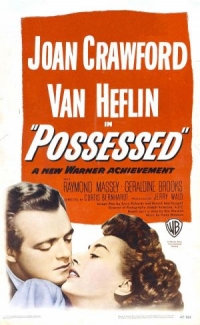
Possessed (1947)

Possessed (1947)
Directed by Curtis Bernhardt
Screenplay by Silvia Richards and Ranald MacDougall
Runtime: 1 hr, 48 min
It’s no secret that our own judgments and perceptions can be flawed.  This is especially true regarding how we perceive our own conditions and personalities.  We don’t see when we are acting cruelly or giving mixed signals, as what we mean to say is clear to us.  Even if we can see the same problems in others, finding them in ourselves is another story entirely.  Throw in some mental instability and the endeavor is nigh impossible.  Throw all of that on the screen, and you get this week’s movie, Possessed.
Possessed begins with a confused woman named Louise (Joan Crawford) wandering the streets of Los Angeles, repeating the name “David” to passers-by.  Brought to a hospital psychiatric ward and prompted by Dr. Willard (Stanley Ridges), Louise spits her story in flashback.  She was a nurse under the employ of one Dean Graham (Raymond Massey) to care for his ailing wife.  More importantly, she was madly in love with a man named David Sutton (Van Heflin), who broke off their relationship.  Simply put, Louise would do anything to keep David with her.  This sort of thing cannot end well.
When we first see Louise and David together, they are at a house across the lake from Graham’s summer home.  It is at this point that David wants to break things off, and their relationship is established expertly.  Crawford’s voice is particularly upbeat as she dresses, but Heflin shows that David’s thoughts are not with Louise; he is clearly more focused on the music he’s playing than his lover.  As David breaks the news, the tone becomes increasingly awkward, the silences more frequent, and Crawford’s delivery more desperate.  Her later madness is made understandable in this scene.
Further, this scene foreshadows the excellent performances in Possessed.  Crawford shifts from being confident and happy to visibly holding back the tears to mentally unstable with fluidity, to the point that what her character feels at any moment can only be described as “muddled”.  Her excellence extends to her scenes in the hospital, where the fatigue on her face is palpable and confusion is pronounced yet restrained.  The work that Crawford put into studying the behavior of mentally ill patients is evident, and it pays off in spades.
As for the men in her life, both Heflin and Massey succeed in their very different portrayals.  Heflin brings a degree of impersonal calculation to his character—appropriate, considering his obsession with mathematical engineering.  He appears level headed, but it hides a tinge of unknown unkindness.  Massey, on the other hand, gives Graham a justified level of dignity, but there’s the feeling he’s suppressing some emotions, especially after proposes to Louise a year after his wife dies.  It’s the same sort of performance that made Massey shine in Abe Lincoln in Illinois and the saving grace of The Fountainhead.
Crawford is the star, however, and it is her character that drives things.  What is being driven, however, is not always clear—but this is to the film’s benefit.  First of all, the story is told via the flashbacks of a character that clearly is not all there.  The doctor himself notes that Louise is very vulnerable to suggestion, and while he doesn’t apply it to her spiel, one need not tax the imagination to believe the whole story, which the doctor is prodding, is in doubt.  All we can say with certainty is that she did in fact marry Dean Graham; the rest would require some investigation.
Even within the flashbacks, however, the difference between perception and reality is front and center.  Despite being a nurse who can clearly see Mrs. Graham is mentally ill and imagining things which aren’t so, Louise is unable to see the same problems in herself until explicitly told.  A five minute sequence, in which Dean’s daughter Carol (Gerladine Brooks) tells Louise that David knows that she killed Mrs. Graham, is completely false and detached from reality.  Of course, whether Louise is even having these delusions is debatable; she claims to see Mrs. Graham, but the audience never does.
Possessed, then, makes for an interesting look at perception, delusions and other psychological phenomena.  Oddly, though, the explicit psychology that Dr. Willard delivers is the one stumbling block of the film.  The flashbacks are interrupted periodically for the doctor to make his diagnoses.  Not only is this distracting to the story, but also it is delivered with such conviction and certitude that it’s pretty damn laughable.  It most reminds me of the last five or so minutes of Psycho; surely this must have sounded better on paper.
Psychobabble aside, Possessed proves to be an intriguing drama which, in its own way, forces one to reconsider the way in which we perceive the world around us.  How open are we to the suggestion of others?  Why is it that we see the flaws in others so clearly, yet can’t find those same problems in ourselves with a GPS?  This is not a film that provides answers to those questions—after all, it is a movie, not a psychology textbook—but we cannot seek out the answers unless we know the questions to ask.

Saturday, March 2, 2013

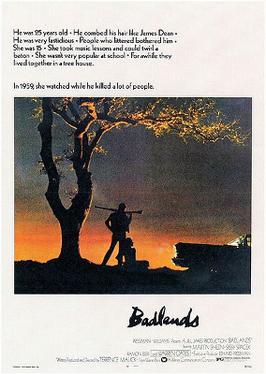
Badlands (1973)

Badlands (1973)
Directed and written by Terrence Malick
Runtime: 1 hr, 34 min
I first became acquainted with Terrence Malick through the beautifully pretentious and liberating film The Tree of Life.  That movie put Malick on the “watch whatever he has directed” list.  But as I discovered, there are not all that many films that he has directed.  In fact, even though his directorial career starts in the early 1970s, The Tree of Life was only the fifth film under his belt.  Certainly that makes him easier to catch up on than, say, Michael Curtiz or George Cukor.  And what better place to start than at film number one, Badlands.
Loosely based on the Starkweather homicides (thank you, Billy Joel), Badlands casts Martin Sheen as Kit, a garbage collector in South Dakota.  Kit, who’s in his mid-20s, falls for the fifteen-year-old Holly (Sissy Spacek); the two try to keep their relationship a secret, but when Holly’s father (Warren Oates) finds out, things turn ugly very quickly.  Kit shoots the father, sets the house on fire, and takes off with Holly.  They spend the rest of the film on the run as Kit piles up an ever-growing body count.
With all that murder and the constant fear of getting caught, one might expect Badlands to be an emotionally charged film.  Certainly there are a lot of emotions bubbling below the surface, but the presentation of the film is remarkably restrained.  Spacek’s narration throughout is delivered almost disturbingly matter-of-factly, and the actors find themselves in a nearly continuous state of numbness.  At times it almost feels like the film is a story being told by a history teacher, rather than a tale of a crime spree.
However, while that feeling is present, I think the presentation ultimately works to the films advantage.  Had the emotions been more visible—more screaming and crying, for instance—then it would have certainly been more movie-like.  But the more restrained tone allows the audience to explore the characters on a deeper level, which is more or less the film’s goal.  With very limited amounts of action, the relationship between Kit and Holly is brought to the forefront, and the long moments of inaction present them at default state.
The emotional distance in Badlands is particularly beneficial for Sheen’s Kit.  There may have been a temptation to play Kit as a sociopath.  Well, he is, but Sheen doesn’t make that the focus of his performance.  His actions may demonstrate his mental issues, but he is not defined by his bloodthirsty ways.  If anything, it’s something he’s grows into, as Sheen’s character does not always seems aware of what he’s doing.  Further, and more importantly, it’s not his sole motivation; his affection for Holly, after all, it what triggers the crime spree in the first place.
Holly, meanwhile, goes through a lot beneath her flat expressions.  Initially, she is quite clearly drawn to Kit’s whole James Dean clone persona, but there is an element of self-deprecation in her narration as she describes life before the death of her father.  There may be genuine affection for Kit at first, but she gradually falls into staying because, well, what other options are there?  Her face seems to be holding back tears towards the end, and she goes from reading Kit a warm narrative in there tree house to the dry celebrity gossip column of a magazine on their way to the border.
The actors and the story tend towards the subdued, and the cinematography furthers this feel.  On the one hand, some of the sequences are absolutely beautiful: a bright full moon against a clear sky, that one mountain way in the distance that appears ever so closer, etc.  It is all so lovingly shot, yet it also creates an overwhelming sense of loneliness (or as Kit prefers, “solitude”).  This is not to say that the film creates the illusion of there being no way out.  Rather, than gorgeousness and loneliness combine to create an oddly blasé texture to the proceedings.
You know, the word “indifferent” might be a good descriptor of the film.  Not in the sense that I didn’t care what was happening—or that the filmmakers didn’t, either.  No, I mean that there’s no sense that Malick or anyone else had a particular message or point to send.  There was simply a story of two people to tell, and everything else involved in the production is merely window-dressing.  This can make Badlands more than a little alienating, but it also makes the film commendably fair and direct—no one’s beating around the bush here.
Malick, both in the script and on the screen, neither condemns the two fugitives nor holds them up as some misunderstood rebels.  That may be the greatest strength of the indifferent tone of the proceedings: it portrays Kit and Holly as people without passing judgment.  I could neither root for them to elude the authorities nor desperately want them to be caught.  Again, to many viewers this might be a major demerit—I certainly get the desire for a rooting interest—but I do appreciate the ambiguities.  In fact, that may be all that a film needs.

Wednesday, February 27, 2013

So Long, Scene: Bob Dylan's Self-Titled Album and His Relationship with Folk Music

I love Bob Dylan.  I mentioned this back when I discussed Christmas music, but I absolutely adore the man.  From the early days of acoustic strumming to the angry young man of Highway 61 Revisited, to the all-too-human failings of "Idiot Wind" all the way through his most recent album Tempest, my favorite record of 2012.  His work is something I have been meaning to discuss for a long time, but it's so wide-ranging that I had a hard time knowing where to start.  But what better place to start than the beginning: Bob Dylan's folk scene days.

Although he is often referred to as a folk musician, Bob Dylan's relationship to the folk tradition has been less that harmonious.  Although the traditional tunes of the American musical landscape have influenced his work for decades, he and the scene have frequently chafed against each other.  During the mid-1960s, for example, Dylan was decried for his entry into the world of rock music and his abandonement of purely acoustic instrumentation.  An article from Antoni E. Gollan is representative of the attitude toward the new Dylan:
Dylan today is accompanied on records and in concert by a fiercely rhythmic rock band and plays electric guitar himself, anathema to many folk purists.  He was booed at the Newport Folk Festival last year, but has decided to play the Festival again this year.  His "folk-rock" records are bought in volume by the teenage screamies whose tastes are huckster-dictated and shallow.  ("I just want to get along," said Dylan a few years ago.  "If I had a lot of money, what would I do?") (638).
The folk scene's reaction to Bob Dylan's changing work is well-documented, so I won't spend an article recapitulating what is already known.  Instead, I shall try to tackle the question of whether Bob Dylan properly fit into the folk tradition to begin with.  To do so, I shall first identify some relevant traits of folk music, so that we may have a point of comparison.  Then I will look at his first album, titled Bob Dylan, and see whether it bears the qualities of folk music, is indicative of Dylan's lack of fidelity to the tradition, or a combination of both.

Traits of Folk Music
Defining folk music is an endeavour outside the scope of this article, but some relevant characteristics of the folk music tradition should be outlined.  A loose definition of folk music would be "the music of the people", but what is meant by this?  Part of this definition refers to the manner in which the folk song is made and then transmitted though the population.  In the folk tradition, according to Zhou Xizheng, a tune "is created by the masses together and spread in the masses as well" (73).  It would not be unfair, then, to say that the folk song is a community effort, albeit an unconscious one.

At first, it may be difficult to see how the masses may create a work, as opposed to a single artist or even a defined collective.  How exactly does an abstract group, the "masses", create a song?  To illustrate how this can be done, John Tasker Howard, Jr. gives the composition of the ballad as an example: "One villager composes the first stanza, his neighbor adds another, and when the rest of the community has had its share the ballad is a lengthy affair" (452).

This suggests that the folk song is by nature a collaborative process.  Even if one supposes that John wrote and composed a ballad on his own, when he plays and teaches it to his neighbor, Peter may added some new verses or change the order.  And his friends may rewrite the lyrics altogether, keeping only the tune, until only a vague sense of the original concept remains, and the identity of the original author becomes unclear.  What is clear, though, is that the folk song is a living beast, passed down from generation to generation is various forms.

Howard, Jr. suggests that there is another essential aspect of folk music.  Not only is folk music created by the people, but is about the people as well; they express the emotions and describe the condition of the group as a whole.  As he puts it:
We should bear in mind that the songs that come into being at the Negro camp meeting, the songs of the Russian peasant, yes, even the satirical songs of the creoles, are a vital expression of the temper of the people that gave them birth.  Such songs are a part of these peoples' existence, and it is this quality that makes them folk music; they are of the folk. (452)
This trait would suggest that songs which are specifically about the condition of one person should not be considered folk music, as they do not express the condition of the group as a whole.  This contention is overly strict.  What does one make of the love song, for example?  Many are undeniably personal in origin, yet they remain applicable to society at large.  More fair to say is that a folk song must be relatable, that is, the author cannot be the only person for whom it can have meaning.

From this brief discussion, we can derive three core traits of folk music to apply to Dylan's music:
  1. Folk music transmitted on a person-to-person level.
  2. Folk music is flexible: elements may be changed, or even repurposed for other songs.
  3. Folk music aims at describing universal experiences of the group, whether social, political or emotional.
With the groundwork out of the way, let's look at Bob Dylan.

On Bob Dylan

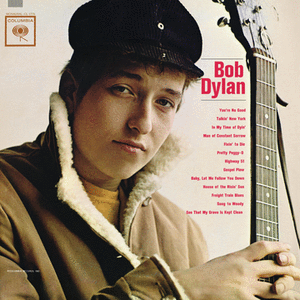
Although he was born in Minnesota, Bob Dylan made his way to New York City, a central folk revival hotspot, in the early 1960s.  After some initial struggles, he signed with Columbia records and began his career as a recording artist.  Bob Dylan's first album, Bob Dylan, was recorded in last 1961 and released in March of the following year.  Virtually no one took notice then, and it remains fairly obscure when considered alongside his subsequent works.  Nevertheless, Bob Dylan is perhaps the Bob Dylan album which is most strongly tied to the folk music tradition.

The most obvious point in favor of this claim is that, despite his renown as a lyricist, Dylan only wrote two songs on the album: "Talkin' New York" and "Song to Woody".  The other ten songs are either traditional folk tunes or covers of songs with known writers.  By putting these songs on a commercially released record, Dylan can engage in both the reinterpretation of the past's culture and the process of spreading knowledge of the people's culture to a wider audience.

However, the question remains, how well does Bob Dylan adhere to the three characteristics of folk music laid out above?  Although not every song on the record observes all three traits, the album as a whole exhibits them all.

Ordinarily, the first trait, person-to-person transmission, would be quite difficult to demonstrate.  Perhaps a diary entry might mention learning a song from someone else, but that is information not ordinarily available.  However, there is one instance on Bob Dylan where the reality of person-to-person transmission is explicitly stated.  Dylan introduces the song "Baby, Let Me Follow You Down" by saying, "I first heard this song from Rick [Eric] von Schmidt.  He lives in Cambridge.  Rick's a blues guitar player.  I met him one day in the green pastures of Harvard University."

With regards to the second trait, flexibility, I would like to highlight two songs: "Song to Woody" and "Highway 51".  "Song to Woody", as its title might suggest, is a tribute to American folk musician Woody Guthrie.  Appropriately, the tune which Dylan uses is often linked a Guthrie composition, "1913 Massacre."  Repurposing the music of his idol for a tribute is logical extension of folk music; it reinterprets the past for the purposes of the present.  You can listen for yourself; you will find that the two tracks are remarkably similar.


The second instance of flexibility is more speculative on my part, but it would suggest that the flexibility in folk music does not imply an attempt to erase the past culture in favor of the present.  One of the covers on Bob Dylan is of Curtis Jones' "Highway 51".  Upon first listening to Bob Dylan's rendition, my first thought was that it sounded similar in both tune and tempo to another Dylan song from 1965: "It's Alright, Ma (I'm Only Bleeding)".  If there is in fact a link between the two, it demonstrates that the folk singer may both straightforwardly and obliquely acknowledge past music.

The third trait, communal relatability, is perhaps the most easily observed aspect of the folk on Bob Dylan.  The most common subject matter on the record is perhaps the sole universal aspect of human existence: death.  Songs such "In My Time of Dyin'", "Fixin' to Die" and "See That My Grave Is Kept Clean" deal with the matter right in there title, and others that aren't specifically about death certainly touch on it.  For example, in "Gospel Plow", Dylan sings, "Mary, Margaret, Luke and John / All them prophets are dead and gone," then subsequently contemplates heaven.

Even the love songs on Bob Dylan, which as I mentioned are somewhat problematic for folk music, are universal enough in presentation that they remain applicable to just about anyone.  The sentiments expressed in "Baby, Let Me Follow You Down" (longing) and "You're No Good" (resentment and hopelessness) are easy to relate to, regardless of whether or not they include specific details about the relationship in question.  They are the sort of songs which can pass amongst a diverse group of people quite easily.

However, Bob Dylan also contains the seeds of his impending split with the folk scene, one which would become evident by 1964 or 1965.  The key lays not with the first or second criteria, but the third one.  The expressly personal lyrics which Dylan would become famous for bubble up on the record, and it was this conflict between the universal and the personal which would ultimately drive Dylan from identifying with the 1960s folk scene.

This is especially evident on the two original compositions of the album, which both describe Dylan's relationship to folk music and hint at an impending split.  "Song to Woody" is the less overt of the two in this regard, as it is a direct tribute to a folk music legend which musically quotes one of the man's well-known composition.  However, compared to the rather general songs of love and death which comprise the vast majority of the album, "Song to Woody" seems oddly specific to Bob Dylan. 

Take the song's second stanza:
Hey, hey, Woody Guthrie, I wrote you song
'Bout a funny old world that's a-coming along
Seems sick and it's hungry; it's tired and it's torn
It looks like it's a-dying and it's hardly been born
On the surface, this seems to keep with the tradition of folk music quite well: acknowledging the past, commenting on the state of human affairs and so forth.  But the fact that Dylan is stating up front that he is the author of the song, taken with the varied detail in the lyrics, suggests that he is taking ownership of the song, which is antithetical to the communal nature of folk music.

"Talkin' New York", on the other hand, displays some repressed contempt for the folk scene which Dylan entered in the early 1960s.  The song is a humorous portrait of the Greenwich Village music crowd, and is particularly biting when Dylan describes first trying to break into the scene in the coffee-houses:
I walked down there and ended up
In one of them coffee-houses on the block
I'd get on the stage, sing and play
Man'd now say, "Come back some other day.
You sound like a hillbilly.
We want folk singers here"
The recording industry associated with the folk scene is similarly skewered.  He mentions being a harmonica player for one studio, where an executive raves about his playing; he loves it "a dollar-a-day's worth."  Even when Dylan gets a deal as a recording artist, the business dealings are called into question:
Now, a very great man once said
That some people rob you with a fountain pen
It don't take too long to find out
Just what he was talking about.
One gets the impression listening to "Talkin' New York" whether Dylan could ever stay in the folk scene for an extended period of time.  Even if one takes the song as tongue-in-cheek, there at least appears to be an undertone of resentment in the lyrics.

Even though he would release two more albums which fit fairly comfortably in the folk tradition (1963's The Freewheelin' Bob Dylan and 1964's The Times They Are a-Changin'), by the end of 1964 he had seemingly left the movement for good.  Even though Another Side of Bob Dylan maintain the sparse instrumentation of his earlier work, the subject matter was purely that of Bob Dylan's concern. and "My Back Pages" is often read as a repudiation of his previous time in the folk scene.

Rather than a sudden shift, then, a reading of Bob Dylan raises the possibility that the great American folk-singer's transition to the more personal, more rock-oriented work he produced in the mid-1960s was in some sense inevitable.  This is not to say that the folk tradition ceased to influence his work.  Far from it; after all, the previously mentioned "It's Alright, Ma (I'm Only Bleeding)" comes from 1965's Bringing It All Back Home.  However, Dylan impurity as a folk musician was present right from the start.

Works Cited
 
Dylan, Bob. Bob Dylan. Columbia, 1962. MP3 file.

Gollan, Antoni E. "The Evolution of Bob Dylan." National Review 28 June 1966: 638-
     640. The National Review Archive. Web. 22 July 2012.

Howard, Jr., John Tasker. "On Folk Music." Art & Life 11.8 (1920): 451-3. JSTOR.
     Web. 23 July 2012.

Xizheng, Zhou. "Probe into the Debate on the Position of 'New Folk Song'." Cross-
     Cultural Communication 8.2 (2012): 73. Academic OneFile. Web. 23 July 2012.

Saturday, February 23, 2013

Dinner at Eight (1933)

Dinner at Eight (1933)
Directed by George Cukor
Screenplay by Frances Marion and Herman J. Mankiewicz, based on the stage play by George S. Kaufman and Edna Furber
Runtime: 1 hr, 51 min
Perhaps my favorite sort of scene is the dinner conversation.  Take a group people, each person with their own baggage, and leave them to their own devices over a meal of variable quality.  They could respond with silence, with mirth, or with overheated discussions of politics and religion.  Perhaps, such as in My Dinner with Andre, the conversation might even hammer at some universal truths.  But here’s a little twist—what gets a person to whatever state of mind he’s at once that dinner comes?
I wouldn’t say that Dinner at Eight is about that topic, but it uses that idea as a backdrop.  This dinner is being hosted by Millicent Jordan (Billie Burke), a New York socialite whose husband Oliver (Lionel Barrymore) runs a prestigious but struggling shipping line.  The party is being thrown for a British couple named the Ferncliffes, but we never see the guests of honor.  Instead, we follow the invited dinner guests going about the day of the dinner: making preparations, engaging with adultery, having suicidal thoughts, etc.  Oh, did I mention this was a comedy?
There are several character-driven subplots in Dinner at Eight, many of which intersect and all of which are interesting.  Some of the plots are purely comedic.  Marie Dressler, who plays the consciously aging stage actress Carlotta Vance, is the ultimately scene-stealer, hammy in the best way possible.  Whether she’s trying to pass her little dog off on other party guests or to sell her stock in Oliver’s company, ever word out of her mouth is pronounced flamboyantly, as if Carlotta never actually left the stage.
If the aging actress represents the comedic subplots, then the aging actor represents the tragic.  Larry Renault (John Barrymore) is the washed-up veteran who doesn’t (or won’t) realize it.  His agent is unable to get producers to even consider casting him, and he has a quite pronounced drinking problem.  On top of that, all of his scenes are shot in a single hotel suite, which not only isolates him from the outside world, but is indicative of his interior world.  Given all this, J. Barrymore gives an excellent performance—perhaps because, as granddaughter Drew has noted, he essentially plays himself.
That these two subplots occupy the same script yet do not feel inappropriate together is a testament to the screenplay from Frances Marion and Herman J. Mankiewicz (a.k.a. the co-writer of Citizen Kane).  Furthermore, their writing manages to convey a slew of socio-political relations in a two hour movie.  Firmly aware of the Great Depression, Dinner at Eight explores the fall of the wealthy, both the aristocracy and the Jazz Age nouveau riche, and their still tense relationship with the working classes.  It invites both sympathy for their declining fortunes and ridicule of their out-of-date manners.
Of course, some characters are easier to sympathize with than others.  Oliver is a generally kind and scrupulous businessman, so not only does the audience sympathize with his failing business, but it further draws us into his failing health.  His wife, on the other hand, is so concerned with the centerpiece for the dinner and whatnot that she comes off as beyond out of touch.  And then there are ambiguous characters such as Kitty Packard (Jean Harlow).  She may be ungrateful to the maid and she’s an adulteress, but she doesn’t take her husband Dan’s (Wallace Beery) crap lying down—well, figuratively, at least.
And, well, I haven’t even gotten to how all these people end up intersecting.  In a way the interconnectivity itself is hilarious.  Among the dinner guests, there are two separate love triangles, one including the daughter of the Jordans.  There are the machinations to buy out the Jordan shipping line and for one of the characters to end up in the President’s cabinet.  And worst of all, there’s the fact that Millicent Jordan has to keep finding replacement guests for the dinner party.  Oh, the horror!
Okay, I jest.  But this rotating guest list only adds to the tensions.  What the hell is going to happen once eight o’clock comes?  There are so many lit fuses near gunpowder that one half expects the Jordan estate to explode the moment that dinner is served.  In fact, the build-up is so developed and emphasized that, well, any resolution to it would be a disappointment.  I will say that the as time runs out on the movie, it takes a definite turn from the heavy to the light material.  I’m not sure this was for the best, but it is gradual enough to not be offensive.
Now that I think on it, I suppose the best analogue for the feel of Dinner at Eight would be The Apartment: at times it is soul-crushingly depressing, but ultimately a story dominated by levity.  This is not to say that Dinner at Eight is a trifle; rather, it suggests that the film attempts to embody the dualities and rapidly shifting tones of everyday life.  Showing the guests as despicable and gold-hearted, sinful and virtuous, adulterous and also adulterous, the movie makes a good case for the notion that company is more important to the meal than the food.

Saturday, February 16, 2013

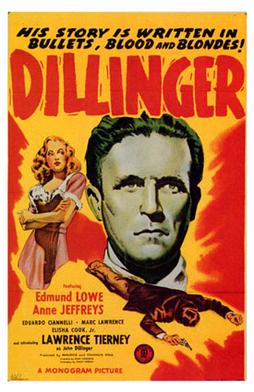
Dillinger (1945)

Dillinger (1945)
Directed by Max Nosseck
Screenplay by Philip Yordan
Runtime: 1 hr, 10 min
I’m never sure what to make of America’s fascination with gangsters and bandits.  Do people view them as Robin Hood analogues?  They do like targeting the major financial establishments, even if they aren’t spreading the spoils.  Maybe we view these fellows as tragic figures, people who rise in some field but are done in by some personal flaw.  Or it could just be their use of violence; man is fond of violence.  Whatever the reason, it’s clear that this interest exists.   Why else would there be at least three different films about John Dillinger simply called Dillinger?
The version I saw, which I’m told plays fast and loose with the historical record, finds Lawrence Tierney as the infamous bank robber and Public Enemy No. 1.  Arrested for robbing a grocer of $7.20, Dillinger is sent to prison, where he joins up with a gang of robbers led by Specs (Edmund Lowe).  Once they’re all out of prison, they set out doing what they do best: robbing banks.  Along the way, Dillinger enters a relationship with a movie ticket saleswoman named Helen (Anne Jeffreys), who, you guessed it, Dillinger robbed.
I realize that this is a movie about a robber, but, well, there’s too much robbing in it.  Whether it’s that poor grocer or the Farmers National Bank, there is simply too much time spent on the direct criminal aspects of the story.  The audience is presumably familiar with John Dillinger’s exploits; I doubt anyone going in thought he was a congressman.  The bank robbing is the obvious, and hence least interesting, part of his legend.  A better question would be, “Who exactly is John Dillinger, and why’d he get into crime?”
The film doesn’t really answer that question.  Tierney doesn’t bring a whole lot of depth to the character; all I can gather is that Dillinger is in a near constant state of annoyance.  On top of that, Dillinger gets into crime very quickly and for seemingly no reason.  One night out drinking he doesn’t have cash on him, so he holds up a grocer…and now he’s a hardened criminal.  I get the feeling that, even if that is how the physical events played out, there’s a lot of footage missing from that sequence.  Unless he just snapped, of course, but that raises the question, “Why?”
The origins of “John Dillinger, Master Stick-Up Artist” may not be explored at all, really, but I will give the film credit for crafting a nice narrative for his rise to his gang’s leadership position.  Specs begins as the double-share-taking head honcho, but compared to Dillinger, he’s a tactical conservative: pass up the highly secured banks, keep the body count as low as possible, etc.  Dillinger, by contrast, is the group’s daredevil.  He’ll target the big money and is none too cautious with his arms.  He’s the group charismatic leader, if you will, and that gets more attention than careful strategy.
Not to say that Dillinger himself isn’t a conniving mastermind; he’s just one willing to assume massive risks.  This can be seen in the famed escape from prison using a hand-carved wooden gun, perhaps the best scene in the film, and in his thorough casing of the Farmers National Bank.  Smart and full of swagger, he’s a legitimate threat to Specs’ authority in the gang, and the tension between the incumbent and the challenger propels the action forward, even if the resolution of this tension is somewhat contrived—the dentist gets involved in the mess.
That Dillinger is at its best when it focuses on the group’s internal politics is somewhat problematic, however.  Once Specs has been permanently removed the equation, the remainder of the film falls flat.  This is because Dillinger’s relationships with all of the other characters, from Helen to his new subordinates, are not very well developed.  They just serve as tools and obstacles to his ends.  Once his main rival has been taken care of, it’s “John Dillinger vs. the Authorities”, and I can’t help but root for the cops here.
In fact, that’s another boat anchor around the film: we know that Dillinger is going to die, where he’s going to die, and a whole bunch of other details.  Unless the lead up is of particular interest, that inevitably overrides the goings-on.  I know that once the politics had been swept away, all I was moved to do was wait for that fated showing of Manhattan Melodrama.  Had Dillinger as a character been more compelling or perhaps the action a bit more grabbing, that feeling could have been averted.  Instead it’s like waiting for the guillotine to drop—or, rather, for the cops to show up.
Granted, this came out in 1945—maybe the allure of John Dillinger really was that powerful a little over a decade after his death that his mere presence was compelling enough for a film.  If that’s the case, then it can be considered a product of its era.  And, no, this is not a film that really fails at filmmaking.  But if this film served as the only evidence of Dillinger in the historical record, I’m fairly certain that historians would be confused as to how to explain his place in the American consciousness.

Wednesday, February 13, 2013

Three Faces of Joan: Shakespeare's, Twain's and Dreyer's Depictions of the Maid of Orléans

Few historical figures are as represented in cultural products as Joan of Arc.  And when one gets down to it, it makes perfect sense why: a teenage girl, claiming to be directed by God, fights to liberate her nation from a foreign invader without actually killing anyone, and is subsequently arrested, put on trial and martyred.  Her story is the plot to the perfect action movie, or religious document, or anti-establishment screed, or whatever it is you want.  There's reason why everyone from Voltaire to Tchaikovsky to Orchestral Manoeuvres in the Dark have produced works based on Joan's life.

Yet while the general story of her life is well known, the multitudes of artists who have tackled her as a subject have produced startlingly different pieces.  Despite the common source, the faces of Joan that the audience encounters are often contradictory.  Even her basic morality is up in the air for artists; while she is usually cast as an unambiguous hero, sometimes, as we shall see, Joan of Arc is in fact the villain of the story.  It's these differences amongst interpretations that lead me to write an article on Joan of Arc in cultural products.

This post will begin with a quick overview of Joan of Arc's life, drawing on two of the myriad biographies about her.  This history will by no means be definitive, but it will serve explain why the figure has been so open to interpretation.  What will follow are brief looks at three different depictions of Joan of Arc from varying mediums and eras.  The first is an early play by William Shakespeare, Henry VI, Part 1, followed by a late period Mark Twain novel, Personal Recollections of Joan of Arc, and concluding with the film by Carl Theodor Dreyer, The Passion of Joan of Arc.

A Brief History of Joan of Arc


Not surprisingly for a 15th century peasant girl, it has been difficult for historians to come to a definitive conclusion regarding the life of Joan of Arc.  Even when evidence is sufficiently plentiful, its utility may be questionable.  For instance, the record of her heresy trial is rather thorough and could be a gold mine for researchers.  However, in his biography of Joan of Arc, the aptly named Anatole France (winner of the 1921 Nobel Prize in Literature) presents a case for skepticism:
Jeanne, who never regarded either the bishop or the promoter as her judge, was not so simple as to tell them the whole truth.  It was very frank of her to warn them that they would not know all.  That her memory was curiously defective must also be admitted.  I am aware that the clerk of the court was astonished that after a fortnight she should remember exactly the answers she had given in her cross-examination.  That may be possible, although she did not always say the same thing.  It is none the less certain that after the lapse of a year she retained but an indistinct recollection of some of the important acts of her life.  Finally, her constant hallucinations generally rendered her incapable of distinguishing between the true and the false.
That said, we may construct at least a vague outline of events in her life.  According to Ronald Sutherland Gower, Joan of Arc was most likely born in 1412 to a relatively well-off family of farmers in the French village of Domrémy; although frequently depicted as a shepherdess, Gower insists that role was only an occasional occupation.  However, his description of Joan of Arc's early life reaffirms the image of the devout teenager; she was a girl who "passed many an hour in a kind of rapt trance before the crucifixes and saintly images".

Central to the narrative are Joan of Arc's visions and voices.  France's biography holds that Joan first heard the voice of the angel Michael when she was about thirteen (roughly 1425).  Gower seems to be in agreement, and highlights a particularly important vision from 1427.  In one vision, Joan "was told to seek this knight [Robert de Baudricourt, commander at Vaucouleurs] that through his help she might be brought to the French Court; for the voices had told her she might find the King and tell him her message, by which she would deliver the land from the English, and restore him to his throne".

Now is a good time for some political grounding.  Joan was born in the context of the Hundred Years' War (1337-1453). The causes and background to the war are beyond the scope of this article. What is important is that, by the time Joan was ten, a large portion of France was under English control. Gower notes the dire mood which had the French in its grip:
Never perhaps in modern times had a country sunk so low as France, when, in the year 1420, the Treaty of Troyes was signed. Henry V. of England had made himself master of nearly the whole kingdom; and although the treaty only conferred the title of Regent of France on the English sovereign during the lifetime of the imbecile Charles VI., Henry was assured in the near future of the full possession of the French throne, to the exclusion of the Dauphin.
It is for this reason that Joan of Arc is such a prominent hero of French history; she was a righteous force against foreign invaders, something the country has dealt with many times throughout its history.

Returning to the historical narrative: Joan, citing her visions as divinely inspired, promises to deliver the city of Orléans to the French.  She succeeds, and soon manages to get Charles VII crowned King of France.  However, a later series of military setbacks results in her capture by the English-allied Duke of Burgundy, and put on trial for heresy.  The resulting trial, one of the most well-known and well-documented in history, is seen as politically motivated and unfairly rigged against Joan.  That said, France notes her strength and resolve during the trial, including the famous "grace" exchange:
Maître Beaupère asked: "Do you know whether you stand in God's grace?"

This was an extremely insidious question; it place Jeanne in the dilemma of having to avow herself sinful or of appearing unpardonably bold.  One of the assessors, Maître Jean Lefèvre of the Order of the Hermit Friars, observed that she was not bound to reply.  There was murmuring throughout the chamber.

But Jeanne said: "If I be not, then may God bring me into it; if I be, then may God keep me in it."
Once all is said and done, however, the trial finds grounds to execute Joan.  However, the verdict would be revoked and Joan fully exonerated in 1456, allowing her legend to grow both in France and throughout the world in the centuries to come.

From that point on, Joan of Arc has been a popular figure in cultural products.  Not only does the outline of her life--lower class girl who saves the country and is wrongfully executed--lend itself to dramatic representation, but also, the historical distance and necessary skepticism toward the historical record lend themselves to an open interpretation of Joan as a figure.  Let us, then, take a quick look at three different portrayals, starting with none other than the Bard.

Shakespeare: Henry VI, Part 1


Ah, the Bard; it's always a good time to talk about Shakespeare's work.  This particular play is among his earliest; it was the Henry VI trilogy which first made Shakespeare's name in the 1590s.  Today, the Henry VI plays are often held as some of Shakespeare's weakest work, and there is good reason to believe that Shakespeare only wrote part of Henry VI, Part 1.  Still, I feel the trilogy has some merits to it, such as the convincing passivity and indecision of the title monarch during a long period of crisis.  However, the most memorable part of all three plays is easily the Bard's take on Joan of Arc.

As an Englishman not two centuries removed from the time of Joan of Arc, it is not surprising that William Shakespeare's portrayal of the maid is less than flattering.  To French, Joan is a godsend--but to the English, she's a witch and scourge.  Frederick S. Boas, in an essay observing different portrayals of the maid, notes this dichotomy in his reading Shakespeare's Joan: "She is courageous, shrewd, and convinced of her divine mission to save France.  On the other hand she is represented as unchaste, coarse of tongue, and in league with the powers of evil" (39).

Of possible significance is how Joan is referred to.  Rather than being called "Joan of Arc", both the characters in Henry VI, Part 1 and the dramatis personae refer to her as "Joan la Pucelle".  Shakespeare may be going for a play on words with this.  In French, the word "pucelle" means "virgin" or "maid", which is an established part of Joan of Arc as a figure.  However, according to the Oxford English Dictionary, an archaic but period meaning of "pucelle" in English was "harlot" ("Pucelle").  This is indicative of how the French and English forces in the play view Joan.

Shakespeare has the characters in Henry VI, Part 1 make up their minds about Joan before she ever meets them on-stage.  For instance, during the English siege of the city, the Bastard of Orléans introduces la Pucelle in the most glowing terms:
Be not dimay'd, for succour is at hand:
A holy maid hither with me I bring,
Which by a vision sent to her from heaven
Ordained is to raise this tedious siege
And drive the English forth the bounds of France.
The spirit of deep prophecy she hath,
Exceeding the nine sybils of old Rome:
What's past and what's to come she can descry. (1.2.50-57)
The English, on the other hand, see la Pucelle not merely as the enemy but as pure evil.  At the end of Act I, Scene 4, when Lord Talbot first hears of Joan's aid to the Dauphin, he declares his intent to ravage the both them: "Your hearts I'll stamp out with my horse's heels, / And make a quagmire of your mingled brains" (1.4.108-109).  When he finally encounters her in the following scene, he has his introduction all prepared:
                          I'll have a bout with thee;
Devil or devil's dam, I'll conjure thee:
Blood will I draw on thee, thou art a witch,
And straightway give thy soul to him thou servest. (1.5.4-7).
Clearly, then, the English and French have irreconcilable views of Joan.  The question is: which view does Shakespeare endorse?

The obvious (and correct) answer is the English perspective.  However, the play does keep the audience in some doubt as to which perspective on Joan is accurate (ignoring, of course, the prejudices of a 16th century English theater-going audience which would lead to a certain conclusion).  For example, Joan initial appearance in Act I, Scene 2 and the combat skills she displays make her out to be the real deal.  When la Pucelle proclaims, "Christ's mother helps me, else I were too weak," there is reason to believe that her divine claims are legitimate (1.2.107).

But Joan's success in Henry VI, Part 1 is inconsistent, and her allies are quick to doubt her when the French suffer a defeat.  When Lord Talbot proves triumphant in battle in Act II, Scene 1, Charles is quick to chew out his savior:
Is this thy cunning, thou deceitful dame?
Didst thou at first, to flatter us withal,
Make us partakers of a little gain,
That now our loss might be ten times so much? (2.1.50-53)
Even though la Pucelle maintains composure and Charles backs down from his condemnation, one gets the sense that Joan's powers are limited or nonexistent when the defeat so quickly follows the French victory at Orléans.

La Pucelle's portrayal for most of the play, then, seems intentionally muddled.  That is, until Act V, when she becomes an unambiguous force of evil.  We witness Joan communing with evil spirits, termed in the stage directions as "fiends", who she reveals to be under her command:
This speedy and quick appearance argues proof
Of your accustom'd diligence to me.
Now, ye familiar spirits, that are cull'd
Out of the powerful regions under earth,
Help me this once, that France may take the field. (5.3.8-12)
Further, that the spirits abandon Joan without a word renders her completely powerless, and she is captured by York immediately after.  It is during her time in captivity that Shakespeare takes the greatest liberty with the Joan of Arc story.  There is no extensive trial and Joan is not resolute and pious in her imprisonment.  Instead, she is executed after a brief interrogation in Anjou and reveals herself to be both heartless and dishonest.

First, at the start of Act V, Scene 4, she pridefully rejects her father, who had travelled the country in search of her and offers to die alongside her:
Decrepit miser! base ignoble wretch!
I am descended of a gentler blood:
You art no father nor no friend of mine. (5.4.7-9)
In addition, Joan's attempts to save her skin by claiming she is a holy virgin, then a pregnant woman (a story which changes between two speeches) paint her as deceitful, and incompetently deceitful at that.  The audience can only feel satisfaction in seeing this girl brought to justice, even if the tone of the English in Act V seems a bit too satisfied with their accomplishment.  La Pucelle, far from the accepted portrait of the Maid of Orléans, is a monstrous villain. 

It's so far removed from the historical Joan of Arc that I find it difficult to even accept the character named Joan in Henry VI, Part 1 as a representation of Joan of Arc.  I can't be too surprised that Shakespeare, living in the time and place he did, would cast a national hero of hate France in so unfavorable a light, but Joan la Pucelle might be better understood as a representation of historical English antipathy towards the French.  There are darker portrayals of characters, and then there's this.

Twain: Personal Recollections of Joan of Arc
 

Shakespeare may cast Joan of Arc as a villain, but the equally acerbic Mark Twain takes a completely different approach.  Going into Personal Recollections of Joan of Arc, I expected Twain to give the French peasant girl the usual treatment.  Based on the rest of his oeuvre, I figured that a humorous barrage of satire and stealthy insults was in order.  After all, from his depictions of white Southerners in The Adventures of Huckleberry Finn to the of medieval Englishmen in A Connecticut Yankee in King Arthur's Court to almost everyone in The Innocents Abroad, Twain's pen is laced with venom.

I could not possibly have been further from the truth.  Sure, Twain pokes fun at some side characters in the novel, but when it comes to Joan of Arc, the gloves are off.  Twain is not just kind to Joan: he is all but in love with her.  His tone throughout is so lofty and proper, so reverential, that I would never guess that Samuel Clemens was the author.  Instead of setting her up at the subject of ridicule or derision, Twain places her on a pedestal.  Personal Recollections of Joan of Arc, then, is the sort of thing that I thought Mark Twain incapable of writing: a work of hagiography.

If you think I exaggerate, let's look at some excerpts.  Unlike Henry VI, Part 1, which focuses entirely on Joan of Arc's military accomplishments, Personal Recollections of Joan of Arc begins during her childhood.  Twain casts the youthful Joan as a paragon of virtue, as close to angelic as a human could possibly be.  She is a defender of the defenseless and stands up to authority despite her class, gender and age.  For instance, she argues with a local clergyman who expelled the fairies (roll with it) who delighted the children of Domrémy:
"Then the fairies committed no sin, for there was no intention to commit one, they not knowing that any one was by; and because they were little creatures and could not speak for themselves and say the law was against the intention, not against the innocent act, and because they had no friend to think that simple thing for them and say it, they have been sent away from their home forever, and it was wrong, wrong to do it!" (12; bk. 1, ch. 2)
Young Joan is able to take on her elders in intellectual combat and always comes down on the morally correct side of the equation.  That she does so without much proper education to speak of and draws clear inspiration from her own brand of Christianity is indicative of her holiness in the narrator's eyes.  This adoration continues through her childhood and into her military career.  By this point two particular devices which Twain uses to cast Joan as the image of perfection are solidified. The first revolves around Joan's physical beauty.  As Joan dresses for battle, she is described thusly:
The sight of soldiers always set her blood to leaping, and lit the fires in her eyes and brought the warm rich color to her cheeks; it was then that you saw that she was too beautiful to be of the earth, or at any rate that there was a subtle something somewhere about her beauty that differed it from the human types of your experience and exalted it above them. (156-157; bk. 2, ch. 15)
Being too beautiful/good for this earth is one of the classic traits of the Mary Sue construction, and rarely is it more apparent than it that particular excerpt.  Not long after that description, the second frequently used device appears: Joan's ability to bring people to her side with the utmost devotion.  There is something appropriately yet frustratingly messianic.  This is more straightforwardly conveyed in her conversation with a man known as the Dwarf, who deserted the army out of misery over a lost love.  Joan, god-on-earth that she is, inspires him to the point where he says this:
"I will give all my heart to you--and all my soul, if I have one--and all my strength, which is great--for I was dead and am alive again; I had nothing to live for, but now I have!  You are France for me.  You are my France, and I will have no other." (160; bk. 2, ch. 15)
The depiction of Joan of Arc as a perfect specimen of mankind is so over-the-top that my gut instinct is to write it off as a parody.  I still haven't ruled that out because of how the novel is presented.  The book was originally credited not to Twain, but to a pseudonym, Jean François Alden, who is taken as the translator of a period account of Joan.  The full title of the work is Personal Recollections of Joan of Arc, by the Sieur Louis de Conte.  De Conte is Joan of Arc's page and secretary; it is he who narrates the story and who lays down all the superlatives regarding his friend and boss.

This means that there is great potential in viewing the speaker in the story as totally distinct from Mark Twain.  After all, Twain is presenting himself as a French translator who is reinterpreting the writings of a 15th century Frenchman who is profiling an historical figure.  Just who is in control of the narrative (Twain, "Alden", "de Conte" or Joan) is not entirely clear.  It would not be too far-fetched to say that Twain, via the character of de Conte, is subtly skewering the reverence we give to historical figures.  Having written a whole post on the subject of ambiguous satire, it was certainly in my mind while reading it.

There are, however, two problems with this view.  The first is that, unlike in A Connecticut Yankee in King Arthur's Court or The Innocents Abroad, the text in Personal Recollections of Joan of Arc never gives the reader reason to suspect that the narrator is less than noble or the ultimate subject of satire; both de Conte and Joan remain in the angelic light throughout the novel.  The second, more salient reason to doubt the ambiguously satirical reading is that, by all accounts, Mark Twain genuinely had a soft spot for Joan of Arc, or at least the stories surrounding her.  As C. M. Newman reports:
[Twain] had always reveled in chronicles about Joan, and to him writing an historical romance with her as its central character was a real labor of love.  Yet a labor it was; he himself says in one of his letters, "I have never done any work before that cost so much thinking and weighing and measuring and planning and cramming, or so much cautious and painstaking execution." (434)
Twain's take on Joan of Arc is, of course, more in line with the fact that she is in fact a patron saint of France, and so would naturally be portrayed as an unambiguous good gal.  But Twain takes things too far: saint or no, Joan of Arc was still a flesh-and-blood human, and Twain's depiction of her glosses over that obvious fact.  It strips Joan of her basic humanity, rendering her a character more fit for a morality tale than an epic novel.  In the end, Twain's demigod Joan is just as insulting, and many times duller, than Shakespeare's demonic take.  What's missing here is the human being named Joan of Arc.

Dreyer: The Passion of Joan of Arc


In crafting this article, I wanted to draw from a variety of sources both in terms of time of productions and artistic medium.  So far, we have looked at an English verse play from the early 1590s and an American prose novel from the end of the 19th century.  So I thought that a 20th century silent film produced in France by a Danish filmmaker would round out the diversity angle rather nicely.  And in terms of works about the Maid of Orléans, few are as respected and acclaimed as The Passion of Joan of Arc, starring Renée Jeanne Falconetti in the title role.

Whereas Henry VI, Part 1 focused almost exclusively on Joan's military exploits and Personal Recollections of Joan of Arc spanned her entire life, The Passion of Joan of Arc restricts itself to her trial, torture and execution.  I wrote a review of the film just the other day (which you can view here), so I'll try not to repeat myself with this essay.  The decision to make her trial the entire plot of the film suggests that Dreyer seeks to show Joan in a moment of crisis: her life is at stake, her visions are under question and her devotion to her calling is put to the test.

Now is a good time to briefly discuss the constraints a medium imposes on its subject.  Mark Twain's Joan is only shown through text, without direct visual accompaniment.  Shakespeare's Joan, as a character in stage play, can be directly shown to the audience, but since Henry VI, Part 1 is rarely staged, she is largely restricted to the written word as well.  Carl Theodor Dreyer, then, in some ways works with an inherent advantage because he chooses film as his medium.  We as an audience can see Joan's struggles for ourselves, which can make for a more direct connection.

On the other hand, while Dreyer's film came out during the early sound era, The Passion of Joan of Arc is a silent film.  Unlike Henry VI, Part 1 and Personal Recollections of Joan of Arc, which feature a great deal of dialogue, The Passion of Joan of Arc is severely limited on this front, despite being drawn directly from the trial record.  While the silent film maker has the ability to use intertitles for dialogue, they must be used sparingly, for they take time away from the visuals--the whole point of using film.  While Shakespeare and Twain sacrifice sight for sound, Dreyer does the reverse.

However, Falconetti's performance more than compensates for the want of dialogue.  Under pressure from her inquisitors, Joan's eye constantly widen and contract, attempting to come to terms with the strain.  Though at many points she looks nearly stoic, she is at equally many points at the point of completely breaking down, with tears a near constant presence on her cheeks.  Falconetti's Joan displays the fullest range of emotions and mental states in her performance, as opposed to the one-dimensional characters that Shakespeare and Twain craft.

At the risk of sounding cliché, Falconetti's portrayal of Joan is so complex and layered that it leaves me at a loss for words.  It would take an actual film scholar, as opposed to a hack blogger such as me, to unpack the nuances in her performance.  Of course, I'm not the only one who finds his voice failing him when describing the picture.  History professor Robert A. Rosenstone is similarly reduced to generalities in discussing the film: "Dreyer's Joan of Arc, according to all commentators, creates a powerful and convincing portrait of the anguish and pain of the maiden on trial at the stake" (74).

What I can say about Falconetti's performance, though, is that it is profoundly human.  I don't mean this merely in terms of the emotions which she brings to the screen, although they certainly play a key role in how the plot points play out.  In The Passion of Joan of Arc, the title character has an inner strength but also visible weaknesses.  For someone who's been canonized this may seem odd to highlight, but watching Joan triumph over her shortcomings is ultimately more inspirational than seeing the image of perfection persecuted.

Two instances in particular stand out.  This first comes from the "grace" exchange mentioned in Anatole France's biography.  The way that the scene plays out, the possibility is raised that Joan may in fact be prideful; her responses to the judges' questions have an air of vanity to them.  When the judges' trap is sprung, can we really rule out the Joan has actually trapped herself.  That we then see Joan in a frenzied state, trying to find the proper response to the question, is vastly different from her perfectly articulate counterpart in Personal Recollections of Joan of Arc.

Then, there is her execution.  In Dreyer's film, Joan first opts to cooperate with her judges and signs a confession.  She does so not as part of some grand scheme to bring about justice or further the French cause, but purely out of fear.  Just as Joan faints when she is brought to the torture chamber, she recoils when she is brought to the stake and looks for some way to save herself.  But unlike her counterpart in Henry VI, Part 1, she is both successful and quickly remorseful.  This Joan chooses to die rather than live with the lie she has told, the sin she has committed.

This sequence, I think, is the reason when Dreyer's Joan is not only perhaps the most historically accurate one, but also the easiest to identify with and admire.  While there is nothing in her to vilify, she resembles the common person enough that we may see ourselves in Joan's position.  Yet we may lack the courage to stand by our convictions to the very end, we can at least aspire to be Joan as played by Falconetti: standing with France, with St. Michael, with the mission from God, until the very end.  As Blaise Pascal said, l'homme n'est ni ange ni bête, and this Joan best encapsulates that sentiment.

Works Cited
Boas, Frederick S. "Joan of Arc in Shakespeare, Schiller, and Shaw." Shakespeare
     Quarterly 2.1 (1951): 35-45. JSTOR. Web. 18 Dec. 2012.

France, Anatole. The Life of Joan of Arc, Vol. 1 and 2. Trans. Winifred Stephens.
     Project Gutenberg. Project Gutenberg, 7 Oct. 2006. Web. 17 Dec. 2012.

Gower, Ronald Sutherland. Joan of Arc. Project Gutenberg. Project Gutenberg, 24
     Oct. 2005. Web. 17 Dec. 2012.

Newman, C. M. "Joan of Arc in English Literature." The Sewanee Review 34.4 (1926):
     431-439. JSTOR. Web. 27 Dec. 2012.

The Passion of Joan of Arc. Dir. Carl Theodor Dreyer. Perf. Renée Jeanne
     Falconetti. Turner Classic Movies. 24 Dec. 2012. Television.

"Pucelle." Oxford English Dictionary. 3rd ed. 2007. Web. 17 Dec. 2012.

Rosenstone, Robert A. "The Reel Joan of Arc: Reflections on the Theory and Practice
     of the Historical Film." The Public Historian 25.3 (2003): 61-77. JSTOR. Web. 31
     Dec. 2012.

Shakespeare, William. Henry VI, Part 1. The Complete Works of William
     Shakespeare. MIT, n.d. Web. 17 Dec. 2012.

Twain, Mark. Personal Recollections of Joan of Arc. 1896. Garden City, NY: Nelson
     Doubleday, 1969. Print.