Showing posts with label music. Show all posts

Wednesday, February 27, 2013

So Long, Scene: Bob Dylan's Self-Titled Album and His Relationship with Folk Music

I love Bob Dylan.  I mentioned this back when I discussed Christmas music, but I absolutely adore the man.  From the early days of acoustic strumming to the angry young man of Highway 61 Revisited, to the all-too-human failings of "Idiot Wind" all the way through his most recent album Tempest, my favorite record of 2012.  His work is something I have been meaning to discuss for a long time, but it's so wide-ranging that I had a hard time knowing where to start.  But what better place to start than the beginning: Bob Dylan's folk scene days.

Although he is often referred to as a folk musician, Bob Dylan's relationship to the folk tradition has been less that harmonious.  Although the traditional tunes of the American musical landscape have influenced his work for decades, he and the scene have frequently chafed against each other.  During the mid-1960s, for example, Dylan was decried for his entry into the world of rock music and his abandonement of purely acoustic instrumentation.  An article from Antoni E. Gollan is representative of the attitude toward the new Dylan:
Dylan today is accompanied on records and in concert by a fiercely rhythmic rock band and plays electric guitar himself, anathema to many folk purists.  He was booed at the Newport Folk Festival last year, but has decided to play the Festival again this year.  His "folk-rock" records are bought in volume by the teenage screamies whose tastes are huckster-dictated and shallow.  ("I just want to get along," said Dylan a few years ago.  "If I had a lot of money, what would I do?") (638).
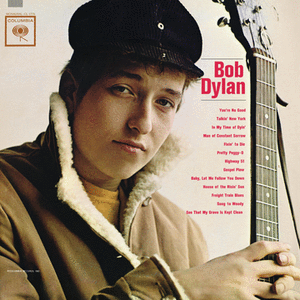
The folk scene's reaction to Bob Dylan's changing work is well-documented, so I won't spend an article recapitulating what is already known.  Instead, I shall try to tackle the question of whether Bob Dylan properly fit into the folk tradition to begin with.  To do so, I shall first identify some relevant traits of folk music, so that we may have a point of comparison.  Then I will look at his first album, titled Bob Dylan, and see whether it bears the qualities of folk music, is indicative of Dylan's lack of fidelity to the tradition, or a combination of both.

Traits of Folk Music
Defining folk music is an endeavour outside the scope of this article, but some relevant characteristics of the folk music tradition should be outlined.  A loose definition of folk music would be "the music of the people", but what is meant by this?  Part of this definition refers to the manner in which the folk song is made and then transmitted though the population.  In the folk tradition, according to Zhou Xizheng, a tune "is created by the masses together and spread in the masses as well" (73).  It would not be unfair, then, to say that the folk song is a community effort, albeit an unconscious one.

At first, it may be difficult to see how the masses may create a work, as opposed to a single artist or even a defined collective.  How exactly does an abstract group, the "masses", create a song?  To illustrate how this can be done, John Tasker Howard, Jr. gives the composition of the ballad as an example: "One villager composes the first stanza, his neighbor adds another, and when the rest of the community has had its share the ballad is a lengthy affair" (452).

This suggests that the folk song is by nature a collaborative process.  Even if one supposes that John wrote and composed a ballad on his own, when he plays and teaches it to his neighbor, Peter may added some new verses or change the order.  And his friends may rewrite the lyrics altogether, keeping only the tune, until only a vague sense of the original concept remains, and the identity of the original author becomes unclear.  What is clear, though, is that the folk song is a living beast, passed down from generation to generation is various forms.

Howard, Jr. suggests that there is another essential aspect of folk music.  Not only is folk music created by the people, but is about the people as well; they express the emotions and describe the condition of the group as a whole.  As he puts it:
We should bear in mind that the songs that come into being at the Negro camp meeting, the songs of the Russian peasant, yes, even the satirical songs of the creoles, are a vital expression of the temper of the people that gave them birth.  Such songs are a part of these peoples' existence, and it is this quality that makes them folk music; they are of the folk. (452)
This trait would suggest that songs which are specifically about the condition of one person should not be considered folk music, as they do not express the condition of the group as a whole.  This contention is overly strict.  What does one make of the love song, for example?  Many are undeniably personal in origin, yet they remain applicable to society at large.  More fair to say is that a folk song must be relatable, that is, the author cannot be the only person for whom it can have meaning.

From this brief discussion, we can derive three core traits of folk music to apply to Dylan's music:
  1. Folk music transmitted on a person-to-person level.
  2. Folk music is flexible: elements may be changed, or even repurposed for other songs.
  3. Folk music aims at describing universal experiences of the group, whether social, political or emotional.
With the groundwork out of the way, let's look at Bob Dylan.

On Bob Dylan

Although he was born in Minnesota, Bob Dylan made his way to New York City, a central folk revival hotspot, in the early 1960s.  After some initial struggles, he signed with Columbia records and began his career as a recording artist.  Bob Dylan's first album, Bob Dylan, was recorded in last 1961 and released in March of the following year.  Virtually no one took notice then, and it remains fairly obscure when considered alongside his subsequent works.  Nevertheless, Bob Dylan is perhaps the Bob Dylan album which is most strongly tied to the folk music tradition.

The most obvious point in favor of this claim is that, despite his renown as a lyricist, Dylan only wrote two songs on the album: "Talkin' New York" and "Song to Woody".  The other ten songs are either traditional folk tunes or covers of songs with known writers.  By putting these songs on a commercially released record, Dylan can engage in both the reinterpretation of the past's culture and the process of spreading knowledge of the people's culture to a wider audience.

However, the question remains, how well does Bob Dylan adhere to the three characteristics of folk music laid out above?  Although not every song on the record observes all three traits, the album as a whole exhibits them all.

Ordinarily, the first trait, person-to-person transmission, would be quite difficult to demonstrate.  Perhaps a diary entry might mention learning a song from someone else, but that is information not ordinarily available.  However, there is one instance on Bob Dylan where the reality of person-to-person transmission is explicitly stated.  Dylan introduces the song "Baby, Let Me Follow You Down" by saying, "I first heard this song from Rick [Eric] von Schmidt.  He lives in Cambridge.  Rick's a blues guitar player.  I met him one day in the green pastures of Harvard University."

With regards to the second trait, flexibility, I would like to highlight two songs: "Song to Woody" and "Highway 51".  "Song to Woody", as its title might suggest, is a tribute to American folk musician Woody Guthrie.  Appropriately, the tune which Dylan uses is often linked a Guthrie composition, "1913 Massacre."  Repurposing the music of his idol for a tribute is logical extension of folk music; it reinterprets the past for the purposes of the present.  You can listen for yourself; you will find that the two tracks are remarkably similar.


The second instance of flexibility is more speculative on my part, but it would suggest that the flexibility in folk music does not imply an attempt to erase the past culture in favor of the present.  One of the covers on Bob Dylan is of Curtis Jones' "Highway 51".  Upon first listening to Bob Dylan's rendition, my first thought was that it sounded similar in both tune and tempo to another Dylan song from 1965: "It's Alright, Ma (I'm Only Bleeding)".  If there is in fact a link between the two, it demonstrates that the folk singer may both straightforwardly and obliquely acknowledge past music.

The third trait, communal relatability, is perhaps the most easily observed aspect of the folk on Bob Dylan.  The most common subject matter on the record is perhaps the sole universal aspect of human existence: death.  Songs such "In My Time of Dyin'", "Fixin' to Die" and "See That My Grave Is Kept Clean" deal with the matter right in there title, and others that aren't specifically about death certainly touch on it.  For example, in "Gospel Plow", Dylan sings, "Mary, Margaret, Luke and John / All them prophets are dead and gone," then subsequently contemplates heaven.

Even the love songs on Bob Dylan, which as I mentioned are somewhat problematic for folk music, are universal enough in presentation that they remain applicable to just about anyone.  The sentiments expressed in "Baby, Let Me Follow You Down" (longing) and "You're No Good" (resentment and hopelessness) are easy to relate to, regardless of whether or not they include specific details about the relationship in question.  They are the sort of songs which can pass amongst a diverse group of people quite easily.

However, Bob Dylan also contains the seeds of his impending split with the folk scene, one which would become evident by 1964 or 1965.  The key lays not with the first or second criteria, but the third one.  The expressly personal lyrics which Dylan would become famous for bubble up on the record, and it was this conflict between the universal and the personal which would ultimately drive Dylan from identifying with the 1960s folk scene.

This is especially evident on the two original compositions of the album, which both describe Dylan's relationship to folk music and hint at an impending split.  "Song to Woody" is the less overt of the two in this regard, as it is a direct tribute to a folk music legend which musically quotes one of the man's well-known composition.  However, compared to the rather general songs of love and death which comprise the vast majority of the album, "Song to Woody" seems oddly specific to Bob Dylan. 

Take the song's second stanza:
Hey, hey, Woody Guthrie, I wrote you song
'Bout a funny old world that's a-coming along
Seems sick and it's hungry; it's tired and it's torn
It looks like it's a-dying and it's hardly been born
On the surface, this seems to keep with the tradition of folk music quite well: acknowledging the past, commenting on the state of human affairs and so forth.  But the fact that Dylan is stating up front that he is the author of the song, taken with the varied detail in the lyrics, suggests that he is taking ownership of the song, which is antithetical to the communal nature of folk music.

"Talkin' New York", on the other hand, displays some repressed contempt for the folk scene which Dylan entered in the early 1960s.  The song is a humorous portrait of the Greenwich Village music crowd, and is particularly biting when Dylan describes first trying to break into the scene in the coffee-houses:
I walked down there and ended up
In one of them coffee-houses on the block
I'd get on the stage, sing and play
Man'd now say, "Come back some other day.
You sound like a hillbilly.
We want folk singers here"
The recording industry associated with the folk scene is similarly skewered.  He mentions being a harmonica player for one studio, where an executive raves about his playing; he loves it "a dollar-a-day's worth."  Even when Dylan gets a deal as a recording artist, the business dealings are called into question:
Now, a very great man once said
That some people rob you with a fountain pen
It don't take too long to find out
Just what he was talking about.
One gets the impression listening to "Talkin' New York" whether Dylan could ever stay in the folk scene for an extended period of time.  Even if one takes the song as tongue-in-cheek, there at least appears to be an undertone of resentment in the lyrics.

Even though he would release two more albums which fit fairly comfortably in the folk tradition (1963's The Freewheelin' Bob Dylan and 1964's The Times They Are a-Changin'), by the end of 1964 he had seemingly left the movement for good.  Even though Another Side of Bob Dylan maintain the sparse instrumentation of his earlier work, the subject matter was purely that of Bob Dylan's concern. and "My Back Pages" is often read as a repudiation of his previous time in the folk scene.

Rather than a sudden shift, then, a reading of Bob Dylan raises the possibility that the great American folk-singer's transition to the more personal, more rock-oriented work he produced in the mid-1960s was in some sense inevitable.  This is not to say that the folk tradition ceased to influence his work.  Far from it; after all, the previously mentioned "It's Alright, Ma (I'm Only Bleeding)" comes from 1965's Bringing It All Back Home.  However, Dylan impurity as a folk musician was present right from the start.

Works Cited
 
Dylan, Bob. Bob Dylan. Columbia, 1962. MP3 file.

Gollan, Antoni E. "The Evolution of Bob Dylan." National Review 28 June 1966: 638-
     640. The National Review Archive. Web. 22 July 2012.

Howard, Jr., John Tasker. "On Folk Music." Art & Life 11.8 (1920): 451-3. JSTOR.
     Web. 23 July 2012.

Xizheng, Zhou. "Probe into the Debate on the Position of 'New Folk Song'." Cross-
     Cultural Communication 8.2 (2012): 73. Academic OneFile. Web. 23 July 2012.

Wednesday, December 12, 2012

"It's Christmas All Over Again": On the Myriad Renditions of Christmas Songs

We once again find ourselves in the middle of December, and in the United States, that can only mean one thing: a never ending barrage of Christmas music.  Set one foot out in public all month and you are liable to get hit with a tactical campaign of Nat King Cole, Bing Crosby and children's choirs.  If my own family is representative of the population, then I can safely say that the annual influx of hymns, chestnuts and novelty records is cherished tradition, something to look forward to the moment that the weather precludes going down the shore.

You know who else loves Christmas music?  The music industry.  In the oft-talked about era of declining record sales, Christmas music remains a fairly reliable source of revenue.  Bing Crosby's rendition of "White Christmas" has been the best selling single of all time for over five decades, and the lucrative nature of holiday tunes continues on.  The individual songs may not be rocketing up the Billboard charts, but the albums are consistently push units.  Case in point: Josh Groban's Noël became the best-selling album of 2007, despite being out for less than three months at the time.

Looking over the Billboard 200 for the week of December 8, 2012, seven of the top 40 selling albums were Christmas records, ranging from Rod Stewart's Merry Christmas, Baby (#6) to Trans-Siberian Orchestra's Dreams of Fireflies (On a Christmas Night) (#37).  Taking the entire chart into account, nearly 1/4 of the best-selling albums that week were Christmas albums.  And keep in mind, that "December 8" is the issue date, corresponding to the tracking period of November 19-25.  We'd just barely entered Christmas season by this point.

Yet the success of Christmas records has always kind of baffled me.  It's not that I don't get why people listen to Christmas music; that's not a particularly shocking phenomenon.  No, what I want to know is why people keep purchasing Christmas music.

There are three reasons for my confusion.  First off all, in relation to the calendar, Christmas music has a short shelf-life; even with the holiday season bleeding out of December, at most we're talking a ten-week period of relevancy.  No one is going to be spinning "Rockin' Around the Christmas Tree" in April without irony.  Secondly, during this brief period of relevancy, it's not as if Christmas music is difficult to come by.  Even if (or especially if) you're from a rural town like I am, you can probably find a radio station that switched to an all-Christmas format around Thanksgiving.

But I can come up with counterpoints to those arguments.  For one thing, even though non-seasonal albums can be enjoyed year-round, who actually listens to any given record that often?  It sort of makes sense to buy a Christmas record and let it gather dust in-between plays.  And while it probably makes more economic sense to just tune in to the local Clear Channel station, to do so makes it impossible to listen to whatever carol it is you want on demand.  Especially in the Internet era of instnat gratification, a personally-owned record seems like a good investment.

Here's the thing (and my third point), though: holiday music is a pretty static genre; it's not as if there is a steady stream of holiday classics coming out.  When we think "Christmas music", we're thinking the standards that have been put on record countless times by countless artists.  There's very little variety in terms of content, just in presentation.  It's this reason that trips me up.  There should be no rush to get new Christmas music because, when you get right down to it, there are only so many ways one can record "Jingle Bells", right?

Well, all this thinking got me thinking: why don't I put that notion to the test?  For this post, I decided to listen to a whole bunch of Christmas albums, from the mega-sellers to the obscurities, and see whether or not I can find some reason, some clue, as to why these things keep selling after all these years.  Maybe the end product is a cynical cash-in used to fill contractual obligations, but it could well be the case that such-and-such's performance of a holiday favorite does justify an album purchase.  Grab a carton of eggnog and stoke up the fire, because here we go!

Exhibit A: Barenaked for the Holidays - Barenaked Ladies (2004)


Well, we might as well start with a bit of the old hypocrisy, because I listen to this record every December (and because I need to start this piece somewhere).  Tie it in with the impulse to experience Christmas music on one's own terms, I suppose.  I absolutely love Barenaked Ladies, but they're not the sort of act that screams, "Christmas album!"  Even at 12 years-old, I doubt that I was clamoring for BNL to hit the studio and record their variation on "Jingle Bells", complete with the "Batman smells" lyrics thrown in for good measure.

Yet, it kind of works.  I know, I've got my own biases, but the arrangements the band gives the material keeps it fresh.  Okay, sometimes the results don't sound remotely Christmas-y ("I Saw Three Ships"), but more often than not, they evoke the proper spirit.  The vibraphone driven "Carol of the Bells" sounds like an impending ice storm, while "God Rest Ye Merry Gentlemen / We Three Kings" captures the feeling of company surrounding a roaring fire on a cold winter's night, aided by Sarah McLachlan's airy vocals.

Further, I've always respected the high proportion of original tracks, and while some are dead-weight (the dour "Snowman" or the overly-goofy "Christmas Pics"), on the whole they give the album the band's signature humorous touch.  "Elf's Lament" always sticks out in my mind; I just love the image of Santa's elves trying to organize a strike, working through a dead end job "making crappy little gizmos".  And, for the longest time, I did not realize that Michael Bublé was a featured vocalist on it.  Speaking of which...

Exhibit B: Christmas - Michael Bublé (2011)


Staying in Canada but transitioning from goofy to classy, we move on to the living anachronism, Michael Bublé.  A Michael Bublé Christmas LP is such a no-brainer as a concept that I'm still shocked it took so long for one to materialize.  As the one of the few performers in the Frank Sinatra/Tony Bennett tradition of vocal jazz with mainstream recognition, a Christmas album was an inevitability, and a lucrative one at that.  Only Adele's 21 moved more units in 2011 than Christmas (though it was by quite a wide margin).

Bublé's set only shares one song with Barenaked for the Holidays, which would be the ubiquitous "Jingle Bells".  Yet I find they share a sense of humor, though Bublé's is far less overt.  Well, okay, there's his rendition of "Santa Baby", which is hilarious by nature, but mostly I find the humor derives from the vocal deliver.  It may just be me, but it sounds like Bublé is trying to stifle a laugh on the upbeat tracks.  Here's clearly having a good time.  And I am perfectly cool with that, since what is Christmas time if not a good time?

Further, the arrangements on Christmas are quite varied in tone.  Some choices are obvious, such as the requisite reverence paid to "Silent Night", but others genuinely surprised me, especially the melancholic take on "All I Want for Christmas Is You".  Oddly, though I normally love big, hot brassy arrangements, songs which feature prominent horn sections, notably "Santa Claus Is Coming to Town" and "Blue Christmas", don't quite work for me; I guess that particular sound doesn't quite fit the Christmas mood.  But at least there's effort in that.

Overall, Bublé's interpretations are rather traditional, but that 1950s sound is a solid one for the occasion.  It's as if Bublé was made to sing Christmas carols.

Exhibit C: Christmas in the Heart - Bob Dylan (2009)


Bob Dylan, on the other hand, was not made to sing Christmas carols.  Now, don't get me wrong: I adore Dylan voice.  No, really.  I've long felt that his loud, nasal singing voice was an asset rather than a liability.  Even as it's disintegrated over the decades, it remains a powerful vehicle for his lyrics.  But gravel and sandpaper are not the sounds one associates with Christmas songs.  On top of that, a large portion of Dylan's work consists of songs which may be summarized as, "You suck!"  Really, he is just about the last person I'd expect to hear singing of peace on earth and good will towards men.

Yet, when I thought about it: of course Bob Dylan would record a Christmas album.  After all, he made his name in the folk revival scene of the early 1960s, and has built a career of recording and appropriating folk music ever since.  The vast majority of Christmas songs we hear are passed down and recast through the various cultural institutions to the point that the originators are historical footnotes.  In other words, Christmas carols may be considered a (very lucrative) subset of modern folk music.  Why wouldn't America's leading folk artist get involved?

One thing that sticks out about Christmas in the Heart compared to the Bublé and BNL efforts is the higher proportion of religious songs.  And it's on these tracks where the concept of a Dylan Christmas album really shines.  Yes, he sounds absolutely wretched on the ballads such as "Hark! The Herald Angels Sing", but I truly believe his inarticulate growl provides for a fresh interpretation of the time-honored tunes.  Rather than the soft, angelic, hopeful renditions I'm used to hearing, Dylan casts himself as man long in the darkness which Christ's birth was to illuminate, particularly on "Do You Hear What I Hear?"

And on a side note: the video for "Must Be Santa" is just hilarious.  I mean, just look at that wig.


Exhibit D: Elivs' Christmas Album - Elvis Presley (1957)


Moving from one American icon to another: the King.  All these decades later, Elvis still holds a prominent position in popular culture.  From the glamour of the Vegas years to the indelible vocal stylings, every element of the Elvis persona permeates the cultural landscape.  The man left his mark not only on the then-emerging genre of rock music, but also gospel, country and blues as well.  So it should come as no surprise to learn that, according to the Recording Industry Association of America, his first Christmas album is the best-selling holiday record of all time.

Elvis' Christmas Album is a split LP: the first side consists of secular Christmas tunes, the second side religious ones.  The two are a study in contrast.  On side one, Elvis' delivery is just dripping with sexuality.  This is, of course, best demonstrated on the definitive take on "Blue Christmas", but it blankets the entire first half.  There is just something righteous about the energy of "Santa Claus in Back in Town", in which the vocals combine with the classic blues lyric pattern to create an irresistible treat.  Even if the thought of Santa Claus is not at all sexy.

The gospel tracks of side two, however, suffer as a result.  The style is not my thing to begin with, but after hearing a similar vocal delivery on the love-laden tracks of side one, I become incapable of hearing it in a nonsexual context.  I realize that Elvis is going for a reverential tone here, and had I listened to say, "Silent Night" or "I Believe" first, I could probably appreciate the whole record.  Alas, given the image of Elvis which has been built in the collective memory over the years, I can't imagine that the sincere religious tunes would hold up very well.  Curse you, sexy Elvis!

Exhibit E: Miracles: The Holiday Album - Kenny G (1994)


Elvis' Christmas Album may be the best selling holiday collection as per the RIAA, but the top spot in the Nielsen SoundScan era (1991-present) goes to Kenny G.  I've always found it rather amusing that an artist as mellow as Kenny G is among the most loathed musicians, period.  Granted, under normal circumstances I would never consciously choose to put on smooth jazz--and I was hoping against reason that I would find a previously unreleased Bill Evans Christmas album--but, really, it's all harmless elevator music.  Boring as all hell, by harmless.

In fact, if there is one context where I can appreciate Kenny G's brand of musak, it's probably Christmas.  The whole mood of Miracles: The Holiday Album is burnt out.  I can just imagine walking into the living room after shoveling the driveway on a late December night, then plopping down in an easy chair beside the fire and falling asleep to Kenny G's warbling sax on "Winter Wonderland".  (And then Norman Rockwell could step in and paint a portrait for the Saturday Evening Post).

Yes, it's all wonderful background music.  And it fades into the background incredibly, blessedly quickly.  Perhaps too well, actually: the whole record comes off as a nonentity.  Still, if you need something to make your eyelids heavy on a cold winter's eve, it's hard to beat Kenny G.  The other 364 days of the year, though, just give me that John Coltrane.

Exhibit F: A Charlie Brown Christmas - Vince Guaraldi (1965)


Actually, let's stick with jazz for a bit.  I take it that all of you--at least you in America, I don't know about elsewhere--know and love A Charlie Brown Christmas.  The sad-sack protagonist, the aluminum trees, Linus' recitation from Luke: so much of this little special has become forever lodged in our collective Christmas consciousness.  Yet perhaps no element of the special has had as great an impact as the score.  Case in point: when I went on to Rhapsody to put on the album, I saw that Vince Guaraldi was listed among the 10 most played artists at the time.  I can think of no other reason why that would be the case.

It's not just nostalgia filters which makes A Charlie Brown Christmas such as delight.  It's just all around great music.  I especially dig the bass solo featured on "O Tannenbaum"; it's the same sort of experience I get listening to Sunday at the Village Vanguard, which is a quite a feat.  And maybe it's because the special is so engrained in my memory, but the drastic tonal shifts make perfect sense.  Of course "Linus and Lucy" gives way to two different versions of the downbeat "Christmastime Is Here".  It's a collection that gets the highest highs and lowest lows of late December.

Of everything here, A Charlie Brown Christmas is the least directly tied to Christmas traditions.  Many pieces are Guaraldi originals, and they don't have the immediate warmth that the chestnuts that Kenny G offers have.  Yet I feel the performances do tie in nicely with the more meditative outings from Bublé, Dylan and Presley.  But instead of communing with the religious or romantic aspects of Christmas, Guaraldi occasionally delves into straight depression--which is just perfect for a Peanuts special, now that I think on it.

Exhibit F: The Beach Boys' Christmas Album - The Beach Boys (1964)


And now for something completely different.  I've never been much of a Beach Boys fan; that surf-y, beach music sound holds very little appeal for me.  Still, there's a certain charm to hearing "Little Saint Nick" every year in December: short and sweet and not in the least bit Christmas-y.  That "Little Saint Nick" steadfastly remains in holiday rotation is another surprise.  How is it that a group called "the Beach Boys" recorded such a winter-time classic?  The name alone should disqualify them, let alone the sound of the track.

Yes, yes, this is a very Northern perspective on Christmas, but there are some styles which just clash with my conception of Christmas.  The sunshiny music of the Beach Boys is definitely one of them.  This is less a problem with the traditional numbers than with the original compositions.  The combination of happy vocal harmonies surf-rock guitar and goofy lyics simply don't mesh with Santa songs.  Not that I can't imagine it working.  Perhaps if they wrote about Christmas in the surf culture, there'd be a place for it.

The traditional tunea and covers are a bit more interesting, in that they seem to be experiments I'm not quite getting.  Between the overblown strings and rather low vocals, "We Three Kings of Orient Are" sounds more morose than I'd expect, while the flute work on "Blue Christmas" gives the recording an underlying happiness.  Neither is a choice that I really agree with, but it at least demonstrates that these well-worn tunes are rather robust.  It doesn't take a drastic move to put a new spin on them, even if that spin doesn't make a whole lot of sense.

Conclusion:

I think seven albums are more than enough to make some tentative conclusions:

1) Is Christmas music a stagnant genre?

Yes and no.  It's stagnant in the sense that, in my investigations, a similar set of songs were present on most of the albums, while none of the original songs got rerecorded by another act.  Granted, seven records representing less than five hours of music is an extremely small data set, but I feel that patterns emerge rather quickly here.

On the other hand, if we treat Christmas music as a sort of folk tradition, then the reuse of chestnuts is not a problem.  In fact, the fresh interpretations I heard throughout were more than enough justification for me to say that it's alive.  Folk music is all about reinterpreting and recontextualizing the past, and it's a area where Christmas music can succeed.

2) Is there a reason to purchase Christmas music?

Even after all these albums have been spun and given me varying degrees of joy, I still say no.  Most of the marquee tracks from each record were singles, which makes them easy to access on the radio.  Even if that were not the case, the presence of the Internet makes laying down however-much-a-CD-goes-for seem like an odd decision.  Even in the case of A Charlie Brown Christmas, by far my favorite, I wouldn't think it vital to have a physical copy for the experience.

3) Why do people keep purchasing Christmas music anyway?

Here, I admit I don't know.  For all I know, a new Christmas album might be a salvage gift.  Don't know what to get someone for Christmas?  Then pick Christmas music!  I kid, but for all I know that could be true.  But, as I said, I don't know.  Maybe my readers do--that's right, all two of you.  If you have any ideas, let me know.

Until next time, Happy Holidays from Cinema Saturdays!

Oh, and one more:

Wednesday, September 5, 2012

GoldDigger: Fitz and The Tantrums and the Parasitic Archetype

Fitz and The Tantrums, an indie-soul band signed to Dangerbird Records, released their debut full length album, entitled Pickin' Up the Pieces, back in 2010.  I first heard them in late January 2011, and after giving the LP a couple of spins, I grew to be a fan.  And I still am one; a year later and I'm still pumping my fist whenever I hear one of their songs come through my speakers.  Yet there's a certain element to their work that is more than a little disconcerting.

Of the ten songs on the album, nine are about relationships, and most of those songs detail breakups (which is not that surprising, considering their first EP was called Songs for a Break Up, Vol. 1).  I certainly have no problem with the kiss-off tune, but when telling an ex-lover to leave, one does run the risk of resorting to problematic or offensive gender stereotypes.  For most of the tunes, the band avoids this problem.  Two songs, however, see the group slip into that troubling mode.

What I find a bit curious is that in both of these instances, Fitz and The Tantrums use the same gender stereotype: the gold-digger.  According to Orrin E. Klapp, in cultural works the gold-digger belongs to a category of villain characters he terms "chiselers or parasites".  Members of the class of villains are characterized by "exploitation of an unfair advantage in an underhanded way by a person whose relationship to society is essentially parasitic" (339).  In the case of the gold-digger, the character gets into a relationship in order to get at the partner's money.

This character type appears in popular culture with a great deal of frequency, especially in the world of music.  Prominent examples include Eartha Kitt's "Santa Baby", Kanye West's "Gold Digger" and, most recently, Cee Lo Green's "Fuck You!"  The gold-digger is almost always a female character, although there are a handful of male examples (Morris Townsend in Henry James' Washington Square, for one).  It is true, however, that this tends to be a female-exclusive character, which has the effect of reinforcing the notion that women are shallow and materialistic.

I shall discuss the two offending songs in the order they appear on the album.  The first track, then, telegraphs the use of the gold-digger character in the title: "MoneyGrabber".

"MoneyGrabber", the lead single to Pickin' Up the Pieces, is easily the best known song from Fitz and The Tantrums; it's also a song that's a little hard for me to critique, because I really like the song.  In fact, "MoneyGrabber" may be my favorite song from 2010.  A killer opening piano riff and an impassioned lead vocal performance will do wonders, I suppose.  Yet the song remains problematic--I mean, the gold-digger character is embedded in every fiber of the song.

It's possible that part of the reason that "MoneyGrabber" didn't really bother me until I actually began to think about it is that the verses seem to be aimed at one particular person.  In that respect it appears to take the form of the personal put-down song, a type of song to which I admit being a fan of.  Michael Fitzpatrick seems legitimately angry at the title character: she was "talkin' double" with her "hands in the pocket".  The lyrics are terse, but they do give the impression that the speaker had been taken advantage of.

However, the verses do contain some troubling lines.  Two examples stick out.  In last line of the second verse, the speaker goes beyond the gold-digger stance and combines it with accusations regarding her sexual nature: "I don't pay twice for the price of a cheap-time whore".  This is not merely an off the cuff insult; the speaker implies that at the end of the relationship, the title character was good solely for (dirty) sexual uses.  This takes the song off focus and suggests that he has more problems with this particular woman.

A line in the first verse, however, I find more disturbing.  According to the speaker, the "MoneyGrabber" was "always made to want it all".  In stating that her gold-digging ways extend into the past, the speaker presents the possibility that being a materialistic woman out to take a poor sap's money--or more generally, being greedy--is somehow a part of her genetic makeup.  Is one supposed to infer that she was born to be a gold-digger?  So much for free will there.

For the most part, though, "MoneyGrabber" keeps its focus on one subject.  The only time that the song makes any generalizations comes in the first lines of the chorus: "Don't come back anytime/I've already had your kind".  It is a nasty generalization, and the whole "you and your kind" business is never inoffensive, but it's not entirely ridiculous.  After all, humanity in general tends to get greedy.  This doesn't forgive its transgressions, but it keeps the song from going too far.

But, yeah, I still dig the song, a lot.  Maybe I'm just able to do the mental gymnastics and see Fitzpatrick as being deep in character.  He's just initiated a bitter break up, and now they're in a heated argument by the front door.  He's sure angry, perhaps justifiably, but in the heat of passion he says a lot of things he may come to regret not too long later.  It's possible, I'll admit, but now I'm engaging too much in apologetics.

Actually, I may just be trying to reconcile the fact that I love "MoneyGrabber" despite its use of the gold-digger stereotype, yet I hate "Rich Girls" precisely for the sexist lyrics.


Well, okay, it's not entirely because of the lyrics that the song bothers me.  The tune doesn't gel with the rest of the album's musicality and it lacks the musical punch that songs such as "Pickin' Up the Pieces", "MoneyGrabber" or "Don't Gotta Work It Out" possess.  In fact, had they replaced this song with "Darkest Street" or "We Don't Need Love Songs" from their EP, it would have greatly improved the record, though some track reordering may have been called for.

But that's not why I'm talking about "Rich Girls".  No, that'd be the lyrics.  Whereas "MoneyGrabber" largely refrained from generalizations, the chorus of "Rich Girls" revels in them:
Don't matter what you do
'Cause the rich girls will break your heart
The poor girls will take your money
I confess and I repent
For the things I've done; this soul is spent
From this chorus alone, one can see a disquieting viewpoint emerge.  Because what one does is irrelevant, one can infer an either-or proposition: Either you take the haughty rich girls, or the lower-class girls looking for cash.  That's quite the narrow view of women, isn't it?  Even if the last two lines of the chorus suggest that the speaker may be to blame in some way, from the rest of the song, I can only conclude that he's "repenting" for bothering with women at all.  Even I can't take that broad bitterness.

I shall skip over the first verse, the one that deals with rich girl Susie, not because it's uninteresting or unproblematic but because it doesn't involve the gold-digger character; Susie just won't give the speaker the time of day.  The second verse, about poor girl Shawnee, is where the stereotype comes into play:
Shawnee came from a broken home
Her mama's sick and her daddy's long gone
Got a job but it don't pay no bread
Lookin' for a man who's well-fed.
At first, Shawnee appears to be a sympathetic character: a tough life growing up, an ailing mother she may be caring for, and working a job which pays little to nothing.  In fact, had I fallen asleep during the chorus, I might have thought that "Rich Girls" was actually a song condemning wealthy women who have it made in favor of the struggling working class women.  I could certainly see the appeal to that kind of song.  Who doesn't love a good takedown of the snooty one-percent crowd?

Granted, that still would involve writing stereotyped characters, which is, yes, still an issue, but in that case it wouldn't include the gold-digger character and I wouldn't be a writing a blog post on it.  Instead, that fourth line starts the turn.  I mean, I would imagine that someone in that situation would not object to finding a partner who happens to have money, but is that Shawnee's number one criterion?  Well, let's look at the other half the verse:
She got the low-rent, underground padlocked studio
Blues and a bus fare to take her to school
She sure needs a steady man
Always got a perfect plan
For you to pay up for playing the fool
It's at this point where the gold-digger character shines through.  The speaker asserts that Shawnee consciously seeks out someone with cash and is more than willing to leave him a sucker.  On top of that, that Shawnee "needs" a man with dough suggests that the only way for the poor girls to get money is to start panning in the river.  Combining the gold-digger with the notion that women really do need men, that, that's quite the feat.

Furthermore, what in Shawnee's character would indicate that she would take advantage of people in that way?  What on earth has she done besides be poor?  I don't know if she's a good person or not from the song, but should I just assume she's a bad apple?  Am I supposed believe that non-wealthy women are just naturally gold-diggers?  At least in "MoneyGrabber", the song made it sound like the woman was in fact evil.  What in "Rich Girls" suggests the same for the poor girls?

When all is said and done, the speaker in "Rich Girls" comes off as an immature teenager who, after some failed relationships, comes to the conclusion that all women must be arrogant or greedy materialists.  There's a jaded edge to the subject matter, which is odd, since I think the performance is kind of jokey.  If that's what they were going for, then I think it makes the song even worse.  If it were sincere, I could still write it off as roleplay (thought it would be more difficult).  But the tone makes it more like a "sandwich" or "women's rights" joke.

I don't want to give the impression that these two songs are representative of the band.  Taken as a whole, the oeuvre of Fitz and The Tantrums seems to be about the spectrum of heartbreak, from rage ("News 4 U") to regret ("Tighter") to a bit off both ("Breakin' the Chains of Love").  On top of that, other than "Rich Girls", every song they've put out sounds fantastic.  Yet the use of the gold-digger stereotype is fairly prominent in their body of work, and may turn listeners off to some great new music.

I'm still a fan; there are just some lyrical issues that must be discussed.  With any luck, their next album will rectify them.

Works cited:
Fitz and The Tantrums. Pickin' Up the Pieces. Dangerbird, 2010. CD.

Klapp, Orrin E. "American Villain Types." American Sociological Review 21.3 (1956):
     337-40. JSTOR. Web. 21 June 2012.