Saturday, April 13, 2013

Finian's Rainbow (1968)

Finian’s Rainbow (1968)
Directed by Francis Ford Coppola
Screenplay and book by E. Y. Harburg and Fred Saidy, based on the stage play by the same
Runtime: 2 hr, 25 min
I may not be any sort of expert on film or film history, but I absolutely love writing about and reviewing classic cinema.  And I have loved maintaining this blog in order to do it.  The process writing up these reviews has exposed me to films that I would otherwise probably ignore, and by several strokes of luck, the vast majority of movies have been a treat to view.  Occasionally, however, one must watch a catastrophe, and few movies I’ve ever seen are quite as catastrophic as today’s film, Finian’s Rainbow.
Set in Rainbow Valley, which is two miles from Fort Knox, Finian’s Rainbow finds Fred Astaire as Finian, an Irishman who has taken a crock of gold from a leprechaun named Og (Tommy Steele) and traveled to America with his daughter Sharon (Petula Clark) to make his money multiply—long story.  Meanwhile, there’s a rancorous senator (Keenan Wynn) who wants the town property for his own corrupt uses, but the residents of Rainbow Valley, led by a fellow named Woody (Don Francks), are none too happy about that.
Finian’s Rainbow, buried somewhere deep in the proceedings, has the makings of a good movie—political corruption and hatred, mysticism and money-making schemes.  It’s got all of that, and that’s the problem.  Watching the film try to juggle all these plotlines and elements is like watching me try to juggle anything—it all falls down very, very quickly.  Despite nearly two-and-a-half hours of screen time, Finian’s Rainbow fails to adequately develop any of its subplots, let alone integrate them into a coherent story.
The clearest example of this problem comes in the romance between Sharon and Woody.  When Sharon and Woody first arrive in town, they clearly demonstrate some possible chemistry.  Yet at their very next interaction, they share a musical number and fall in love.  I get that it’s a light-hearted affair, but can we at least get them some more dialogue before they get to that point in their arc?  This event occurs about a third of the way through the film—which leaves a good hour-and-a-half of their relationship going absolutely nowhere.
Normally, a weak storyline (or several) can be salvaged by some good performances.  Sadly, Finian’s Rainbow is in short supply of those.  I will say that Petula Clark has a fine sing voice and brings energy to her character, but the rest of the cast is dire.  Fred Astaire, no doubt a result of his age, appears lethargic as Finian, and Francks’ Woody is as stiff as board; there’s no way he’s in love.  But the worst is by far Tommy Steele, who is overacting in all the wrong ways and performs as if restraint is a foreign concept.  I hated him from thirty seconds in, and not one second passed where I didn’t wish for him to drown.
Still, I can see why Steele, a teen idol in Britain, would be cast in a musical—he certainly can sing.  But given the voices of Steele and Clark and the moves of Astaire, I’m a bit perplexed how shaky the musical elements of the film are.  Most of the songs are flat or cloying and fail to advance the plot or characters; only the melody of “This Time of the Year” sticks out.  Even worse is the choreography, which is confused as all hell.  The dances aren’t engaging and the staging is hacked to bits by poorly placed cuts.  Apparently dance gives you the power of teleportation.
Yet what gets my goat the most—more than the acting, the plotting, or the music—is the fact that Finian’s Rainbow has a message.  Not that it’s a bad message; “Don’t be a bigot,” while obvious today, would be a worthwhile one for the film’s setting.  The problem is that it’s this movie that’s delivering it.  The amount of disconnect between the painful slapstick from the god-forsaken leprechaun and the sudden turns to anti-racism from Sharon is staggering.  Even for light entertainment, Finian’s Rainbow does not earn the right to preach to its audience.
Okay, I will give the film one thing: it look beautiful.  Even though the amount of green in the movie sets gives the impression that Finian and Sharon never left Ireland, the textures and cinematography are lovely.  There’s a certain surreal appearance to the grass, especially where Finian buries the crock of gold.  This does an excellent job of accentuating the mystical qualities of the film’s story and characters.  It also leads to the obvious joke that, yes, I would rather watch the grass growing than what was portrayed on screen.
Finian’s Rainbow fails in some many ways that laying the blame on anyone person would be inadequate.  Is it Coppola’s fault for not getting how a musical is staged?  Do we blame Tommy Steele for making a bad set of performances intolerable?  Or could it be that the screenwriters clearly needed to give the script a good once-over before handing it in?  Yes, yes, and yes, and yes to several more possibilities.  Ultimately, Finian’s Rainbow serves as a great guide to filmmaking.  See what they did here?  Yeah, don’t do that.

Saturday, April 6, 2013

Eight Men Out (1988)

Eight Men Out (1988)
Directed by John Sayles
Screenplay by John Sayles, based on the book by Eliot Asinof
Runtime: 1 hr, 59 min
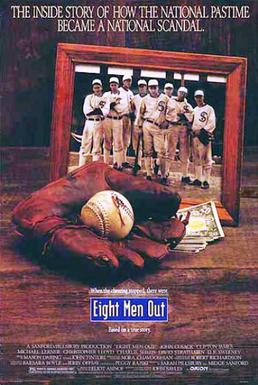
Baseball has had a long history of, shall we say, less than ethical behavior.  From Ty Cobb sharpening his spikes to take out fielders, to allegations that Gaylord Perry threw spitballs, all the way to the still-current steroid era, the national pastime has had scandal galore and then some.  But one incident in particular stands out, and that of course would be the Black Sox scandal, in which in several players on the Chicago White Sox threw the 1919 World Series as part of gambling scandal.  It is this dark episode of baseball lore which John Sayles chronicles in Eight Men Out.
The eight men in the title refer to the ballplayers who were implicated in the scandal.  The most famous is “Shoeless” Joe Jackson (D. B. Sweeney), but he’s largely in the background.  In terms of the players, Sayles chooses to focus on the lesser known figures: first baseman and ringleader Chick Gandil (Michael Rooker), conflicted ace pitcher Eddie Cicotte (David Strathairn), and, especially, third baseman Buck Weaver (John Cusack), whose involvement in the scandal has been, as with Jackson’s, hotly contested.
The strength of Sayles’ film partially lies in how he portrays the chemistry, or lack thereof, within the White Sox organization.  Forget feelings on throwing the series; the opening sequence, depicting the last game of the regular season, shows the players ragging and sniping at each other regarding place of birth and education level.  Perhaps more importantly, the scene highlights the players’ incentive to throw the series, when owner Charles Comiskey (Clifton James) gives his team flat champagne in lieu of an actual bonus for winning the pennant.
Had the film kept the action squarely on the players, the story told would be both crystal clear and compelling on the character level.  Unfortunately, too broad a net is cast; every angle of the Black Sox scandal is covered.  The gamblers who initiate the scandal; the circle of Arnold Rothstein (Michael Lerner), who provided the money; the journalists who suspect something is up; the families of the players—they all get screen time.  But there simply isn’t enough screen time to adequately cover everything involved in the conspiracy.
In fact, the movie juggles so many story elements that there is scant time to register who’s who in the scandal.  Few of the characters who are not on the White Sox are given substantive introductions, and unless one is intimately familiar with the history of the 1919 World Series, I can’t imagine how one could follow this story without significant mental effort.  One of my rules for filmmaking is that the audience should always be able to determine what is literally happening on screen, but Eight Men Out has too broad a scope to follow that rule.
The performances in the movie are significantly better than the structure, though the best turns tend to be in supporting roles.  Christopher Lloyd keeps a comic undertone as gambling man Bill Burns, and Charlie Sheen is perfectly cast as the not-entirely-there centerfielder Happy Felsch.  My personal favorites, however, are Strathairn, who appears the most torn up about the scandal, and Gordon Clapp as beleaguered catcher Ray Schalk, constantly fuming that his pitchers are crossing him up and not throwing breaking balls.
Besides the acting, what Eight Men Out does best is capture the game on the field and in the stands.  While the real story of the Black Sox scandal involves backrooms and disreputable gamblers, this ultimately is a baseball film.  From Cicotte hitting the first batter of the series to Jackson’s home run during garbage time in game eight, Sayles puts a gradually changing atmosphere into each at-bat.  The crowd in Cincinnati is on its feet from the get go, but by the time the last game is played in Chicago, both the suspected fix and the inevitability of defeat weigh heavily on the fans.
As a matter of fact, the film captures the emotions in the park so well that it may have been a more effective movie if the fix were gradually revealed through the actions of the players and the reactions of the fans and journalists.  It would have kept the character count down, added a sense of mystery and dread to the proceedings, and allowed for some more complex character developments.  Sure, anyone with a cursory knowledge of baseball history would know that the series was fixed, but the question of how it’s exposed would still remain.
Alas, that not the movie that John Sayles made.  I find it difficult to fault a director for ambition, and covering every aspect of a story certainly would qualify as an ambitious endeavor.  But to accomplish such a feat, one must lay the foundations properly, and that’s ultimately what sinks the film.  Not enough background and too little individual character development prevent Eight Men Out from being a home run.  Maybe it’s a single that just gets past the shortstop.  In other words, it’s just a routine, unspectacular baseball flick.

Saturday, March 30, 2013

The Circus (1928)

The Circus (1928)
Written and directed by Charlie Chaplin
Runtime: 1 hr, 11 min
As goes my motto, “I need to watch more silent movies.”  I find unacceptable that I didn’t see a silent picture until the summer before my senior year of high school (Speedy).  I find it unacceptable that I’ve only seen Buster Keaton in a cameo role in Around the World in 80 Days.  I could go on, but the question always on my mind regarding the subject is, “Why haven’t I viewed more Chaplin movies?”  After all, I’ve seen two and liked both; what am I waiting for?  Well, here’s to addressing that issue, and here’s a review of The Circus.
Chaplin, who wrote, directed, produced and later composed the score for the movie, stars as the Tramp.  After a run-in with the authorities rife with laugh-out-loud pratfalls, the Tramp winds up at a circus, which is struggling to get the audience to laugh.  Chaplin’s efforts to evade the cops, however, bring down the house, and the ring master (Allan Garcia) offers him a job.  The Tramp accepts and soon falls in love with Merna (Merna Kennedy), the ring master’s mistreated step-daughter.  Being a Chaplin film, hilarity ensues.
And hilarity does indeed ensue, but there’s a twist to this story.  See, the Tramp is only an accidental comedic genius.  When the ring master has him audition with the clowns, he has no idea what he’s doing.  Therefore, the Tramp must be put into situations where he must improvise his survival.  There’s a bit of dissonance at work—the audience is supposed to believe that Charlie Chaplin isn’t a natural funnyman.  Yet Chaplin pulls it off, largely because his failure to be funny is itself hilarious: never give clueless actors shaving cream, am I right?
Furthermore, the times where the Tramp is funny on accident are uproarious.  My personal favorite sequence occurs early in the film, where the Tramp is hiding from the cops in a funhouse.  Caught outside, he pantomimes being one the robotic figurine on the funhouse with such precision and timing—with punctuation from the score—that the feat alone is a riot.  He’s forced to work on the spot, which in some ways mirrors Chaplin’s method of filmmaking, where improvising from a vague premise was a frequent tool.
This contrasts nicely with the atmosphere of the circus, which is tightly managed and authoritarian.  It’s telling that before the Tramp arrives, the circus performance scenes are shot largely from backstage, highlighting the artificial nature of the material.  It is only when the Tramp barges in and inadvertently shines a light on the machinery (such as accidently activating the magician’s apparatus) that the audience begins to laugh.  In fact, by making the Tramp an unconscious comedian, Chaplin may be arguing for an unscripted form of comedy.
Arguments about the nature of comedy aside, The Circus can also be enjoyed as a fairly straightforward love story with a slew of zany hijinks thrown in for good measure.  Despite some early brusqueness towards her, the Tramp quickly takes a shine to Merna and stands up to her abusive stepfather.  However, when Rex (Harry Crocker), a new tightrope act, arrives at the circus, Merna is immediately drawn to him.  The Tramp doesn’t take to kindly to this; he wishes for Rex to take a spill on the tightrope while he and Merna watch the show.
This incident indicates that the Tramp is not a flawless figure and Chaplin’s reactions as he watches Rex go a long way to humanizing his character.  Sure, I love how the way the Tramp eludes the authorities casts the powers that be as incompetent and wrongheaded, but at the same time it’s good to see the scrappy everyman with legitimate faults.  In the end, though, one can count on the Tramp to do the right thing, get well away from the police’s path, and make the audience fall from their seats in mirth.
Chaplin’s so good in this role that the rest of cast suffers by comparison.  Garcia plays the typical mustachioed villain, Kennedy is charming but a little bland as the stepdaughter, and while Crocker has his moments, he doesn’t get enough time on screen to flesh out a fully formed character.  That they don’t turn in great performances does drag down the more pathos driven sequences of the film, but I realize that to do more justice to these roles would mean diluting the screen presence of Chaplin—and that is, after all, why we ultimately are here.
Yes, the audience is here because of Chaplin, and Chaplin delivers the goods.  I’m not sure what else the audience would be able to ask for.  Sure, The Circus doesn’t have the same social awareness as the other two films I’d seen (The Kid and The Great Dictator), but then, this film, like the title attraction, exists to entertain.  And it does precisely that.  If you are like me, then you will be laughing, laughing, pondering the film’s position on the role of spontaneity in comedy, and laughing.

Saturday, March 23, 2013

Rebel Without a Cause (1955)

Rebel Without a Cause (1955)
Directed by Nicholas Ray
Screenplay by Stewart Stern
Runtime: 1 hr, 51 min
Despite never having seen a James Dean film, the Dean persona was still ingrained in my head.  The image of the handsome, troubled young man in a red jacket may just a part of the American collective unconscious now, or it could be that the image is just widely disseminated throughout culture.  Given that Dean has had that great an impact with that small a body of work, I thought it only just to give one of his films a look.  And what better film to review that the one that made him a star soon after his death: 1955’s Rebel Without a Cause.
Dean plays Jim Stark, a teenager with a whole mess of issues but a heart of gold.  His parents have relocated every time he gets into trouble, but have made no attempts to understand their son’s plight.  On a field trip to Griffith Observatory, he draws the attention of the local bad boys, led by Buzz (Corey Allen), who tries to rough him up.  At the same time, Jim becomes friends with Plato (Sal Mineo), who idolizes Jim as a father figure.  Jim also develops a relationship with Buzz’s girl Judy (Natalie Wood), despite her initial cold attitude.
Through all of these interactions, Dean is pitch-perfect as the angst-ridden Jim.  He tends to be quiet throughout, only raises his voice in frustration (including the famous “You’re tearing me apart!” bit).  Sometimes, this quiet persona is philosophical, while at other points Jim seems on the edge of tears.  More importantly, it gives the impression that Dean’s character does not know why he does the things he does.  He wants answers, especially from his weak-willed father (Jim Backus), but he also seems aware he won’t get them.
Indeed, the unanswerable “Why?”, I think, drives the turning point of the film.  To prove to Buzz’s gang that he not chicken, Jim and Buzz participate in a “chickie race”.  Long story short, Jim jumps out of his car first, while Buzz ends up crashing over a bluff into water.  There are some many questions: Why does Jim have the compulsive need to not be a chicken?  Why is everyone on board with a stunt so mind-meltingly dangerous?  Why does Judy take Buzz’s death so calmly?  So many questions and so little answers.
Then again, that’s kind of the point.  Rebel Without a Cause attempts to understand what it means to be a teenager.  It may be stereotypical to say so, but one’s teenage years are rife with confusion—pure, unadulterated confusion.  It’s the sort of confusion which leads to the film’s opening sequence at the police station: Jim was drinking, Judy was walking the streets at one in the morning, and Plato was shooting puppies.  Despite all of this, the authorities, except for one officer (Edward Platt), make little effort to get to the bottom of their actions.
Not that getting to that point would be easy.  I’ve already mentioned the well-meaning mess that is Jim, but Judy and Plato are no less complicated.  Judy hides behind a wall of insincerity which only gradually gets lowered.  Her father’s treatment of her carries some incestuous undertones, which no doubt can’t be healthy.  Plato, meanwhile, essentially has no parents, and tries to make Jim and Judy his surrogate family.  Plato is kind-hearted, but is obviously unstable, from the puppy shooting to his general shaky demeanor.
It’s not just the story and characters that demonstrate the confusion of the teenage years.  It’s also Ernest Haller’s cinematography. This is most evident in Jim’s argument with his parents after Buzz’s death.  As Jim and his folks flip back and forth between idealism and pragmatism, between respectability and honor, the camera moves from POV shots to long takes with sudden shifts into slight Dutch angles.  It’s about as uneasy as the shouting match taking place on the stairwell, and it provides for a marvelous effect.
Finally, it appears that the events in Rebel Without a Cause are an exercise in futility.  Jim wonders aloud why he isn’t able to do anything right.  Given how events unfold, that may not be all his fault.  This is especially true in Jim’s dealings with the cops after Buzz’s death.  He tries to tell the cops what happened on the bluff, but they won’t listen and Jim’s not very articulate.  And that doesn’t even touch the tragic ending, in which a lack of communication ends up costing a life.  Sometimes, one just can’t do the right thing.
All of this combines to make Rebel Without a Cause one of the best movies that I’ve seen since starting this blog.  I’ll say that it handily surpasses Blackboard Jungle for the best “teenager” film that I’ve done, and that it makes want to devour the rest of James Dean’s oeuvre—I’ve been meaning to watch Giant at some point, and I can easily throw East of Eden on the to-do list as well.  If you’re like me and you’ve been waiting to watch this movie, do yourself a favor and get straight on doing that.

Saturday, March 16, 2013

Our Vines Have Tender Grapes (1945)

Our Vines Have Tender Grapes (1945)
Directed by Roy Rowland
Screenplay by Dalton Trumbo, based on the novel For Our Vines Have Tender Grapes by George Victor Martin
Runtime: 1 hr, 45 min
Our Vines Have Tender Grapes is a movie that, I will admit, I judged by its title.  I figured that it would be a story about parents and their children, probably in a rural community.  It would probably be charming but too precious, and ultimately would be a coming of age story.  Well, it turns out that I was mostly correct.  Except for the last, plot-related guess, my uninformed prediction was on the nose.  This means that I was not disappointed with the film, but it also means that it rarely deviates too far from pleasant.
Our Vines Have Tender Grapes is a slice-of-life story set in a Wisconsin town of Norwegian immigrants.  Martinius Jacobson (Edward G. Robinson), like most of the townsfolk, is a farmer with dreams of a new barn.  He’s also a doting father, for he loves his seven-year-old daughter Selma (Margaret O’Brien) above all else.  The film follows the family through the school year, along with a host of other characters: Nels, the editor of the local paper (James Craig); Miss Johnson, the new, Milwaukee born schoolteacher (Frances Gifford), etc.
There is some interconnectivity between the vignettes.  Nels wanting to marry Miss Johnson and Selma raising her own calf are two prominent examples.  For the most part, though, Our Vines Have Tender Grapes eschews a central narrative.  This film wants to capture an assortment of moments that add up to a collective whole.  One could argue, seeing it was made during WWII, that its purpose was to present audiences with a wholesome, quaint view of everyday life to be had once the war was over.  Or it might have its goal regardless of real life circumstances.
The town life shown on screen is certainly wholesome, at times a bit too Rockwell-esque.  Selma’s younger cousin Arnold (Butch Jenkins) says “shucks” to just about everything, and a Christmas pageant sequence goes on for far longer than necessary.  These sorts of things do make life in town charming, but it also seems to be longing for an era that was never around to begin with.  I will say that making the town specifically of Norwegian ancestry adds a certain texture to the goings-on—more so than if the town had been generic white-bread America, anyway.
The town as a whole may be a foreshadowing of 1950s sitcoms, but the individual townsfolk are a bit more varied.  Robinson brings to Martinius a perhaps overly-loving streak; he’s unwilling to punish Selma when she misbehaves, and one can see the pain in his face as he sends her to be without supper.  His wife, Bruna (Agnes Moorehead), while a bit cold at times, shows genuine concern for her husband’s well being, and has a damn good point when she argues against him building a new barn.
Margaret O’Brien’s performance as Selma is bit harder to evaluate.  O’Brien herself is fine, able to portray both a naïve and caring little girl and an egocentric child who won’t give others a turn on her skates.  She speaks with an appropriate hesitancy during the pageant yet is carefree throughout the film.  The problem comes in how she is written.  Her dialogue is far too sophisticated for a seven-year-old to be saying.  I just can’t buy a child that young getting philosophical so damn often.  Blame writer Dalton Trumbo for this tension.
The characters in Jacobson family are sweet, and others, such as unfortunate farmer Bjorn Bjornson (Morris Carnovsky), are lively and amusing.  Other characters are, shall we say, uncomfortable.  The way that Nels is constantly asking for Miss Johnson’s hand goes from funny to “leave her alone already” territory rather quickly.  Meanwhile, the way the mentally disturbed Ingeborg Jensen (Dorothy Morris) is handled, and how quickly she is disposed of, comes across as exploitative and mars a good portion of the film’s proceedings.
Finally, at 105 minutes, the movie is far too padded.  It’s not that the vignettes told aren’t interesting; in fact, ones such as the roller skate affair allow for explorations of the characters’ interior emotions.  The problem is that, since the connective tissue of the film is virtually nonexistent, after awhile Our Vines Have Tender Grapes begins to feel like a vacation slide show.  A few anecdotes from your relatives are fine, but there’s a point where it all just blurs together.  That about sums my viewing experience: “Well, that was nice.  When’s dinner?”
I don’t mean to imply that the film is of poor quality, because it isn’t.  In fact, I wouldn’t even say that Our Vines Have Tender Grapes isn’t entertaining.  It’s not as if watching it was excruciating or boring.  The film achieved what it set out to be: an inoffensive look at farm life in Wisconsin.  Hell, if I were living during WWII, I’m sure I’d want a pleasant distraction from the events of the world.  That the filmmakers succeeded, however, results in a movie which does not promise a lot of re-watch value.

Wednesday, March 13, 2013

Evil for Evil's Sake: Don John, Satan and One-Dimensional Villainy

William Shakespeare's Much Ado About Nothing, a festive comedy written ca. 1599, is a showcase for all sorts of human treachery, including slander and the injustice of the patriarchal system.  These are issues which still plague society and capture the attention of the modern day reader.  However, it's worth noting that the play's explicit villain, Don John, barely figures into this discussion.  He may be the source of the stain on Hero's good name, but his motivations and actions fade into the mental background.

The simplest, and most likely, explanation for this tendency is the fact that Don John is a very one-dimensional villain.  There is no need to discuss his motivations because he barely has any.  In fact, J. Albert Shepherd argues that Don John is "the only example of absolutely motiveless villainy" to be found in Shakespeare's oeuvre (346).  There are no practical ends to his madness and no high-minded principles he deigns to follow; if there is ever a character in Shakespeare's work that just wants to watch the world burn, it would be Don John.

While I believe that a monstrous villain can be compelling to read about, Don John just does not fit that bill.  The reason for that is a matter worth discussing, and I feel that comparison to one of the greatest villains in all of literature is appropriate: Satan from John Milton's Paradise Lost.  In fact, I would and will argue that Milton's Satan is an improved version of Don John, creating a villain who, while lacking sympathetic motivations, is exciting to read about and tempting to root for.  Yes, I shall be comparing something unfavorably to epitome of evil.  This shall be fun.

In this article, I shall first argue that Don John and Satan belong to the same archetypal categories of villains, as laid out by Orrin E. Klapp.  In addition, I will posit that a link between Shakespeare and Milton's characters, while unnoted in scholarship, is in fact a plausible one.  From that point, we may discuss why Satan works as a compelling villain and Don John does not, despite them being so similar in personal makeup.  This discussion will ultimately come down to two points: the size of the threat posed and the eloquence of the characters' stated goals.

Klapp and Villain-Types

Before I begin, I should concede a bit of ethnocentrism in this piece.  As I have neither the time nor the space to research the villain-types identified in every modern society, I will be assuming an American point-of-view in terms of villainy; given the influence of American media worldwide, I feel there is some universality to these archetypes.  There is an argument to be made that to apply such a viewpoint to the creation of a 16th century British man writing about people in Sicily is unfair, but I feel it is impossible to view past works while ignoring the modern perspective.  That said...

I have mentioned Orrin E. Klapp before on this blog; in my piece on the music of Fitz and The Tantrums, I brought up what Klapp refers to as the "parasite" or "chisler" villain-type; in that case it took the form of the "gold-digger" stereotype.  This particular villain-type does not apply to Don John, but Klapp lists off many more roles and sources for antagonists in the American imagination, which he largely separates into two broad groups: "high-visibility" and "low-visibility", based on whether the villain acts in a manner obvious to heroes or society.

I say "largely", because the most obvious subtype into which Don John fits is actually a miscellaneous category based on what Klapp terms "ambiguous vilifying epithets".  The first epithet he lists is "bastard", which is what Don John is.  According to Klapp, to be labeled as a bastard or some other ambiguous vilifying epithet "consign[s] a person, without nice discrimination, to the entire category of villain" (339).  Since Don John cannot help being a bastard, this suggests that his role as a villain is innate; he is intrinsically evil.

If one were to discount the miscellaneous category, however, one would see that villain-types are differentiated primarily based on how obviously they put their treacherous plans into motion.  The "high-visibility" type acts in a manner which is transparent, whereas the "low-visibility" type is most apt to work subtly, perhaps behind-the-scenes to achieve the same ends.  Of course, the problem with categorizing villains in terms of visibility in a fictional setting is that to do so raises the question: whose vision are we discussing?  Is it the characters' or the audience's?

From the perspective of the audience, both Don John's and Satan's deeds are quite transparent, as we see or read about them planning them; it comes as no surprise to us when Don John's gang convinces the men of Messina that Hero has been unfaithful or when the Fall of Man occurs in the narrative.  However, from the point of view of the characters--or at least the relevant ones--these antagonists act in ways which are sneaky and go completely unannounced.  So what is the solution?  Do we simply ignore one perspective, or do we adopt a hybrid approach?

I propose the latter, because in observing these works we have no choice but to engage in both perspectives.  "High-visibility" and "low-visibility" may seem incompatible, but we may take elements from Klapp's groupings to describe Don John and Satan.  First, in terms of the high-visibility, audience-based type, I feel that the descriptor of "monster" fits best: "A bizarre villain whose acts and motivations are beyond the ordinary range of human comprehension and whose stature approaches the demonic" (338).  This is the closest categorization to "pure evil", so it fits for Don John and Satan.

In terms of the low-visibility, in-universe type, there fewer options to choose from.  However, both Don John and Satan would clearly fall under the "deceiver" label, as the pair "puts one over on people through fraud or deception" (338).  Thus, we may consider both villains to be in a category which can be term "monstrous deceivers".  There is no problem of incompatibility here, since one half of the label describes the motives of the villain (evil for evil's sake) while the other half describes the method used (deception).  Both terms describe Shakespeare's and Milton's creations quite well.

Now that we have established how Don John and Satan belong to the same class of treachery, I would like to suggest that similarity between the characters is not merely a coincidence.

Linking Much Ado About Nothing to Paradise Lost

Shakespeare's influence on John Milton has been well documented.  In a compilation of Miltonic allusions to the Bard, Alwin Thaler remarks, "That there are numerous points of contact between Shakspere [sic] and Milton is, to be sure, a matter of common knowledge" (645).  He goes on to argue that if anything, the relationship between the two has been understated in scholarship, and Thaler does his best to list every conceivable connection between the works of Shakespeare and Milton; just about every play credited to Shakespeare is cited.

In addition, one may surmise that Milton may have drawn more than mere inspiration from Shakespeare; there may be an element of reverence.  In the poem "On Shakespeare", originally published anonymously in the second folio of Shakespeare's works, Milton lays out his admiration for the dramatist:
Dear son of memory, great heir of Fame,
What needs't thou such weak witnes of thy name?
Thou in our wonder and astonishment
Hath built thy self a live-long Monument. (lines 5-8)
This poem, and its placement in the Second Folio, is a simple but emotionally powerful justification for reading the Bard into Milton's works.  Quite clearly there was admiration for the playwright on Milton's part.

In reading Much Ado About Nothing and parsing through Don John's declarations, my first thought was, "Hey, this sounds exactly like Satan."  In Act I, Scene 3, Don John has a conversation with one of his followers, Conrad, who pleads that Don John should be thankful, and visibly so, for the relative mercy which Don Pedro showed him.  The bastard, though, will have none of it:
I had rather be a canker in a hedge than a rose in his grace, and it better fits my blood to be disdained of all than to fashion a carriage to rob love from any.  In this, though I cannot be said to be a flattering honest man, it must not be denied that I am a plain-dealing villain. (1.3.24-29)
The opening phrases structure immediately brings to mind Satan's most famous line in Paradise Lost: "Better to reign in hell than to serve in Heaven" (1.263).  Even if Milton didn't use this particular line from Shakespeare as inspiration from Satan (a similar structure is found in Richard III), it would not be surprising if Milton at least had Don John in mind while crafting his epic.

The connections between Don John and Satan go beyond that one line near the beginning of the play.  Both characters are ultimately driven by revenge, and their motivations seem more and more petty as their respective narratives unfold.  They are able to gain the trust of key figures through deception, but their plans ultimately prove futile and justice is carried out.  Most importantly, Don John and Satan are unambiguously evil characters: they are representative of chaos and have no even semi-noble reasons to fight the protagonists.

The similarities between Don John and Satan have not gone completely unnoticed.  Michael Taylor argues that both characters have "a concept of freedom [which] is paradoxically self-denying" (146), using the "canker in a hedge" quip as evidence.  That said, the possible link between the two characters has received very little attention from the academic world; Thaler goes so far as to say that Much Ado About Nothing has absolutely no analogues anywhere in Milton's body of work (688).  Yet I cannot help linking these two villains together.

Nor can I help comparing them, and when I do so, Milton's creation comes out as clearly superior each and every time.  How is it that Milton is able to create a villain so one-dimensional as the devil himself, yet make him so fascinating and compelling, while Shakespeare's same creation barely has enough character to make it through the play?  Let us see.

Grandeur and Eloquence, or, the Making of a Monster

One may initially think that Don John's uninspired role as a villain is a product of the genre of his play.  Much Ado About Nothing, is, after all, a festive comedy, and the genre would seem to dictate an unambiguously happy tone throughout; crafting a compelling villain would detract from the experience.  Paradise Lost, meanwhile, is an epic retelling of the Creation and the Fall of Man.  The villain, Satan, is far more integral to the form of Milton's piece than a similar character would be in Shakespeare's play.

I do not find this explanation satisfying, however.  Many of Shakespeare's comedies featured villains with complex motivations and real menace behind their threats.  Setting aside the blatant, period anti-Semitism, Shylock from The Merchant of Venice is a truly frightening antagonist, and Angelo from Measure for Measure is an excellent character from the "sinner in the position of saint" archetype.  Even restricting the search to festive comedies, I find the bastard Duke Frederick in As You Like It a far better version of the archetype than Don John.  Genre, then, is not the problem.

Scale, however, may be one.  Part of the appeal in watching a monstrous villain of any sort is that they pose a great threat to society.  The dragon wants to burn down the kingdom, the rebel wants to assassinate the president, and so forth.  Sure, for villains to have concrete motivations for their deeds is often a nice touch, but what they have to gain from wreaking such havoc may end up being beside the point.  So long as the audience can see that the monstrous villain's plans will have dire consequences, it can be roped into the drama without much explanation.

This is where Don John and Satan differ the most.  Satan is...well, he is Satan.  From a Christian perspective, he is the embodiment of all that is wrong in the world, and there is an awful lot that is wrong in the world.  On top of that, he is in a perpetual war with God himself, and in Paradise Lost, Satan's goal is to get revenge on God by ruining his most prized creation: man.  Not only is the fate of humanity ultimately at stake, but what amounts to cosmic combat has been raised.  If the reader can't get behind Satan as an entertaining bad guy in this setting, than nothing could achieve that effect.

Whereas Satan's aims are impressively grand, Don John's goals are absurdly small.  I can see why, after just having lost to Don Pedro in battle, he'd not be in the mood to overthrow his brother or something to that effect.  But, despite the romantic comedy storyline, his goal of breaking up the marriage of Claudio and Hero as a means of revenge feels so insignificant that I'm still not sure he wasn't supposed to comic relief.  Hell, when Borachio tells him of the marriage, Don John asks, "Will it serve for any model to build mischief on?" (1.3.40).  He sounds more like a prankster than a menace.

On top of that, the two villains differ in how they present their ideas.  As a character in an epic, Satan gets many monologues and he certainly makes the most of them.  In particular, I've always admired his reaction to seeing the Garden of Eden, contemplating all he gave up when he rebelled against God but ultimately resolving to put his wretched schemes into motion.  It's little wonder that many people, from William Blake on down, believe that Satan is the real hero of Paradise Lost.  His way with words could win most anyone over.

Don John, on the other hand, is not eloquent in the slightest.  He describes himself as being "not of many words," and for once he speaks the truth (1.1.150).  I will admit that my reading is influenced by Keanu Reeves' dull performance in the Kenneth Branagh-directed 1993 film version, but even on paper Don John is not a well-spoken villain; at best, his dialogue is utilitarian: effective in-universe but uninteresting on its own merits.  In fact, the "canker in a hedge" quip is probably the most poetic thing he says in the entire play.

Here, then, I think we can arrive a conclusion.  One-dimensional villains, such as monstrous deceivers, can be compelling, but the trick lies in grandeur.  Classic foes such as Satan have large-scale plots which pose a real threat and present themselves in a captivating manner.  On the other hand, dull one-dimensional villains along the lines of Don John lack these qualities; their schemes are hopelessly small and their demeanor is depressingly uninspired.  Not even the hand of the Bard can rescue such an antagonist. 

Works Cited
 
Kelley, Maurice, ed. Paradise Lost and Other Poems. New York: Walter J. Black,
     1943. Print.

Klapp, Orrin E. "American Villain Types." American Sociological Review 21.3 (1956):
     337-340. JSTOR. Web. 18 Oct. 2012.

Milton, John. "On Shakespeare." Kelley 23.

---. Paradise Lost. Kelley 88-386.

Shakespeare, William. Much Ado About Nothing. Ed. Peter Holland. The Complete
     Pelican Shakespeare. Ed. Stephen Orgel and A. R. Braunmuller. New York:
     Penguin, 2002.  Print. 371-400.

Shepherd, J. Albert. "The Self-Revelations of Shakespeare's Villains." The Sewanee
     Review 10.3 (1902): 341-363. JSTOR. Web. 18 Oct. 2012.

Taylor, Michael. "Much Ado about Nothing: The Individual in Society." Essays in
     Criticism 23.3 (1973): 146-153. Literature Resource Center. Web. 9 Oct. 2012.

Thaler, Alwin. "The Shaksperian Element in Milton." PMLA 40.3 (1925): 645-691.
     JSTOR. Web. 9 Oct. 2012.

Saturday, March 9, 2013

Possessed (1947)

Possessed (1947)
Directed by Curtis Bernhardt
Screenplay by Silvia Richards and Ranald MacDougall
Runtime: 1 hr, 48 min
It’s no secret that our own judgments and perceptions can be flawed.  This is especially true regarding how we perceive our own conditions and personalities.  We don’t see when we are acting cruelly or giving mixed signals, as what we mean to say is clear to us.  Even if we can see the same problems in others, finding them in ourselves is another story entirely.  Throw in some mental instability and the endeavor is nigh impossible.  Throw all of that on the screen, and you get this week’s movie, Possessed.
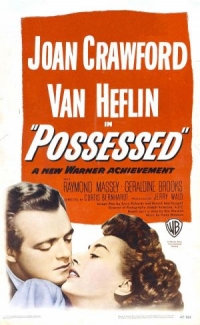
Possessed begins with a confused woman named Louise (Joan Crawford) wandering the streets of Los Angeles, repeating the name “David” to passers-by.  Brought to a hospital psychiatric ward and prompted by Dr. Willard (Stanley Ridges), Louise spits her story in flashback.  She was a nurse under the employ of one Dean Graham (Raymond Massey) to care for his ailing wife.  More importantly, she was madly in love with a man named David Sutton (Van Heflin), who broke off their relationship.  Simply put, Louise would do anything to keep David with her.  This sort of thing cannot end well.
When we first see Louise and David together, they are at a house across the lake from Graham’s summer home.  It is at this point that David wants to break things off, and their relationship is established expertly.  Crawford’s voice is particularly upbeat as she dresses, but Heflin shows that David’s thoughts are not with Louise; he is clearly more focused on the music he’s playing than his lover.  As David breaks the news, the tone becomes increasingly awkward, the silences more frequent, and Crawford’s delivery more desperate.  Her later madness is made understandable in this scene.
Further, this scene foreshadows the excellent performances in Possessed.  Crawford shifts from being confident and happy to visibly holding back the tears to mentally unstable with fluidity, to the point that what her character feels at any moment can only be described as “muddled”.  Her excellence extends to her scenes in the hospital, where the fatigue on her face is palpable and confusion is pronounced yet restrained.  The work that Crawford put into studying the behavior of mentally ill patients is evident, and it pays off in spades.
As for the men in her life, both Heflin and Massey succeed in their very different portrayals.  Heflin brings a degree of impersonal calculation to his character—appropriate, considering his obsession with mathematical engineering.  He appears level headed, but it hides a tinge of unknown unkindness.  Massey, on the other hand, gives Graham a justified level of dignity, but there’s the feeling he’s suppressing some emotions, especially after proposes to Louise a year after his wife dies.  It’s the same sort of performance that made Massey shine in Abe Lincoln in Illinois and the saving grace of The Fountainhead.
Crawford is the star, however, and it is her character that drives things.  What is being driven, however, is not always clear—but this is to the film’s benefit.  First of all, the story is told via the flashbacks of a character that clearly is not all there.  The doctor himself notes that Louise is very vulnerable to suggestion, and while he doesn’t apply it to her spiel, one need not tax the imagination to believe the whole story, which the doctor is prodding, is in doubt.  All we can say with certainty is that she did in fact marry Dean Graham; the rest would require some investigation.
Even within the flashbacks, however, the difference between perception and reality is front and center.  Despite being a nurse who can clearly see Mrs. Graham is mentally ill and imagining things which aren’t so, Louise is unable to see the same problems in herself until explicitly told.  A five minute sequence, in which Dean’s daughter Carol (Gerladine Brooks) tells Louise that David knows that she killed Mrs. Graham, is completely false and detached from reality.  Of course, whether Louise is even having these delusions is debatable; she claims to see Mrs. Graham, but the audience never does.
Possessed, then, makes for an interesting look at perception, delusions and other psychological phenomena.  Oddly, though, the explicit psychology that Dr. Willard delivers is the one stumbling block of the film.  The flashbacks are interrupted periodically for the doctor to make his diagnoses.  Not only is this distracting to the story, but also it is delivered with such conviction and certitude that it’s pretty damn laughable.  It most reminds me of the last five or so minutes of Psycho; surely this must have sounded better on paper.
Psychobabble aside, Possessed proves to be an intriguing drama which, in its own way, forces one to reconsider the way in which we perceive the world around us.  How open are we to the suggestion of others?  Why is it that we see the flaws in others so clearly, yet can’t find those same problems in ourselves with a GPS?  This is not a film that provides answers to those questions—after all, it is a movie, not a psychology textbook—but we cannot seek out the answers unless we know the questions to ask.